Thank you for visiting SNEWPapers!
Sign up free
Alexandria Daily Gazette, Commercial & Political
Alexandria, Virginia
What is this article about?
Timothy Pickering's 1811 address criticizes Jefferson's administration for anti-English bias, subservience to Napoleonic France, unwise repeal of internal taxes, and prioritizing party power over U.S. interests, while defending Washington's balanced policies on foreign affairs and fiscal matters.
Merged-components note: These four components form a single continuous editorial address by Timothy Pickering, spanning pages 2-3 with sequential reading orders and coherent text flow on political topics.
Clippings
1 of 2
OCR Quality
Full Text
TO THE
PEOPLE OF THE
UNITED STATES.
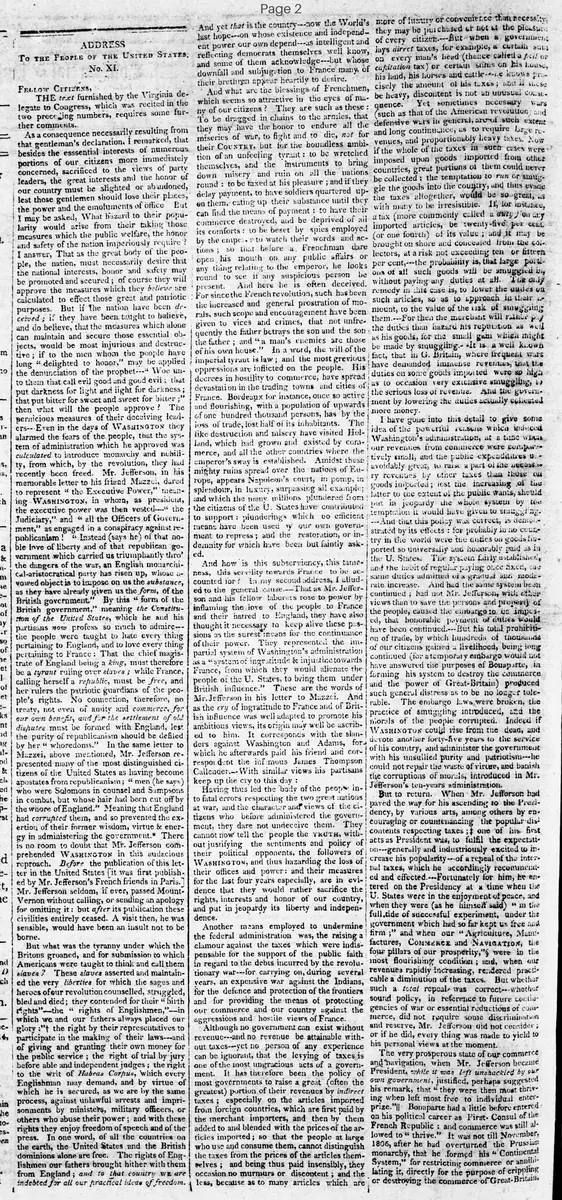
Fellow Citizens,
The text furnished by the Virginia delegate to Congress, which was recited in the two preceding numbers, requires some further comments.
In that gentleman's declaration, I remarked, that As a consequence necessarily resulting from besides the essential interests of numerous portions of our citizens more immediately leaders, the great interests and the honor of our country must be slighted or abandoned, the power and the emoluments of office. But lest those gentlemen should lose their places, I may be asked, What hazard to their popularity would arise from their taking those measures which the public welfare, the honor and safety of the nation imperiously require? I answer, That as the great body of the people, the nation, must necessarily desire that the national interests, honor and safety may be promoted and secured; of course they will approve the measures which they believe are calculated to effect those great and patriotic purposes. But if the nation have been deceived; if they have been taught to believe, and do believe, that the measures which alone can maintain and secure those essential objects, would be most injurious and destructive; if to the men whom the people have long "delighted to honor," may be applied the denunciation of the prophet---"Woe unto them that call evil good and good evil; that put darkness for light and light for darkness; that put bitter for sweet and sweet for bitter;" then what will the people approve? The pernicious measures of their deceiving leaders--Even in the days of Washington they alarmed the fears of the people, that the system of administration which he approved was calculated to introduce monarchy and nobility, from which, by the revolution, they had recently been freed. Mr. Jefferson, in his memorable letter to his friend Mazzei, dared to represent "the Executive Power," meaning Washington, in whom, as president, the executive power was then vested--"the Judiciary," and "all the Officers of Government," as engaged in a conspiracy against republicanism! "Instead (says he) of that noble love of liberty and of that republican government which carried us triumphantly thro' the dangers of the war, an English monarchical-aristocratical party has risen up, whose avowed object is to impose on us the substance, as they have already given us the form, of the British government." By this "form of the British government," meaning the Constitution of the United States, which he and his partisans now profess so much to admire--the people were taught to hate every thing pertaining to England, and to love every thing pertaining to France: That the chief magistrate of England being a king, must therefore be a tyrant ruling over slaves; while France, calling herself a republic, must be free, and her rulers the patriotic guardians of the people's rights. No connection, therefore, no treaty, not even of amity and commerce, for our own benefit, and for the settlement of old disputes must be formed with England, lest the purity of republicanism should be defiled by her "whoredoms." In the same letter to Mazzei, above mentioned, Mr. Jefferson represented many of the most distinguished citizens of the United States as having become apostates from republicanism; "men (he says) who were Solomons in counsel and Sampsons in combat, but whose hair had been cut off by the whore of England." Meaning that England had corrupted them, and so prevented the exertion of their former wisdom, virtue & energy in administering the government.* There is no room to doubt that Mr. Jefferson comprehended Washington in this audacious reproach. Before the publication of this letter in the United States [it was first published by Mr. Jefferson's French friends in Paris.] Mr. Jefferson seldom, if ever, passed Mount-Vernon without calling, or sending an apology for omitting it: but after its publication these civilities entirely ceased. A visit then, he was sensible, would have been an insult not to be borne.
But what was the tyranny under which the Britons groaned, and for submission to which Americans were taught to think and call them slaves? These slaves asserted and maintained the very liberties for which the sages and heroes of our revolution counselled, struggled, bled and died; they contended for their "birth rights"--the "rights of Englishmen,"--in which we and our fathers always placed our glory: the right by their representatives to participate in the making of their laws---and of giving and granting their own money for the public service; the right of trial by jury before able and independent judges; the right to the writ of Habeas Corpus, which every Englishman may demand, and by virtue of which he is secured, as we are by the same process, against unlawful arrests and imprisonments by ministers, military officers, or others who abuse their power; and with these rights they enjoy freedom of speech and of the press. In one word, of all the countries on the earth, the United States and the British dominions alone are free. The rights of Englishmen our fathers brought hither with them from England; and to that country we are indebted for all our practical ideas of freedom. And yet that is the country---now the world's greatest power our own depend---as intelligent and last hope---on whose existence and independence and some of them acknowledge---but whose reflecting democrats themselves well know, downfall and subjugation to France many of their brethren appear heartily to desire.
And what are the blessings of Frenchmen, which seem so attractive in the eyes of many of our citizens? They are such as these: To be dragged in chains to the armies, that they may have the honor to endure all the miseries of war, to fight and to die, not for their Country, but for the boundless ambition of an unfeeling tyrant: to be wretched themselves, and the instruments to bring down misery and ruin on all the nations round: to be taxed at his pleasure; and if they delay payment, to have soldiers quartered upon them, eating up their substance until they can find the means of payment: to have their commerce destroyed, and be deprived of all its comforts: to be beset by spies employed by the emperor to watch their words and actions; so that before a Frenchman dare open his mouth on any public affairs or any thing relating to the emperor, he looks round to see if any suspicious person be present. And here he is often deceived. For since the French revolution, such has been the increased and general prostration of morals, such scope and encouragement have been given to vices and crimes, that not unfrequently the father betrays the son and the son the father; and "a man's enemies are those of his own house." In a word, the will of the imperial tyrant is law; and the most grevious oppressions are inflicted on the people. His decrees in hostility to commerce, have spread devastation in the trading towns and cities of France. Bordeaux for instance, once so active and flourishing, with a population of upwards of one hundred thousand persons, has by the loss of trade, lost half of its inhabitants. The like destruction and misery have visited Holland, which had grown and existed by commerce, and all the other countries where the emperor's sway is established. Amidst these mighty ruins spread over the nations of Europe, appears Napoleon's court, in pomp, in splendour, in luxury, surpassing all example; and which the many millions plundered from the citizens of the U. States have contributed to support: plunderings which no efficient means have been used by our own government to repress; and the restoration, or indemnity for which have been but faintly asked.
And how is this subserviency, this tameness, this servility towards France to be accounted for? In my second address, I alluded to the general cause.--That as Mr. Jefferson and his fellow laborers rose to power by inflaming the love of the people to France and their hatred to England, they have also thought it necessary to keep alive these passions as the surest means for the continuance of their power. They represented the impartial system of Washington's administration as a "system of ingratitude & injustice towards France, from which they would alienate the people of the U. States, to bring them under British influence." These are the words of Mr. Jefferson in his letter to Mazzei. And as the cry of ingratitude to France and of British influence was well adapted to promote his ambitious views, its origin may well be ascribed to him. It corresponds with the slanders against Washington and Adams, for which he afterwards paid his friend and correspondent the infamous James Thompson Callender.--With similar views his partisans keep up the cry to this day:
Having thus led the body of the people into fatal errors respecting the two great nations at war, and the character and views of the citizens who before administered the government, they dare not undeceive them. They cannot now tell the people the TRUTH, without justifying the sentiments and policy of their political opponents, the followers of Washington, and thus hazarding the loss of their offices and power: and their measures for the last four years especially, are in evidence that they would rather sacrifice the rights, interests and honor of our country, and put in jeopardy its liberty and independence.
Another means employed to undermine the federal administration was, the raising a clamour against the taxes which were indispensable for the support of the public faith in regard to the debts incurred by the revolutionary war---for carrying on, during several years, an expensive war against the Indians, for the defence and protection of the frontiers and for providing the means of protecting our commerce and our country against the aggressions and hostile views of France.
Although no government can exist without revenue---and no revenue be attainable without taxes--yet no person of any experience can be ignorant, that the levying of taxes is one of the most ungracious acts of a government. It has therefore been the policy of most governments to raise a great (often the greatest) portion of their revenues by indirect taxes; especially on the articles imported from foreign countries, which are first paid by the merchant importers, and then by them added to and blended with the prices of the articles imported; so that the people at large who use and consume them, cannot distinguish the taxes from the prices of the articles themselves; and being thus paid insensibly, they occasion no murmurs or discontent; and the less, because as to many articles which are more of luxury or convenience than necessity they may be purchased or not at the pleasure of every citizen.---But when a government lays direct taxes, for example, a certain sum on every man's head (thence called a poll or capitation tax) or certain sums on his house, his land, his horses and cattle--he knows precisely the amount of his taxes; and if these be heavy, discontent is not an unusual consequence. Yet sometimes necessary wars (such as that of the American revolution) and defensive wars in general, are of such extent and long continuance, as to require large revenues, and proportionably heavy taxes. Now if the whole of the taxes in such cases were imposed upon goods imported from other countries, great portions of them could never be collected: the temptation to run or smuggle the goods into the country, and thus evade the taxes altogether, would be so great, as with many to be irresistible. If, for instance, a tax (more commonly called a duty) on dry goods imported articles, be twenty-five per cent. (or one fourth) of its value.; and it may be brought on shore and concealed from the collectors, at a risk not exceeding ten or fifteen per cent,---the probability is, that large portions of all such goods will be smuggled in, without paying any duties at all. The only remedy in this case is, to lower the duties on such articles, so as to approach in their amount, to the value of the risk of smuggling them.---For then the merchant will rather pay the duties than hazard his reputation as well as his goods, for the small gain which might be made by smuggling.- It is a well known fact, that in G. Britain, where frequent wars have demanded immense revenues, that the duties on some goods imported were so high as to occasion very extensive smuggling, to the serious loss of revenue. And the government by lowering the duties actually collected more money
I have gone into this detail to give some idea of the powerful reasons which induced Washington's administration, at a time when our revenues from commerce were comparatively small, and the public expenditures unavoidably great, to raise a part of the necessary revenues by other taxes than those on goods imported; lest the increasing of the latter to the extent of the public wants, should put in jeopardy the whole system by the temptation it would have given to smuggling. --And that this policy was correct, is demonstrated by its effects: for probably in no country in the world were the duties on goods imported so universally and honorably paid as in the U. States. The system fairly established, and the habit of regular paying once fixed, can same duties admitted of a gradual and moderate increase. And had the same system been continued; had not Mr. Jefferson, with other views than to save the persons and property of the people, caused the embargo to be imposed, that honorable payment of duties would have been continued.---But his total prohibition of trade, by which hundreds of thousands of our citizens gained a livelihood, being long continued (for a temporary embargo would not have answered the purposes of Bonaparte, in forming his system to destroy the commerce and the power of Great-Britain) produced such general distress as to be no longer tolerable. The embargo laws were broken, the practice of smuggling introduced, and the morals of the people corrupted. Indeed if Washington could rise from the dead, and devote another forty-five years to the service of his country, and administer the government with his unsullied purity and patriotism--he could not repair the waste of virtue, and banish the corruptions of morals; introduced in Mr. Jefferson's ten-years administration.
But to return. When Mr. Jefferson had paved the way for his ascending to the Presidency, by various arts, among others by encouraging or countenancing the popular discontents respecting taxes; one of his first acts as President was, to fulfil the expectation---generally and industriously excited to increase his popularity---of a repeal of the internal taxes, which he accordingly recommended and effected.--Fortunately for him, he entered on the Presidency at a time when the U. States were in the enjoyment of peace, and when they were (as he himself said) "in the full tide of successful experiment, under the government which had so far kept us free and firm;" and when our "Agriculture, Manufactures, Commerce and Navigation, the four pillars of our prosperity," were in the most flourishing condition: and, when our revenues rapidly increasing, rendered practicable a diminution of the taxes. But whether such a total repeal was correct---whether sound policy, in reference to future contingencies of war or essential reductions of commerce, did not require some discrimination and reserve, Mr. Jefferson did not consider; or if he did, every thing was made to yield to his personal views at the moment.
The very prosperous state of our commerce and navigation, when Mr. Jefferson became President while it was left unshackled by our own government, justified, perhaps suggested his remark, that "they were then most thriving when left most free to individual enterprize." Bonaparte had a little before entered on his political career---as First-Consul of the French Republic: and commerce was still allowed to "thrive." It was not till November, 1806, after he had overturned the Prussian monarchy, that he formed his "Continental System," for restricting commerce or annihilating it, directly for the purpose of crippling or destroying the commerce of Great-Britain, which he considered as the vital principle of her power. -To render this system effectual, he said " its execution must be complete." .. The principal powers of Europe had adopted it."4--The concurrence of the U. States (whose commerce then surpassed that of any other nation, that of G. Britain excepted) was necessary to render the execution of Bonaparte's system complete. And within less than three months afterwards, & in four days after the arrival of dispatches at Washington, by Mr. Jefferson's special messenger from Paris, his embargo Was recommended to Congress. and the bill for imposing it passed in the Senate on the same day. The unpopularity of the internal taxes (however necessary and prudent in their establishment) we have seen that Mr Jefferson well understood. Yet the direct tax, on houses, lands &c. originated if I mistake not, with Mr. Jefferson's own party : and I believe Mr. Madison (then in the house of representatives) reported a resolution for the direct tax. The journals of Congress (which I have not at hand) will show. Perhaps it was an artifice to add to the existing unpopularity of the federal administration respecting internal taxes. A direct tax was laid, in exact conformity with the constitution which declares, that representatives and direct taxes shall be apportioned from the several states according to their respective numbers, or population. It was then said by Mr. Jefferson's partizans, that the taxes ought to be direct, that the people might know and feel what they paid. But these gentlemen have since taken care to repeal every such tax ; and now dare not propose any tax which the people can know and feel. Instead of which, they have contemplated a vast addition to the duties already laid on imported goods--even at the hazard of encouraging smuggling, which would occasion losses probably beyond such. legislative additions. Possibly the fear of this may hitherto have prevented the projected increase of the duties. Instead of which, or any other sort of taxation, they have had recourse, in time of peace, to the borrowing of several millions of dollars, for the ordinary expenditures of the government ! We now see the reason why the government is determined " not to protect commerce by force," nor " risk a war until our resources are sufficient to defray the expenses without creating burthens to make them unpopular." But our ordinary resources never will be sufficient to defray the expences of war : the government know it: and the conclusion is unavoidable; That notwithstanding all their blustering (and there has been enough of this to make us ridiculous in our own eyes as well as in the eyes of foreign nations) our government are determined to submit, as they have submitted, to every sort of insult and injury, rather than go to war : for war will require more taxes, and taxes may render them unpopular. They choose rather to flatter the people to their ruin --than tell them the truths necessary for their safety, because the latter may prove unpleasant, and perhaps occasion some upbraidings of their deceivers. Thus a course of thinking and of opinions having been industriously effected by Mr. Jefferson and his fellow-laborers, as the means of rising to the supreme power ; and these opinions, in opposition to the system of administering the government, which under Washington was judged essential to the public safety and welfare, having been long and zealously inculcated by the leaders of that opposition--they have become the fixed creed of the People. And now these same leaders dare not attempt to correct those erroneous opinions, although they hazard the safety and independence of the country---as they have already caused the sacrifice of its interests and honor.
TIMOTHY PICKERING: May 13, 1811.
NOTES. This letter to Mazzei was probably written in 1796, soon after Mr. Jefferson quitted the department of state, " to avoid figuring in scenes" which he could not control, and turn to the service of France and his own elevation to the presidency, so well as in his philosophic retirement of Monticello t The first congress, which was assembled at New-York, unanimously resolved, " That our ancestors, who first settled these colonies, were, at the time of their emigration from the mother country, entitled to all the rights, liberties and immunities of free and natural born subjects within the realm of England. That by such emigration they by no means forfeited, surrendered, or lost any of those rights. They also Resolved, " That the foundation of English Liberty and of all free Government, is, a right in the people to participate in their legislative council.' t In his letter of October 5. 1799, to Callender, Mr. Jefferson says : " I thank you for the proof sheets [of the "Prospect before us?" containing the infamous slanders on Washington and Adams] you enclosed to me. Such papers cannot fail to produce the best effect. They inform the thinking part of the nation j and these again supported by the tax gatherers or their vouchers set the people to rights." § Mr. Jefferson's first message to Congress, Dec.- 8, 1801. 1 Mr. Jefferson's first message to Congress, Dec. 8, 1801. 4 Champagny, the French Minister's letter to General Armstrong, October 7, 1807.
What sub-type of article is it?
What keywords are associated?
What entities or persons were involved?
Editorial Details
Primary Topic
Critique Of Jefferson's Pro French Policies And Fiscal Decisions
Stance / Tone
Strongly Anti Jeffersonian And Pro Federalist
Key Figures
Key Arguments