Thank you for visiting SNEWPapers!
Sign up free
The Recorder
Richmond, Virginia
What is this article about?
Richmond Recorder editorial reprints and defends the French Consular Manifesto criticizing Britain's breach of the Treaty of Amiens and naval threats, portraying France as just and England as perfidious, with historical arguments against British character amid looming war in 1803.
Merged-components note: Merged the reprinted foreign news article on the consular manifesto (spanning columns) with the subsequent editorial commentary and continuation on the same topic of Anglo-French relations, as they form a single coherent opinion piece in the newspaper's editorial section.
Clippings
1 of 2
OCR Quality
Full Text
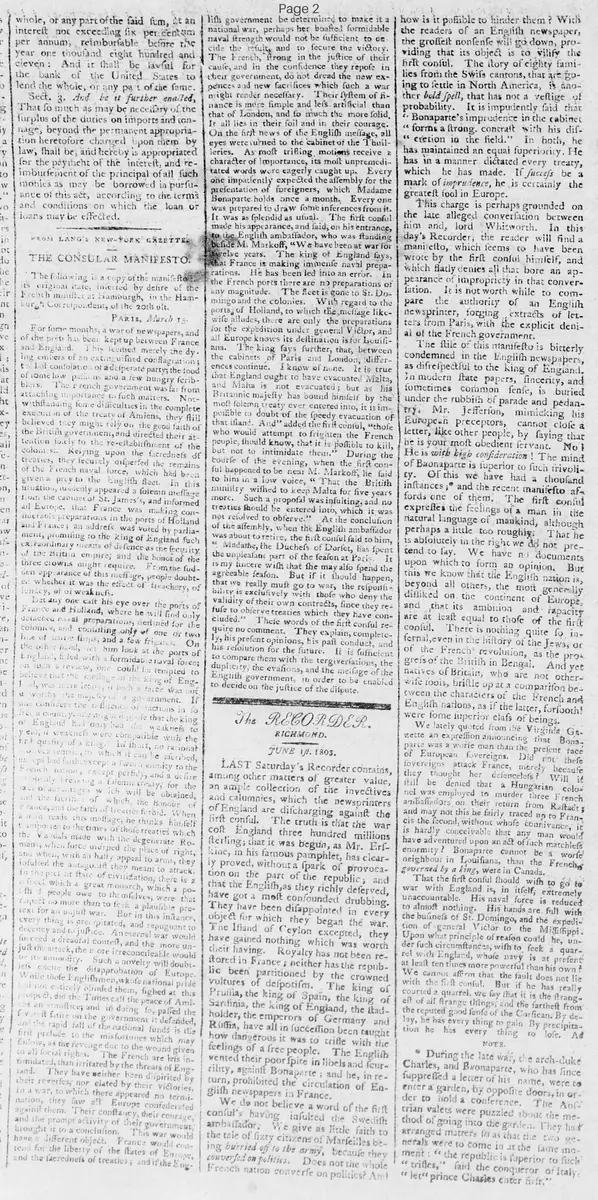
THE CONSULAR MANIFESTO.
The following is a copy of the manifesto, inserted by desire of the French minister at Hamburg, in the Hamburg Correspondent, of the 20th ult.
PARIS, March 15.
For some months, a war of newspapers, and of the press has been kept up between France and England. This seemed merely the dying embers of an extinguished conflagration; the last consolation of a desperate party; the food of some low passions and a few hungry scribblers. The French government was far from attaching importance to such matters. Notwithstanding some difficulties in the complete execution of the treaty of Amiens, they still believed they might rely on the good faith of the British government, and directed their attention solely to the re-establishment of the colonies. Relying upon the sacredness of treaties, they securely dispersed the remains of the French naval force, which had been given a prey to the English fleet. In this situation, suddenly appeared a solemn message from the cabinet of St. James's, and informed all Europe, that France was making connubial preparations in the ports of Holland and France; an address was voted by parliament, promising to the king of England such extraordinary means of defence as the security of the British empire; and the honor of the three crowns might require. From the sudden appearance of this message, people doubted whether it was the effect of treachery, of lunacy, of or weakness.
Let any one cast his eye over the ports of France and Holland, where he will find only detached naval preparations, destined for the colonies, and consisting only of one or two ships of the line, and a few frigates. On the other hand, let him look at the ports of England, filled with a formidable naval force; on such a review, one could be tempted to believe that the message of the king of England was more ironical, than that it was unworthy of a government. If one considers the issue of actions in so great a country, no one can suppose that the king of England had only had the weakness to send, his wretched were compatible with the dignity of a king. In this, no rational cause remains, to which it can be ascribed, except a sworn enmity to the French nation, except perfidy, and a desire of gaining a little time for the advantages which will be obtained, and the lack of which, the honour of France, and the faith of treaties forbid. When one reads this message, he thinks himself transported to the times of those treaties which the Gauls made with the degenerate Romans, when force usurped the place of right, and when, with a hasty appeal to arms, they insulted the antagonist they meant to attack. In the present state of civilization, there is a decency which a great monarch, which a polished people owe to themselves, were that respect no more than to seek a plausible pretext for an unjust war. But in this instance, every thing is precipitated, and repugnant to decency and justice. An eternal war would succeed a dreadful contest, and the more unjust the attack, the more irreconcileable would be its animosity. Such a novelty will doubtless excite the disapprobation of Europe.
While those Englishmen, whose national pride had not entirely blinded them, sighed at this point, did the Times call the peace of Amiens an armistice; and in doing so, passed the severest satire on the government it defended, and the rapid fall of the national funds is the first prelude to the misfortunes which may follow, as the revenge due to the wound given to social rights. The French are less intimidated, than irritated by the threats of England. They have neither been dispirited by their reverses, nor elated by their victories. In a war, to which there appeared no termination, they saw all Europe confederated against them. Their constancy, their courage, and the prompt activity of their government, brought it to a conclusion. This war would have a different object. France would contend for the liberty of the states of Europe, and the sacredness of treaties; and if the English English government be determined to make it a national war, perhaps her boasted formidable naval strength would not be sufficient to decide the result, and to secure the victory. The French, strong in the justice of their cause, and in the confidence they repose in their government, do not dread the new expenses and new sacrifices which such a war might render necessary. Their system of finance is more simple and less artificial than that of London, and so much the more solid. It all lies in their soil and in their courage.
On the first news of the English message, all eyes were turned to the cabinet of the Tuileries. As most trifling motions receive a character of importance, its most unpremeditated words were eagerly caught up. Every one impatiently expected the assembly for the presentation of foreigners, which Madame Bonaparte holds once a month. Every one was prepared to draw some inferences from it. It was as splendid as usual. The first consul made his appearance, and said, on his entrance, to the English ambassador, who was standing beside M. Markoff, "We have been at war for twelve years. The king of England says, that France is making immense naval preparations. He has been led into an error. In the French ports there are no preparations of any magnitude. The fleet is gone to St. Domingo and the colonies. With regard to the ports of Holland, to which the message likewise alludes, there are only the preparations for the expedition under general Victor, and all Europe knows its destination is for Louisiana. The king says further, that, between the cabinets of Paris and London, differences continue. I know of none. It is true that England ought to have evacuated Malta, and Malta is not evacuated; but as his Britannic majesty has bound himself by the most solemn treaty ever entered into, it is impossible to doubt of the speedy evacuation of that island. And" added the first consul, "those who would attempt to frighten the French people, should know, that it is possible to kill, but not to intimidate them." During the course of the evening, when the first consul happened to be near M. Markoff, he said to him in a low voice, "That the British ministry wished to keep Malta for five years more. Such a proposal was insulting and no treaties should be entered into, which it was not resolved to observe." At the conclusion of the assembly, when the English ambassador was about to retire, the first consul said to him, "Madame, the Duchess of Dorset, has spent the unpleasant part of the season at Paris." It is my sincere wish that she may also spend the agreeable season. But if it should happen, that we really must go to war, the responsibility is exclusively with those who deny the validity of their own contracts, since they refuse to observe treaties which they have concluded." These words of the first consul require no comment. They explain, completely, his present opinions, his past conduct, and his resolution for the future. It is sufficient to compare them with the tergiversations, the duplicity, the evasions, and the message of the English government, in order to be enabled to decide on the justice of the dispute.
THE RECORDER.
RICHMOND.
JUNE 1st. 1803.
LAST Saturday's Recorder contains, among other matters of greater value, an ample collection of the invectives and calumnies, which the newsprinters of England are discharging against the first consul. The truth is that the war cost England three hundred millions sterling; that it was begun, as Mr. Erskine, in his famous pamphlet, has clearly proved, without a spark of provocation on the part of the republic; and that the English, as they richly deserved, have got a most confounded drubbing. They have been disappointed in every object for which they began the war. The Island of Ceylon excepted, they have gained nothing which was worth their having. Royalty has not been restored in France; neither has the republic been partitioned by the crowned vultures of despotism. The king of Prussia, the king of Spain, the king of Sardinia, the king of England, the stadholder, the emperors of Germany and Russia, have all in succession been taught how dangerous it was to trifle with the feelings of a free people. The English vented their poor spite in libels and scurrility, against Bonaparte; and he, in return, prohibited the circulation of English newspapers in France.
We do not believe a word of the first consul's having insulted the Swedish ambassador. We give as little faith to the tale of sixty citizens of Marseilles being hurried off to the army, because they conversed on politics. Does not the whole French nation converse on politics? And how is it possible to hinder them? With the readers of an English newspaper, the grossest nonsense will go down, providing that its object is to vilify the first consul. The story of eighty families from the Swiss cantons, that are going to settle in North America, is another bold spell, that has not a vestige of probability. It is impudently said that Bonaparte's imprudence in the cabinet "forms a strong contrast with his discretion in the field." In both, he has maintained an equal superiority. He has in a manner dictated every treaty which he has made. If success be a mark of imprudence, he is certainly the greatest fool in Europe.
This charge is perhaps grounded on the late alleged conversation between him and lord Whitworth. In this day's Recorder: the reader will find a manifesto, which seems to have been wrote by the first consul himself, and which flatly denies all that bore an appearance of impropriety in that conversation. It is not worth while to compare the authority of an English newsprinter, forging extracts of letters from Paris, with the explicit denial of the French government.
The stile of this manifesto is bitterly condemned in the English newspapers, as disrespectful to the king of England. In modern state papers, sincerity, and sometimes common sense, is buried under the rubbish of parade and pedantry. Mr. Jefferson, mimicking his European preceptors, cannot close a letter, like other people, by saying that he is your most obedient servant. No: He is with high consideration! The mind of Buonaparte is superior to such frivolity. Of this we have had a thousand instances; and the recent manifesto affords one of them. The first consul expresses the feelings of a man in the natural language of mankind, although perhaps a little too roughly: That he is absolutely in the right we do not pretend to say. We have no documents upon which to form an opinion. But this we know that the English nation is, beyond all others, the most generally disliked on the continent of Europe. and that its ambition and rapacity are at least equal to those of the first consul. There is nothing quite so infernal, even in the history of the Jews, or of the French revolution, as the progress of the British in Bengal. And yet natives of Britain, who are not otherwise fools, bristle up at a comparison between the characters of the French and English nations, as if the latter, forsooth! were some superior class of beings.
We lately quoted from the Virginia Gazette an expression announcing that Bonaparte was a worse man than the present race of European sovereigns. Did not these sovereigns attack France, merely because they thought her defenceless? Will it still be denied that a Hungarian colonel was employed to murder three French ambassadors on their return from Ratadt; and may not this be fairly traced up to Francis the second, without whose connivance, it is hardly conceivable that any man would have adventured upon an act of such matchless enormity? Bonaparte cannot be a worse neighbour in Louisiana, than the French governed by a king, were in Canada.
That the first consul should wish to go to war with England is, in itself; extremely unaccountable. His naval force is reduced to almost nothing. His hands are full with the business of St. Domingo, and the expedition of general Victor to the Mississippi. Upon what principle of reason could he, under such circumstances, wish to seek a quarrel with England, whose navy is at present at least ten times more powerful than his own? We cannot affirm that the fault does not lie with the first consul. But if he has really courted a quarrel, we say that it is the strangest of all strange things; and the farthest from the reputed good sense of the Corsican. By delay, he has every thing to gain By precipitation he has every thing to lose.
NOTE.
During the late war, the arch-duke Charles, and Bonaparte, who has since suppressed a letter of his name, were to enter a garden, by opposite doors, in order to hold a conference. The Austrian valets were puzzled about the method of going into the garden. They had arranged matters so as that the two generals were to come in at the same moment : "the republic is superior to such trifles," said the conqueror of Italy. "let prince Charles enter first."
for the old sing-song story about his ambition. There is not the smallest reason for supposing that the British would have made a more moderate use of their good fortune than the French have done of theirs.
That stupid partiality which makes it impossible for a man to see the faults of his native countrymen can have no influence on the conduct of the Recorder. We know that the British are quite as remarkable for ambition, for rapacity, and for treachery, as any other people upon earth; witness their horrible behaviour in this country during the war of the revolution! Nor is there the smallest reason to make a moral distinction in their favour to the prejudice of the French nation. They have always been as forward as any other people in the commencement of unjust wars. Edward the III. invaded France without provocation and almost without pretence. He conquered a great part of the country. But the tyrannical government of his son, the Black Prince, compelled the conquered provinces to revolt and drive him away. All these facts, the injustice of the invasions and the rapacity of the conqueror, are tacitly confessed by the English themselves,* and even by David Hume, who is, upon all occasions, sufficiently solicitous to give a varnish to their crimes.† Yet, because Edward was for a time successful, the present English are proud of his reign, which is distinguished by nothing but ravine, perfidy, and murder: and although that it was such a reign, is virtually acknowledged by the English themselves, yet, if any writer of history were to say as much, nobody would read his book.
Mr. Macpherson, the translator of Ossian, published a large work, wherein he probed, although with a tender hand, the real characters of king William, and the heroes of the revolution of 1688. "I cannot endure that book," said a whig gentleman of some eminence. "I believe that what the writer says is true: but I cannot bear the exposure of the characters of those men, whose names I have been accustomed to revere."‡ It was indeed impossible to contest Macpherson's facts, for most of them were supported by the hand-writing of the parties themselves; just as the bitter denial of Thomas Jefferson that he paid an hundred dollars for The Prospect,§ was exploded by the production of his own letters. But still this weight of testimony did not hinder the world, [Horresco referens] from reviling the man whom they could not refute. He became one of the most unpopular characters in England, because he had acted like an honest man. On the same principles, and on the same portion of English history, Sir John Dalrymple met with the very same fate.
As an additional proof that the English are as often in the wrong as other nations, accept of the following particulars. Henry the IV. of England had usurped the crown to the exclusion of the lawful heir, and against the sense of a majority of the nation. He advised his son and successor to get the country into a foreign war, otherwise the people would be rebelling at home. Accordingly, the new king invaded France and carried matters so far that he was actually crowned at Paris. The war lasted for many years, and the expulsion of the English was not completed without an immense carnage on both sides. This is a portion of English history, upon which that nation looks back with peculiar satisfaction and pride: and yet what is it but a scene of rapine, of barbarity, and of guilt? In all this account of Edward and Henry, it is not French but English treachery, which bears away the palm of infamy.
Some honest Englishmen are apt to deafen us with invectives against the peculiar and indelible perfidy of the French character. Away with such nonsense! If they are such hateful beings, what is the reason, that both in Europe and among the savages of America, they have always been a thousand times more popular and beloved than the English? Ay, but there, sir, the French are a false, cringing, hollow people, extremely selfish, full of fair professions, and they are always ready to stoop to little attentions, which a plain honest Englishman not is.
NOTES.
* We do not mean to say that, if placed in the same situation, the Scots, or Irish would have behaved better than the English.
† When the first volume of The Prospect was published, a friend, with tears in his eyes, entreated the author, to be more tender in his details. "I believe it all to be true" said he "but still I cannot bear it!'"
‡ What an idea must we form of the veracity of this man! It has been said that when he paid fifty dollars for the first volume, he was a stranger to the tone of its contents. An absolute untruth! which is refuted by his two letters. But it is not denied, that nine months after its publication, he paid fifty dollars for the second. When his cowardly and ungrateful conduct had very justly provoked the writer to tell all this, he denied it, in the most solemn manner to Thomas Madison. His letters were then produced and printed. They ran, like wild fire, all over the continent; and his excellency will stand recorded to the next age, as an atrocious and execrable violator of truth. There are some wretched parts of the story, which we have never yet had the fortitude to publish.
No man would spurn at with disdain. Very well. As for French falsehood, we truly believe that England has produced her full quota of as consummate villains as ever infested the world. As for cringing, you may among ten millions of other proofs that occur daily, peruse the fulsome addresses, which parliament is in the habit of presenting to the king: to a king without talents and without virtues. This king has been much more a subject of laughter and ridicule than any other man in England. His reign has been nothing but a series of misfortunes and disgraces. His wars, undertaken without justice, and conducted without judgement, have added much more than four hundred millions sterling to the public debt, besides enormous sums that have been squandered out of the annual revenues of the country. A writer of currilous rhymes,§ has earned a genteel subsistence chiefly by making this royal pageant an object of mockery. The English, at once, venerate and contemn their most gracious sovereign.
After Pitt and the house of commons had vented a vocabulary of the most outrageous and even personal reproach against Bonaparte, after they had ten thousand times reproached him, as void of probity and humanity, after some of them, as the climax of absurdity, had represented him as without abilities,* they now complain with bitterness, because he begins to repay them in their own coin. If George permitted his ministers to make speeches for him, wherein the crowned parrot belied and calumniated the French nation; if his ministers themselves stood up in parliament, and squirted venom for hours together against the greatest man in Europe, if the newspapers under their immediate direction have represented him to be as black a usurper, as the worst tyrants of antiquity, they must not be surprised if the first consul begins to address them in their own style. They must not be surprised if he tells them that their master has acted either like a lunatic, a knave, or a fool.
Thus much for the two charges against the French nation, that they are false and cringing: A third is that they are extremely selfish. Granted: But are they worse than their neighbours? No. The British are quite as bad as it is possible that the French or the Tartars can be. General Burgoyne, as chairman of a committee of the house of commons, once gave in a report of their conduct in Bengal. In the first page he affirmed that in five or six years from 1766, to 1771, they destroyed in that country five or six millions of people. This estimate is given in the first page of a quarto volume, which contains mountains of testimony to the truth of this assertion. The correctness of the estimate was confirmed, if, after such authority, it could want confirmation, by colonel Dow. He was a Scots officer in the company's service, an eye witness to the scene, and an historian of uncommon merit. Two millions of these harmless people perished of famine by a British monopoly of rice. Now don't speak another word about the selfishness of Frenchmen, or the horrors of the French revolution: because Robespierre himself never committed any crime that came within sight of this.
It shall be granted that Frenchmen are often affectedly, and even sometimes absurdly polite. But does sincerity consist in rudeness? Or, to be an honest man, is it necessary to become a brute? Is not an excess of civility more pleasing, as well as more rational than an excess of rusticity? And is not almost every human character as full of follies, as a barber's block is with bristles? Without some attention to the feelings, without some tenderness for the faults of each other, society would become a bear garden. "The purest felicity upon earth," says a late writer, "the purest felicity upon earth, or at least the purest of mine, is always that which arises from the consciousness of giving innocent pleasure, of brightening the smile of benevolence, and animating the glow of friendship. Nor do I see for what purpose any man should wish to become president, but for the sake of exerting the power, and enjoying the glory of making mankind happy."
Thus much in defence of the first consul, of his recent manifesto, and of the character of the French nation. It is not our design to represent them as better than their neighbours, but merely as not worse. Reasons have been stated, why it is highly improbable that Bonaparte should wish, at present, to go to war with England. Let us examine the other side of the picture, and see what might be the motives of England for desiring a speedy rupture. We begin with some previous remarks on the French navy. The existence of British independence rests entirely upon the maintenance of her superiority by sea. By land, France has beaten almost all the rest of Europe collectively; and has added to her dominions, in the shape of allies or fellow citizens, a much greater number of people than Britain contains. If that country, therefore, were accessible by land, or, what is the same thing, if her navy were overpowered, Britain would run the utmost risk of sharing the same fate with Holland, Italy, and the Netherlands. Were France to enjoy peace for ten years, and to expend two millions sterling per annum upon building a navy, she could, in that time, make ready for sea two hundred seventy-four gun ships. The common estimate for building and equipping an English man of war, with provisions for a six months voyage, is a thousand pounds per gun. The expense has undoubtedly been much raised since this computation was first made. An hundred thousand pounds are therefore allowed for a French seventy-four. By turning her attention more seriously than she ever has done to maritime affairs, the republic may, in a few years, possess a very formidable navy. It is not from want of physical strength that she has hitherto made so wretched a figure by sea. It is an adherence to some absurd maxims that has hitherto prevented her success. Some time ago, a pamphlet on this subject was printed at Paris. The writer, besides other matters, blamed the French seamen for firing at the masts and rigging of a vessel, while the English fire constantly at the hull. It is this, and other reasons, which so frequently makes the carnage aboard a French ship ten times greater than that in an English one. Something more still remains to be said concerning the comparative prowess of French and British ships of war. But this must be deferred till next Saturday.
NEXT Saturday's Recorder will contain a second essay concerning the consular manifesto in a series of details as to the French and English navy, an answer to some of the democratic newspapers, respecting the two millions of dollars, an acknowledgment of a mistake, which has been corrected by the Examiner—something about the horrid practice of stealing dead bodies from the grave, another small brush at our Washington Algernon Sidney, and a little more about the national debt. The history of the Army, which was begun some months ago, was interrupted by the loss of a part of the manuscript, which had been prepared for the press: but the materials were safe; and the whole will speedily be published at once, including what was printed some months ago, as a first part: This will be done in one of the Saturday's Recorders,
NOTES.
§ Peter Pindar.
Mr. Sheridan made a smart reply to a harangue of this sort. By the way, the British government never employed their newspapers in printing pitch-pipes to recommend the murder of the first consul. Can our beloved president say as much?
Defence of Thomas Jefferson, dated Richmond jail, December, 1800.
What sub-type of article is it?
What keywords are associated?
What entities or persons were involved?
Editorial Details
Primary Topic
Defense Of French Consular Manifesto Against British Aggression
Stance / Tone
Pro French, Anti British, Defending Bonaparte And Critiquing English Perfidy
Key Figures
Key Arguments