Thank you for visiting SNEWPapers!
Sign up free
Alexandria Advertiser And Commercial Intelligencer
Alexandria, Virginia
What is this article about?
Transcript of U.S. Senate debate on January 13, 1802, on Mr. Brackenridge's motion to repeal the Judiciary Act of 1801 reorganizing the court system. Mr. Mason argues against unnecessary expense and for sufficiency of existing courts, critiquing federal arithmetic and state sovereignty. Mr. Stone supports repeal on expediency, judicial knowledge needs, and constitutionality, emphasizing legislative power to remove judges without impeachment for misbehavior.
Merged-components note: Merged continuation of Senate debate report across pages 2 and 3; changed label from editorial to story as it is a full narrative article on congressional proceedings.
Clippings
1 of 2
OCR Quality
Full Text
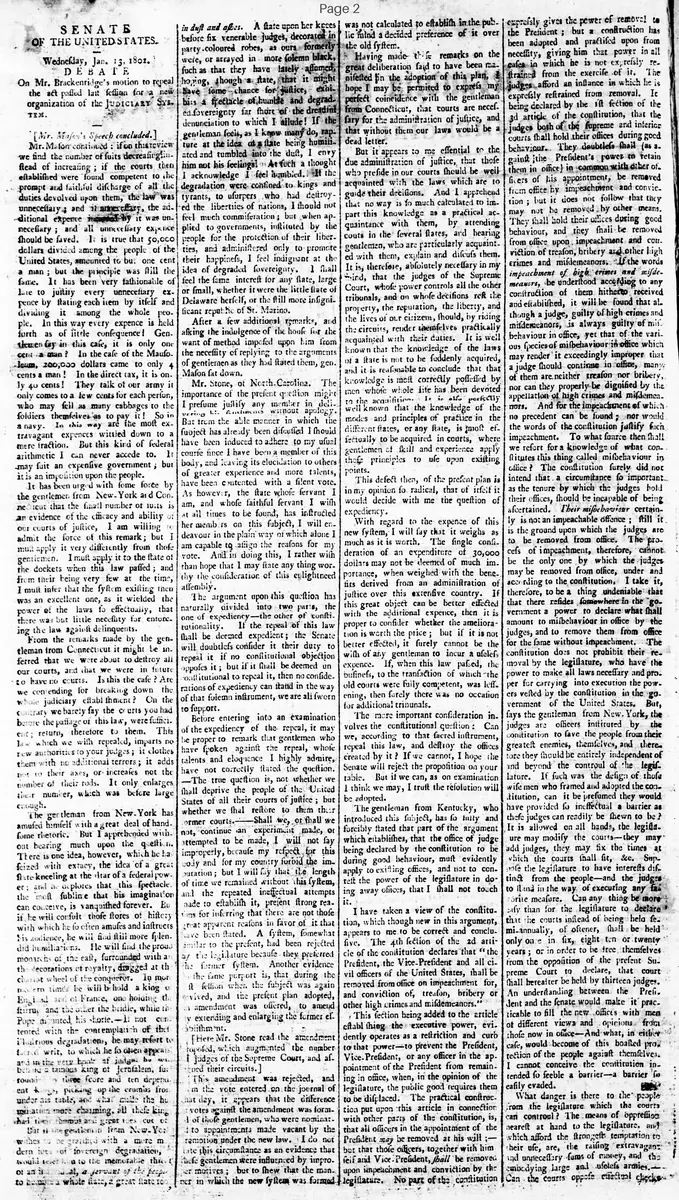
OF THE UNITED STATES.
Wednesday, Jan. 13, 1802.
DEBATE
On Mr. Brackenridge's motion to repeal
the act passed last Session for a new
organization of the Judiciary System.
[Mr. Mason's Speech concluded.]
Mr. Mason continued: From this review
we find the number of suits decreasing in-
stead of increasing; if the courts then
established were found competent to the
prompt and faithful discharge of all the
duties devolved upon them, the law was
unnecessary; and if unnecessary, the ad-
ditional expense incurred by it was un-
neccessary; and all unnecessary expense
should be saved. It is true that 50,000
dollars divided among the people of the
United States, amounted to but one cent
a man; but the principle was still the
same. It has been very fashionable of
late to justify every unnecessary ex-
penditure by stating each item by itself and
dividing it among the whole peo-
ple. In this way every expense is held
forth as of little consequence! Gentlemen
say in this case, it is only one
cent a man? In the case of the Man-
sion, 200,000 dollars came to only 4
cents a man! In the direct tax, it is on-
ly 40 cents! They talk of our army it
only comes to a few cents for each person,
who may sell as many cabbages to the
soldiers themselves as to pay it! So in
a navy. In this way are the most ex-
travagant expenses whittled down to a
mere fraction. But this kind of federal
arithmetic I can never accede to. It
may suit an expensive government; but
it is an imposition upon the people.
It has been urged with some force by
the gentlemen from New York and Con-
necticut that the small number of suits is
an evidence of the efficacy and ability of
our courts of justice, I am willing to
admit the force of this remark; but I
must apply it very differently from those
gentlemen. I must apply it to the state of
the dockets when this law passed; and
from their being very few at the time,
I must infer that the system existing then
was an excellent one, as it wielded the
power of the laws effectually, that
there was but little necessity for enforcing the law against delinquents.
From the remarks made by the gen-
tleman from Connecticut it might be in-
ferred that we were about to destroy all
our courts, and that we were in future
to have no courts. Is this the case? Are
we contending for breaking down the
whole judiciary establishment? On the
contrary we barely say the courts you had
before the passage of this law, were sufficient. return, therefore to them. This
law which we wish repealed, imparts no
new authorities to your judges; it clothes
them with no additional terrors; it adds
no to their axes, or increases not the
number of their rods. It only enlarges
their number, which was before large
enough.
The gentleman from New York has
amused himself with a great deal of hand-
some rhetoric. But I apprehended with-
out bearing much upon the question.
There is one idea, however, which he has
seized with ecstasy, the idea of a great
State kneeling at the altar of a federal pow-
er: and he deplores that this spectacle.
the most sublime that his imagination
can conceive, is vanquished forever. But
if he will consult those stores of history
with which he so often amuses and instructs
his audience, he will find still more plen-
did humiliations. He will find the proud
monarchs of the east, surrounded with all
the decorations of royalty, dragged at the
chariot wheel of the conqueror. In more
modern times he will behold a king of
England and of France, one holding the
stirrup, and the other the bridle, while the
Pope mounted his horse. If not con-
tented with the contemplation of these
illustrious degradations, he may resort to
sacred writ, to which he often appeals.
and in the very book of judges he will
behold a famous king of Jerusalem, sur-
rounded by three score and ten dependent
kings, picking up the crumbs from
under his table, and what added the hu-
miliation more charming, all these kings
had their thumbs and great toes cut off.
One of the gentlemen from New York
wishes to be gratified with a more modern view of sovereign degradation,
would refer him to the memorable threat
of an alderman, a servant of the people
to bring a whole fist, a great state too.
in dust and ashes. A state upon her knees
before six venerable judges, decorated in
party coloured robes, as ours formerly
were, or arrayed in a more solemn black.
such as that they have lately assumed.
hoping, though a state, that it might
have some chance of justice, exhibits
a spectacle of humble and degrad-
ed sovereignty far short of the dreadful
denunciation to which I allude! If the
gentleman feels, as I know many do, rap-
ture at the idea of a state being humili-
ated and tumbled into the dust, I envy
him not his feelings! At such a thought
I acknowledge I feel humiliated. If the
degradation were confined to kings and
tyants, to usurpers who had destroyed
the liberties of nations, I should not
feel much commiseration; but when ap-
plied to governments, instituted by the
people for the protection of their liber-
ties, and administered only to promote
their happiness, I feel indignant at the
idea of degraded sovereignty. I shall
feel the same interest for any state, large
or small, whether it were the little state of
Delaware herself, or the still more insigni-
ficant republic of St. Marino.
After a few additional remarks, and
asking the indulgence of the house for the
want of method imposed upon him from
the necessity of replying to the arguments
of gentlemen as they had stated them, Gen.
Mason sat down.
Mr. Stone, of North Carolina. The
importance of the present question might
I presume justify any member in deli-
vering his arguments without apology.
But from the able manner in which the
subject has already been discussed I should
have been induced to adhere to my usual
course since I have been a member of this
body, and leaving its elucidation to others
of greater experience and more talents,
have been contented with a silent vote.
As however, the state whose servant I
am, and whose faithful servant I wish
at all times to be found, has instructed
her members on this subject, I will en-
deavour in the plain way of which alone I
am capable to assign the reasons for my
vote. And in doing this, I rather wish
than hope that I may state any thing wor-
thy the consideration of this enlightened
assembly.
The argument upon this question has
naturally divided into two parts, the
one of expediency--the other of consti-
tutionality. If the repeal of this law
shall be deemed expedient; the Senate
will doubtless consider it their duty to
repeal it if no constitutional objection
opposes it; but if it shall be deemed un-
constitutional to repeal it, then no conside-
rations of expediency can stand in the way
of that solemn instrument, we are all sworn
to support.
Before entering into an examination
of the expediency of the repeal, it may
be proper to remark that gentlemen who
have spoken against the repeal, whose
talents and eloquence I highly admire,
have not correctly stated the question.
The true question is, not whether we
shall deprive the people of the United
States of all their courts of justice; but
whether we shall restore to them their
former courts. Shall we, or shall we
not, continue an experiment made, or
attempted to be made, I will not say
improperly, because my respect for this
body and for my country forbid the im-
putation; but I will say that the length
of time we remained without this system,
and the repeated ineffectual attempts
made to establish it, present strong rea-
sons for inferring that there are not those
great apparent reasons in favor of it that
have been stated. A system, somewhat
similar to the present, had been rejected
by the legislature because they preferred
the former system. Another evidence
of the same purport is, that during the
last session when the subject was again
revived, and the present plan adopted,
an amendment was offered, to amend
by extending and enlarging the former es-
tablishment.
[Here Mr. Stone read the amendment
proposed, which augmented the number
of judges of the Supreme Court, and as-
signed their circuits.]
This amendment was rejected, and
from the vote entered on the journal of
that day, it appears that the difference
of votes against the amendment was form-
ed of those gentlemen, who were nominated
to appointments made vacant by the
removal under the new law. I do not
state this circumstance as an evidence that
these gentlemen were influenced by impro-
per motives; but to show that the man-
ner in which the new system was formed.
was not calculated to establish in the pub-
lic mind a decided preference of it over
the old system.
Having made these remarks on the
great deliberation said to have been ma-
ifested in the adoption of this plan, I
hope I may be permitted to express my
perfect coincidence with the gentleman
from Connecticut, that courts are neces-
sary for the administration of justice, and
that without them our laws would be a
dead letter.
But it appears to me essential to the
due administration of justice, that those
who preside in our courts should be well
acquainted with the laws which are to
guide their decisions. And I apprehend
that no way is so much calculated to im-
part this knowledge as a practical ac-
quaintance with them, by attending
courts in the several states, and hearing
gentlemen, who are particularly acquaint-
ed with them, explain and discuss them.
It is, therefore, absolutely necessary in my
mind, that the judges of the Supreme
Court, whose power controls all the other
tribunals, and on whose decisions rest the
property, the reputation, the liberty, and
the lives of our citizens, should, by riding
the circuits, render themselves practically
acquainted with their duties. It is well
known that the knowledge of the laws
of a state is not to be suddenly acquired,
and it is reasonable to conclude that that
knowledge is most correctly possessed by
men whose whole life has been devoted
to the acquisition. It is also perfectly
well known that the knowledge of the
modes and principles of practice in the
different states, or any state, is most ef-
fectually to be acquired in courts, where
gentlemen of skill and experience apply
those principles to use upon existing
points.
This defect then, of the present plan is
in my opinion so radical, that of itself it
would decide with me the question of
expediency.
With regard to the expense of this
new system, I will say that it weighs as
much as it is worth. The single consi-
deration of an expenditure of 30,000
dollars may not be deemed of much im-
portance, when weighed with the bene-
fits derived from an administration of
justice over this extensive country. If
this great object can be better effected
with the additional expense, then it is
proper to consider whether the ameliora-
tion is worth the price; but if it is not
better effected, it surely cannot be the
wish of any gentleman to incur a useless
expense. If, when this law passed, the
business to the transaction of which the
old courts were fully competent, was less-
ening, then surely there was no occasion
for additional tribunals.
The more important consideration in-
volves the constitutional question: Can
we, according to that sacred instrument,
repeal this law, and destroy the offices
created by it? If we cannot, I hope the
Senate will reject the proposition on your
table. But if we can, as on examination
I think we may, I trust the resolution will
be adopted.
The gentleman from Kentucky, who
introduced this subject, has so fully and
forcibly stated that part of the argument
which establishes, that the office of judge
being declared by the constitution to be
during good behaviour, must evidently
apply to existing offices, and not to con-
test the power of the legislature in do-
ing away offices, that I shall not touch
it.
I have taken a view of the constitu-
tion, which though new in this argument,
appears to me to be correct and conclu-
sive. The 4th section of the 2d arti-
cle of the constitution declares that "the
President, the Vice-President and all ci-
vil officers of the United States, shall be
removed from office on impeachment for,
and conviction of, treason, bribery or
other high crimes and misdemeanors."
This section being added to the article
establishing the executive power, evi-
dently operates as a restriction and curb
to that power--to prevent the President,
Vice-President, or any officer in the ap-
pointment of the President from remain-
ing in office, when, in the opinion of the
legislature, the public good requires them
to be displaced. The practical construc-
tion put upon this article in connection
with other parts of the constitution, is,
that all officers in the appointment of the
President may be removed at his will:--
but that those officers, together with him
himself and Vice President, shall be removed
upon impeachment and conviction by the
legislature. No part of the constitution
expressly gives the power of removal to
the President; but a construction has
been adopted and practiced upon from
necessity, giving him that power in all
cases in which he is not expressly re-
strained from the exercise of it. The
judges afford an instance in which he is
expressly restrained from removal. It
being declared by the 1st section of the
3d article of the constitution, that the
judges both of the supreme and inferior
courts shall hold their offices during good
behaviour. They doubtless shall (as a-
gainst the President's power to retain
them in office) in common with other of-
ficers of his appointment; be removed
from office by impeachment and convic-
tion; but it does not follow that they
may not be removed by other means.
They shall hold their offices during good
behaviour, and they shall be removed
from office upon impeachment and con-
viction of treason, bribery and other high
crimes and misdemeanors. If the words
impeachment of high crimes and misde-
meanors, be understood according to any
construction of them hitherto received
and established, it will be found that al-
though a judge, guilty of high crimes and
misdemeanors, is always guilty of mis-
behaviour in office, yet that of the vari-
ous species of misbehaviour in office which
may render it exceedingly improper that
a judge should continue in office, many
of them are neither treason nor bribery,
nor can they properly be dignified by the
appellation of high crimes and misdemea-
nors. And for the impeachment of which
no precedent can be found; nor would
the words of the constitution justify such
impeachment. To what source then shall
we resort for a knowledge of what con-
stitutes this thing called misbehaviour in
office? The constitution surely did not
intend that a circumstance so important
as the tenure by which the judges hold
their offices, should be incapable of being
ascertained. Their misbehaviour certain-
ly is not an impeachable offence; till it
is the ground upon which the judges are
to be removed from office. The pro-
cess of impeachment, therefore, cannot
be the only one by which the judges
may be removed from office, under and
according to the constitution. I take it,
therefore, to be a thing undeniable that
there resides somewhere in the go-
vernment a power to declare what shall
amount to misbehaviour in office by the
judges, and to remove them from office
for the same without impeachment. The
constitution does not prohibit their re-
moval by the legislature, who have the
power to make all laws necessary and pro-
per for carrying into execution the pow-
ers vested by the constitution in the go-
vernment of the United States. But,
says the gentleman from New York, the
judges are officers instituted by the
constitution to save the people from their
greatest enemies, themselves, and there-
fore they should be entirely independent of
and beyond the controul of the legis-
lature. If such was the design of those
wise men who framed and adopted the con-
titution, can it be presumed they would
have provided so ineffectual a barrier as
these judges can readily be shewn to be?
It is allowed on all hands, the legisla-
ture may modify the courts--they may
add judges, they may fix the times at
which the courts shall sit, &c. Sup-
pose the legislature to have interests dif-
ferent from the people--and the judges
to stand in the way of executing any fa-
vourite measure. Can any thing be more
easy than for the legislature to declare
that the courts instead of being held bi-
annually, or oftener, shall be held
only once in six, eight, ten or twenty
years; or in order to free themselves
from the opposition of the present Su-
preme Court to declare, that court
shall hereafter be held by thirteen judges.
An understanding between the Presi-
dent and the Senate would make it prac-
ticable to fill the new offices with men
of different views and opinions from those now in office--And what, in such
case, would become of this boasted pro-
tection of the people against themselves.
I cannot conceive the constitution in-
tended so feeble a barrier--a barrier so
easily evaded.
What danger is there to the people
from the legislature which the courts
can controul? The means of oppression
nearest at hand to the legislature, and
which afford the strongest temptation to
their use, are, the raising extravagant
and unnecessary sums of money, and the
embodying large and useless armies.
Can the courts oppose effectual checks
to these powers? I presume not. The constitution permits their exercise to any extent within the discretion of the legislature.
The objects of courts of law, as I understand them, are, to settle questions of right between suitors—to enforce obedience to the laws—and to protect the citizens against the oppressive use of power in the executive officers.—Not to protect them against the legislature; for that I think I have shown to be impossible with the powers which the legislature may safely use and exercise: and because the people have retained in their own hands the power of controlling and directing the legislature, by their immediate and mediate elections of President, Senate and House of Representatives.
It is not alone the sixteen rank and file, which the gentleman from New York has so ludicrously depicted, that I apprehend immediate danger from, but it is the principle which converts the office of judge into an hospital of incurables; and declares that an expiring faction, after having lost the public confidence, may add to those sixteen until they become 1,600, or 16,000: and that the restored good sense of the legislature, the whole government and constitution retains no means of casting them off, but by destroying itself and resorting to revolutionary principles.—
The legislature may repeal unnecessary taxes, may disband useless and expensive armies, may declare they will no longer be bound by the stipulations of an oppressive treaty: and if war should ensue the constitution is still safe. But if the constitution which gentlemen contend for be correct, a band of drones to any amount in number under the denomination of judges, may prey upon the substance of the people, and the government retains not the power to remove them but by destroying the constitution itself.
I beseech this enlightened assembly to pause before they adopt a construction capable of producing so great mischief, and so ineffectual to the ends proposed. The question is not now, as it would seem from the arguments of gentlemen, they understand it to be: whether we shall abolish offices without compensating the officers for the sacrifices they may have made. If a proposal to compensate them shall be brought forward, the legislature will surely do what honor and justice shall require.
If I possessed equal powers of speech with the gentleman from Connecticut, I might be tempted to make as impressive an address to the feelings of the Senate. Sure I am, I feel as deep an interest in and solicitude for the constitution, as that gentleman. I view it with him as the bond of our union and the foundation of our safety. But it must be supported on reasonable and practical grounds. My understanding is incapable of seeing how the absurdities and evils of the constitution contended for, can be avoided. I hope therefore that the power of the legislature to put down as well as to build up, courts of justice as the public good may require, will be established.
Not having accustomed myself to deliver my sentiments in this or the other branch of the legislature, I may not have comprised them in so short a compass, nor in such orderly shape, as would be proper in submitting them to this enlightened assembly. If however, I have succeeded in stating intelligibly the grounds of my conviction, I am satisfied. If my remarks have contributed to elucidate the subject to others, I shall rejoice; but if failing in this, they also are mixed with error, I trust gentlemen will set them right.
What sub-type of article is it?
What themes does it cover?
What keywords are associated?
What entities or persons were involved?
Where did it happen?
Story Details
Key Persons
Location
Senate Of The United States
Event Date
Wednesday, Jan. 13, 1802
Story Details
Debate on motion to repeal the Judiciary Act passed last session for new organization of courts. Mr. Mason argues decreasing suits show prior courts sufficient, criticizes unnecessary expense and federal arithmetic, defends state sovereignty. Mr. Stone argues for expediency due to prior system's adequacy, need for judges' practical knowledge via circuits, and constitutionality allowing repeal and office abolition without impeachment for misbehavior.