Thank you for visiting SNEWPapers!
Sign up free
Editorial
April 13, 1867
Springfield Weekly Republican
Springfield, Hampden County, Massachusetts
What is this article about?
The editorial warns of civilization's tendency toward barbarism, seen in New York's urban class divides driving middle classes to suburbs and risking riots, England's degrading gang-labor system, and America's factory life corrupting workers, urging radical social reforms beyond individual efforts.
Clipping
OCR Quality
98%
Excellent
Full Text
The Savagism of Civilization.
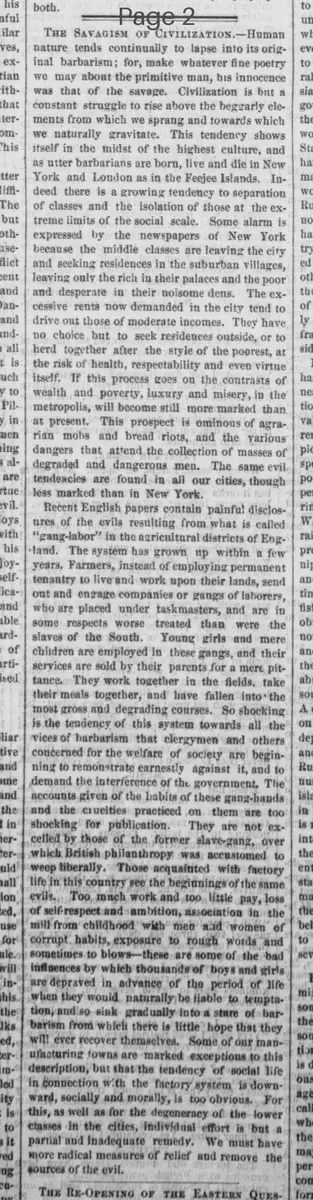
Human nature tends continually to lapse into its original barbarism; for, make whatever fine poetry we may about the primitive man, his innocence was that of the savage. Civilization is but a constant struggle to rise above the beggarly elements from which we sprang and towards which we naturally gravitate. This tendency shows itself in the midst of the highest culture, and as utter barbarians are born, live and die in New York and London as in the Feejee Islands. Indeed there is a growing tendency to separation of classes and the isolation of those at the extreme limits of the social scale. Some alarm is expressed by the newspapers of New York because the middle classes are leaving the city and seeking residences in the suburban villages, leaving only the rich in their palaces and the poor and desperate in their noisome dens. The excessive rents now demanded in the city tend to drive out those of moderate incomes. They have no choice but to seek residences outside, or to herd together after the style of the poorest, at the risk of health, respectability and even virtue itself. If this process goes on the contrasts of wealth and poverty, luxury and misery, in the metropolis, will become still more marked than at present. This prospect is ominous of agrarian mobs and bread riots, and the various dangers that attend the collection of masses of degraded and dangerous men. The same evil tendencies are found in all our cities, though less marked than in New York.
Recent English papers contain painful disclosures of the evils resulting from what is called 'gang-labor' in the agricultural districts of England. The system has grown up within a few years. Farmers, instead of employing permanent tenantry to live and work upon their lands, send out and engage companies or gangs of laborers, who are placed under taskmasters, and are in some respects worse treated than were the slaves of the South. Young girls and mere children are employed in these gangs, and their services are sold by their parents for a mere pittance. They work together in the fields, take their meals together, and have fallen into the most gross and degrading courses. So shocking is the tendency of this system towards all the vices of barbarism that clergymen and others concerned for the welfare of society are beginning to remonstrate earnestly against it, and to demand the interference of the government. The accounts given of the habits of these gang-bands and the cruelties practiced on them are too shocking for publication. They are not excelled by those of the former slave-gang, over which British philanthropy was accustomed to weep liberally. Those acquainted with factory life in this country see the beginnings of the same evils. Too much work and too little pay, loss of self-respect and ambition, association in the mill from childhood with men and women of corrupt habits, exposure to rough words and sometimes to blows—these are some of the bad influences by which thousands of boys and girls are depraved in advance of the period of life when they would naturally be liable to temptation, and so sink gradually into a state of barbarism from which there is little hope that they will ever recover themselves. Some of our manufacturing towns are marked exceptions to this description, but that the tendency of social life in connection with the factory system is downward, socially and morally, is too obvious. For this, as well as for the degeneracy of the lower classes in the cities, individual effort is but a partial and inadequate remedy. We must have more radical measures of relief and remove the sources of the evil.
Human nature tends continually to lapse into its original barbarism; for, make whatever fine poetry we may about the primitive man, his innocence was that of the savage. Civilization is but a constant struggle to rise above the beggarly elements from which we sprang and towards which we naturally gravitate. This tendency shows itself in the midst of the highest culture, and as utter barbarians are born, live and die in New York and London as in the Feejee Islands. Indeed there is a growing tendency to separation of classes and the isolation of those at the extreme limits of the social scale. Some alarm is expressed by the newspapers of New York because the middle classes are leaving the city and seeking residences in the suburban villages, leaving only the rich in their palaces and the poor and desperate in their noisome dens. The excessive rents now demanded in the city tend to drive out those of moderate incomes. They have no choice but to seek residences outside, or to herd together after the style of the poorest, at the risk of health, respectability and even virtue itself. If this process goes on the contrasts of wealth and poverty, luxury and misery, in the metropolis, will become still more marked than at present. This prospect is ominous of agrarian mobs and bread riots, and the various dangers that attend the collection of masses of degraded and dangerous men. The same evil tendencies are found in all our cities, though less marked than in New York.
Recent English papers contain painful disclosures of the evils resulting from what is called 'gang-labor' in the agricultural districts of England. The system has grown up within a few years. Farmers, instead of employing permanent tenantry to live and work upon their lands, send out and engage companies or gangs of laborers, who are placed under taskmasters, and are in some respects worse treated than were the slaves of the South. Young girls and mere children are employed in these gangs, and their services are sold by their parents for a mere pittance. They work together in the fields, take their meals together, and have fallen into the most gross and degrading courses. So shocking is the tendency of this system towards all the vices of barbarism that clergymen and others concerned for the welfare of society are beginning to remonstrate earnestly against it, and to demand the interference of the government. The accounts given of the habits of these gang-bands and the cruelties practiced on them are too shocking for publication. They are not excelled by those of the former slave-gang, over which British philanthropy was accustomed to weep liberally. Those acquainted with factory life in this country see the beginnings of the same evils. Too much work and too little pay, loss of self-respect and ambition, association in the mill from childhood with men and women of corrupt habits, exposure to rough words and sometimes to blows—these are some of the bad influences by which thousands of boys and girls are depraved in advance of the period of life when they would naturally be liable to temptation, and so sink gradually into a state of barbarism from which there is little hope that they will ever recover themselves. Some of our manufacturing towns are marked exceptions to this description, but that the tendency of social life in connection with the factory system is downward, socially and morally, is too obvious. For this, as well as for the degeneracy of the lower classes in the cities, individual effort is but a partial and inadequate remedy. We must have more radical measures of relief and remove the sources of the evil.
What sub-type of article is it?
Social Reform
Labor
Moral Or Religious
What keywords are associated?
Urban Decay
Class Separation
Gang Labor
Factory System
Moral Degradation
Social Reform
What entities or persons were involved?
Middle Classes
Rich
Poor
Farmers
Gang Laborers
Clergymen
Government
Editorial Details
Primary Topic
Barbaric Tendencies In Civilization And Need For Social Reform
Stance / Tone
Critical Warning Against Social Degradation
Key Figures
Middle Classes
Rich
Poor
Farmers
Gang Laborers
Clergymen
Government
Key Arguments
Human Nature Lapses Into Barbarism Despite Civilization
Urban Class Separation In New York Exacerbates Wealth Poverty Contrasts Risking Riots
Gang Labor In England Degrades Workers Especially Children Into Vice
Factory Life In America Leads To Moral And Social Decline Through Poor Conditions
Individual Efforts Insufficient; Radical Measures Needed To Address Evils