Thank you for visiting SNEWPapers!
Sign up free
Virginia Argus
Richmond, Virginia
What is this article about?
A letter criticizing the Pittsylvania County Court for refusing to distribute pamphlets ordered by the Virginia Assembly, which included the Declaration of Independence, U.S. Constitution, Alien and Sedition Acts, and resolutions condemning them. The author argues this act of presumption withholds vital information from the people and usurps legislative authority.
Merged-components note: Main body and signature of the letter to the people of Virginia regarding Pittsylvania court proceedings.
Clipping
OCR Quality
Full Text
FRIDAY, NOVEMBER 15
FOR THE VIRGINIA ARGUS.
TO THE PEOPLE OF VIRGINIA.
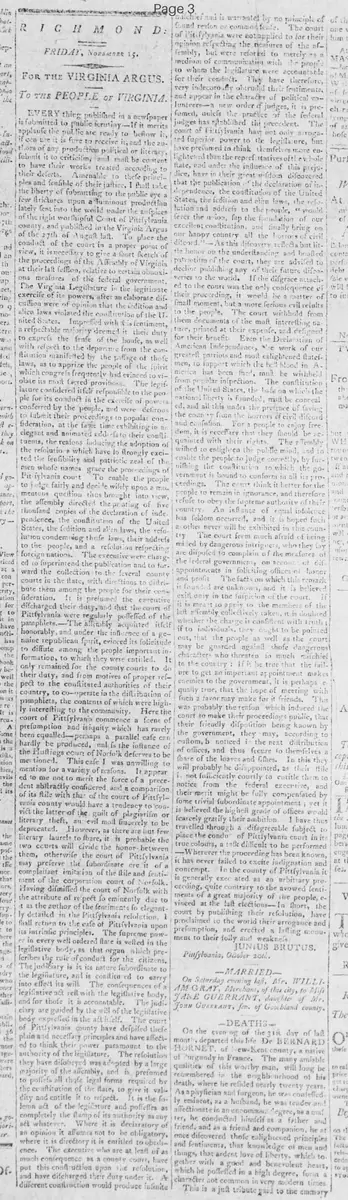
EVERY thing published in a newspaper is submitted to public scrutiny— If it merits applause the public are ready to bestow it, if censure it is sure to receive it, and the authors of any production political or literary, submit it to criticism, and must be content to have their works treated according to their deserts. Amenable to these principles and sensible of their justice. I shall take the liberty of submitting to the public here a few strictures upon a luminous production lately sent into the world under the auspices of the right worshipful Court of Pittsylvania county, and published in the Virginia Argus of the 27th of August last. To place the conduct of the court in a proper point of view, it is necessary to give a short sketch of the proceedings of the Assembly of Virginia at their last session, relative to certain obnoxious measures of the federal government.
The Virginia Legislature in the legitimate exercise of its powers, after an elaborate discussion were of opinion that the sedition and alien laws violated the constitution of the United States. Impressed with this sentiment, a respectable minority deemed it their duty to express the sense of the house, as well with respect to the departure from the constitution manifested by the passage of those laws, as to apprise the people of the spirit which congress frequently had evinced to violate its most sacred provisions. The legislature considered itself responsible to the people for its conduct in the exercise of powers conferred by the people, and were desirous to submit their proceedings to popular consideration, at the same time exhibiting in an elegant and animated address to their constituents, the reasons inducing the adoption of the resolutions which have so strongly excited the sensibility and patriotic zeal of the men whose names grace the proceedings of Pittsylvania court. To enable the people to judge fairly and decide wisely upon a momentous question thus brought into view, the assembly directed the printing of five thousand copies of the declaration of independence, the constitution of the United States, the sedition and alien laws, the resolution condemning those laws, their address to the people, and a resolution respecting foreign nations. The executive were charged to superintend the publication and to forward the collection to the several county courts in the state, with directions to distribute them among the people for their consideration. It is presumed the executive discharged their duty, and that the court of Pittsylvania were regularly possessed of the pamphlets.—The assembly acquitted itself honorably, and under the influence of a genuine republican spirit, evinced its solicitude to diffuse among the people important information, to which they were entitled. It only remained for the county courts to do their duty, and from motives of proper respect to the constituted authorities of their country, to co-operate in the distribution of pamphlets, the contents of which were highly interesting to the community. Here the court of Pittsylvania commence a scene of presumption and iniquity which has rarely been equalled—perhaps a parallel case can hardly be produced, unless the instance of the Hustings court of Norfolk deserves to be mentioned. This case I was unwilling to mention for a variety of reasons. It appeared to me not to merit the force of a precedent abstractly considered and a comparison of its stile with that of the court of Pittsylvania county would have a tendency to convict the latter of the guilt of plagiarism or literary theft, an evil most sincerely to be deprecated. However, as there are but few literary laurels to share, it is probable the two courts will divide the honor between them, otherwise the court of Pittsylvania may preserve the subordinate credit of a complaisant imitation of the stile and sentiment of the corporation court of Norfolk.
Having dismissed the court of Norfolk with the attribute of respect eminently due to it as the author of the sentiments so elegantly detailed in the Pittsylvania resolution, I shall return to the case of Pittsylvania upon its intrinsic principles. The supreme power in every well ordered state is vested in the legislative body, as that organ which prescribes the rule of conduct for the citizens. The judiciary is in its nature subordinate to the legislature, and is constituted to carry into effect its will. The consequences of a legislative act rest with the legislative body, and for those it is accountable. The judiciary are guided by the will of the legislative body expressed in the act itself. The court of Pittsylvania county have despised these plain and necessary principles and have affected to think their power paramount to the authority of the legislature. The resolution they have disobeyed was adopted by a large majority of the assembly, and is presumed to possess all those legal forms required by the constitution of the state, to give it validity and entitle it to respect. It is the solemn act of the legislature and possesses as completely the stamp of its authority as any act whatever. Where it is declaratory of an opinion it assumes not to be obligatory, where it is directory it is entitled to obedience. The executive who are at least of as much consequence as a county court, have put this construction upon the resolution, and have discharged their duty under it. A different construction would be fraught with mischief and is warranted by no principle of sound reason or common sense. The courts of Pittsylvania were not applied to for their opinion respecting the measures of the assembly, but were resorted to merely as a medium of communication with the people: to whom the legislature were accountable for their conduct. They have therefore, very indecorous-ly obtruded their sentiments. I. and appear in the character of political volunteers—a new order of judges, it is presumed, unless the practice of the federal judges has established the precedent. The court of Pittsylvania have not only arrogated superior power to the legislature, but have presumed to think themselves more enlightened than the representatives of the whole state, and under the influence of this prejudice. have in their great wisdom discovered that the publication of the declaration of independence. the constitution of the United States, the sedition and alien laws, the resolution and address to the people, "would sever the union, sap the foundation of our excellent constitution, and finally bring on our happy country all the horrors of civil discord."—As this discovery reflects but little honor on the understanding and boasted patriotism of the court, they are advised to decline publishing any of their future discoveries to the world. If the disgrace attached to the court was the only consequence of their proceeding, it would be a matter of small moment, but a more serious evil results to the people, The court withhold from them documents of the most interesting nature, printed at their expense, and designed for their benefit. Even the Declaration of American Independence, a work of our greatest patriots and most enlightened statesmen, to support which the best blood in America has been shed, must be withheld from popular inspection. The constitution of the United States. the basis on which the national liberty is founded, must be concealed, and all this under the pretense of saving the country from the horrors of civil discord and confusion. For a people to enjoy freedom, it is necessary that they should be acquainted with their rights. The assembly wished to enlighten the public mind, and to enable the people to judge correctly, by furnishing the constitution to which the government is bound to conform in all its proceedings. The court think it better for the people to remain in ignorance, and therefore refuse to obey the supreme authority of their country. An instance of equal insolence has seldom occurred, and it is hoped such as another never will be exhibited in this country. The court seem much afraid of being misled by dangerous intriguers, who they say are disposed to complain of the measures of the federal government, on account of disappointments in soliciting offices of honor and profit. The facts on which this remark is founded are unknown, and it is believed exist only in the suspicion of the court. if it is meant to apply to the members of the last assembly collectively taken. it is doubted whether the charge is consistent with truth; if to individuals. they ought to be pointed out, that the people as well as the court may be guarded against those dangerous characters who threaten so much mischief to the country: this be true that the failure to get an important appointment makes enemies to the government, it is perhaps equally true, that the hope of meeting with such a favor may make for it friends. This was probably the reason which induced the court to make their proceedings public, that their friendly disposition being known by the government, they may, according to custom, be noticed in the next distribution of offices, and thus secure to themselves a share of the loaves and fishes. In this they will probably be disappointed, as their stile is not sufficiently courtly to entitle them to notice from the federal executive, and their merit might be fully compensated by some trivial subordinate appointment; yet it is believed the highest grade of offices would scarcely gratify their ambition. I have thus travelled through a disagreeable subject to place the conduct of Pittsylvania court in its true colours, a task difficult to be performed — Wherever the proceeding has been known, it has never failed to excite indignation and contempt. In the county of Pittsylvania it is generally execrated as an arbitrary proceeding, quite contrary to the avowed sentiments of a great majority of the people, evinced at the last elections—In short, the court by publishing their resolution, have proclaimed to the world their arrogance and presumption, and erected a lasting monument to their folly and weakness.
JUNTUS BRUTUS.
Pittsylvania, October 20th.
What sub-type of article is it?
What themes does it cover?
What keywords are associated?
What entities or persons were involved?
Letter to Editor Details
Author
Juntus Brutus
Recipient
To The People Of Virginia
Main Argument
the pittsylvania county court has presumptuously refused to distribute pamphlets ordered by the virginia assembly condemning the alien and sedition acts, thereby usurping legislative authority, withholding essential documents from the people, and promoting ignorance over enlightenment.
Notable Details