Thank you for visiting SNEWPapers!
Sign up free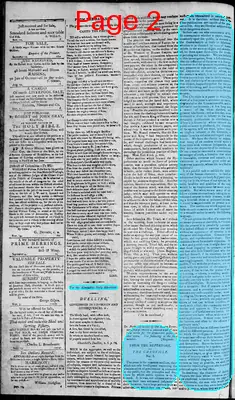
Editorial
September 18, 1804
Alexandria Daily Advertiser
Alexandria, Virginia
What is this article about?
The Boston Reperatory's editorial series begins by criticizing the rival Chronicle as a source of vilest slanders and falsehoods, edited by depraved men like Anthony Pasquin. It stresses the press's role in forming public opinion and the need to expose such abuses to protect society.
Clipping
OCR Quality
95%
Excellent
Full Text
Dr. Park, the Editor of the Boston Reper-
tory, has promised to unmask a set of men
who write for the democratic paper in
that town.
The following is the first
number.
[Register.
FROM THE REPERTORY.
THE CHRONICLE.
No. I.
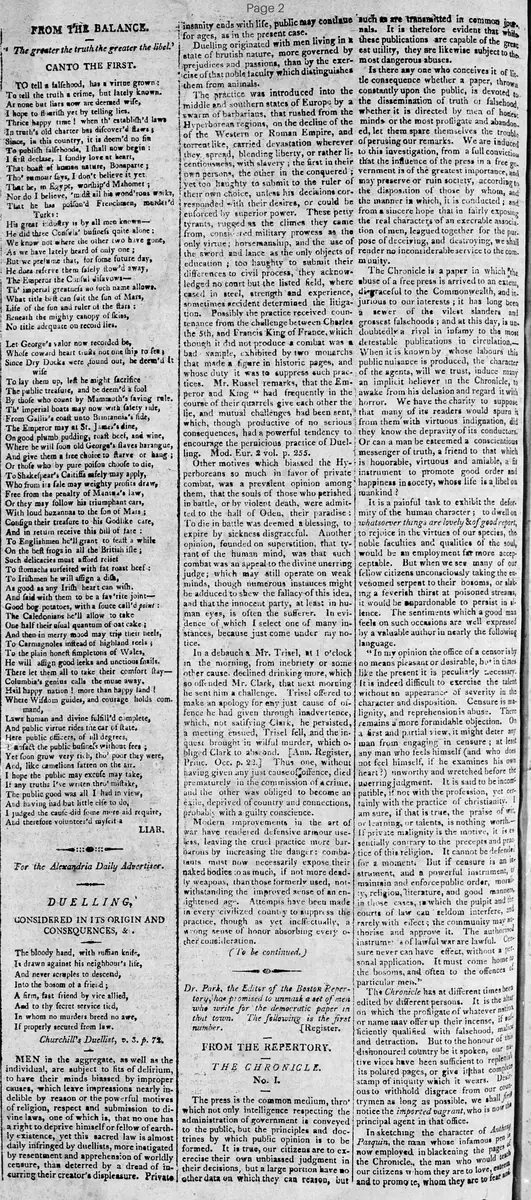
The press is the common medium, thro'
which not only intelligence respecting the
administration of government is conveyed
to the public, but the principles and doc-
trines by which public opinion is to be
formed. It is true, our citizens are to ex-
ercise their own unbiassed judgment in
their decisions, but a large portion have no
other data on which they can reason, but
such as are transmitted in common jour-
nals. It is therefore evident that while
these publications are capable of the great-
est utility, they are likewise subject to the
most dangerous abuses.
Is there any one who conceives it of lit-
tle consequence whether a paper, thrown
constantly upon the public, is devoted to
the dissemination of truth or falsehood.
whether it is directed by men of honest
minds or the most profligate and abandon-
ed, let them spare themselves the trouble
of perusing our remarks. We are induced
to this investigation, from a full conviction
that the influence of the press in a free go-
vernment is of the greatest importance, and
may preserve or ruin society, according to
the disposition of those by whom, and
the manner in which, it is conducted; and
from sincere hope that in fairly exposing
the real characters of an execrable associa-
tion of men, leagued together for the pur-
pose of deceiving, and destroying, we shall
render no inconsiderable service to the com-
munity.
The Chronicle is a paper in which 'the
abuse of a free press is arrived to an extent,
disgraceful to the Commonwealth, and in-
jurious to our interests; it has long been
sewer of the vilest slanders and
grossest falsehoods; and at this day, is un-
doubtedly a rival in infamy to the most
detestable publications in circulation,-
When it is known by whose labours this
public nuisance is produced, the character
of the agents, will we trust, induce many
an implicit believer in the Chronicle, to
awake from his delusion and regard it with
horror. We have the charity to suppose
that many of its readers would spurn it
from them with virtuous indignation, did
they know the depravity of its conductors.
Or can a man be esteemed a conscientious
messenger of truth, a friend to that which
is honorable, virtuous and amiable, a fit
instrument to promote good order and
happiness in society, whose life is a libel on
mankind?
It is a painful task to exhibit the defor-
mity of the human character; to dwell on
whatsoever things are lovely & of good report.
to rejoice in the virtues of our species, the
noble faculties and qualities of the soul,
would be an employment far more accep-
table. But when we see many of our
fellow citizens unconsciously taking the en-
venomed serpent to their bosoms, or slak-
ing a feverish thirst at poisoned streams,
it would be unpardonable to persist in si-
lence. The sentiments which a good man
feels on such occasions are well expressed
by a valuable author in nearly the following
language.
"In my opinion the office of a censor is by
no means pleasant or desirable, but in times
like the present it is peculiarly necessary.
It is indeed difficult to exercise the talent
without an appearance of severity in the
character and disposition. Censure is ma-
lignity, and reprehension is abuse. There
remains a more formidable objection. On
a first and partial view, it might deter any
man from engaging in censure; at least
any man who feels himself (and who does
not feel himself, if he examines his own
heart?) unworthy and wretched before the
unerring judgment. It is said to be incom-
patible, if not with the profession, yet cer-
tainly with the practice of christianity. I
am sure, if that is true, the praise of wit
or learning, or talents, is nothing worth.-
If private malignity is the motive, it is es-
sentially contrary to the precepts and prac-
tice of this religion. It cannot be defended
for a moment: But if censure is an in-
strument, and a powerful instrument, to
maintain and enforce public order, morali-
ty, religion, literature, and good manners,
in those cases, in which the pulpit and the
courts of law can seldom interfere, and
rarely with effect; the community may au-
thorise and approve it. The authorised
instruments of lawful warfare are lawful. Cen-
sure never can have effect, without a per-
sonal application. It must come home to
the bosoms, and often to the offences of
particular men."
The Chronicle has at different times been
edited by different persons. It is the altar
on which the profligate of whatever nation
or name may offer up their incense,
if sufficiently qualified with falsehood, malice
and detraction.
But to the honour of this
dishonoured country be it spoken, our na-
tive vices have been sufficient to replenish
its polluted pages, or give it that complete
stamp of iniquity which it wears.
Desir-
ous to withhold disgrace
from our coun-
try men as long as possible, we shall first no-
tice the imported vagrant, who is now the
principal agent in that office.
In sketching the character
of Anthony
Pasquin, the man whose infamous pen
is
now employed in blackening the pages
of
the Chronicle
the
man
our citizens whom they are to love, esteem
and to promote, whom they are to fear and.
tory, has promised to unmask a set of men
who write for the democratic paper in
that town.
The following is the first
number.
[Register.
FROM THE REPERTORY.
THE CHRONICLE.
No. I.
The press is the common medium, thro'
which not only intelligence respecting the
administration of government is conveyed
to the public, but the principles and doc-
trines by which public opinion is to be
formed. It is true, our citizens are to ex-
ercise their own unbiassed judgment in
their decisions, but a large portion have no
other data on which they can reason, but
such as are transmitted in common jour-
nals. It is therefore evident that while
these publications are capable of the great-
est utility, they are likewise subject to the
most dangerous abuses.
Is there any one who conceives it of lit-
tle consequence whether a paper, thrown
constantly upon the public, is devoted to
the dissemination of truth or falsehood.
whether it is directed by men of honest
minds or the most profligate and abandon-
ed, let them spare themselves the trouble
of perusing our remarks. We are induced
to this investigation, from a full conviction
that the influence of the press in a free go-
vernment is of the greatest importance, and
may preserve or ruin society, according to
the disposition of those by whom, and
the manner in which, it is conducted; and
from sincere hope that in fairly exposing
the real characters of an execrable associa-
tion of men, leagued together for the pur-
pose of deceiving, and destroying, we shall
render no inconsiderable service to the com-
munity.
The Chronicle is a paper in which 'the
abuse of a free press is arrived to an extent,
disgraceful to the Commonwealth, and in-
jurious to our interests; it has long been
sewer of the vilest slanders and
grossest falsehoods; and at this day, is un-
doubtedly a rival in infamy to the most
detestable publications in circulation,-
When it is known by whose labours this
public nuisance is produced, the character
of the agents, will we trust, induce many
an implicit believer in the Chronicle, to
awake from his delusion and regard it with
horror. We have the charity to suppose
that many of its readers would spurn it
from them with virtuous indignation, did
they know the depravity of its conductors.
Or can a man be esteemed a conscientious
messenger of truth, a friend to that which
is honorable, virtuous and amiable, a fit
instrument to promote good order and
happiness in society, whose life is a libel on
mankind?
It is a painful task to exhibit the defor-
mity of the human character; to dwell on
whatsoever things are lovely & of good report.
to rejoice in the virtues of our species, the
noble faculties and qualities of the soul,
would be an employment far more accep-
table. But when we see many of our
fellow citizens unconsciously taking the en-
venomed serpent to their bosoms, or slak-
ing a feverish thirst at poisoned streams,
it would be unpardonable to persist in si-
lence. The sentiments which a good man
feels on such occasions are well expressed
by a valuable author in nearly the following
language.
"In my opinion the office of a censor is by
no means pleasant or desirable, but in times
like the present it is peculiarly necessary.
It is indeed difficult to exercise the talent
without an appearance of severity in the
character and disposition. Censure is ma-
lignity, and reprehension is abuse. There
remains a more formidable objection. On
a first and partial view, it might deter any
man from engaging in censure; at least
any man who feels himself (and who does
not feel himself, if he examines his own
heart?) unworthy and wretched before the
unerring judgment. It is said to be incom-
patible, if not with the profession, yet cer-
tainly with the practice of christianity. I
am sure, if that is true, the praise of wit
or learning, or talents, is nothing worth.-
If private malignity is the motive, it is es-
sentially contrary to the precepts and prac-
tice of this religion. It cannot be defended
for a moment: But if censure is an in-
strument, and a powerful instrument, to
maintain and enforce public order, morali-
ty, religion, literature, and good manners,
in those cases, in which the pulpit and the
courts of law can seldom interfere, and
rarely with effect; the community may au-
thorise and approve it. The authorised
instruments of lawful warfare are lawful. Cen-
sure never can have effect, without a per-
sonal application. It must come home to
the bosoms, and often to the offences of
particular men."
The Chronicle has at different times been
edited by different persons. It is the altar
on which the profligate of whatever nation
or name may offer up their incense,
if sufficiently qualified with falsehood, malice
and detraction.
But to the honour of this
dishonoured country be it spoken, our na-
tive vices have been sufficient to replenish
its polluted pages, or give it that complete
stamp of iniquity which it wears.
Desir-
ous to withhold disgrace
from our coun-
try men as long as possible, we shall first no-
tice the imported vagrant, who is now the
principal agent in that office.
In sketching the character
of Anthony
Pasquin, the man whose infamous pen
is
now employed in blackening the pages
of
the Chronicle
the
man
our citizens whom they are to love, esteem
and to promote, whom they are to fear and.
What sub-type of article is it?
Press Freedom
Moral Or Religious
Partisan Politics
What keywords are associated?
Press Abuse
Chronicle Criticism
Anthony Pasquin
Falsehoods
Moral Depravity
Public Opinion
Censure Necessity
What entities or persons were involved?
Dr. Park
Boston Reperatory
Chronicle
Anthony Pasquin
Editorial Details
Primary Topic
Critique Of The Boston Chronicle And Its Editors
Stance / Tone
Strongly Condemnatory Of Press Abuse And Moral Depravity
Key Figures
Dr. Park
Boston Reperatory
Chronicle
Anthony Pasquin
Key Arguments
The Press Conveys Intelligence And Forms Public Opinion But Is Subject To Dangerous Abuses
The Chronicle Disseminates Falsehoods And Slanders Under Depraved Conductors
Exposing The Chronicle's Agents Will Awaken Readers From Delusion
Censure Of The Press Is Necessary To Maintain Public Order And Morality
Anthony Pasquin Is The Principal Depraved Editor