Thank you for visiting SNEWPapers!
Sign up free
Editorial
October 3, 1812
Alexandria Gazette, Commercial And Political
Alexandria, Virginia
What is this article about?
The editorial analyzes Marmont's defeat at Salamanca, predicting Soult's difficult retreat through hostile Spanish provinces, obstructed by allies, guerrillas, and locals. It foresees French expulsion from Spain, including Catalonia, and hopes for the end of Napoleon's tyrannical influence.
Clipping
OCR Quality
95%
Excellent
Full Text
ALEXANDRIA.
SATURDAY, October 3.
"TO SHEW
THE VERY AGE & BODY OF THE TIME"
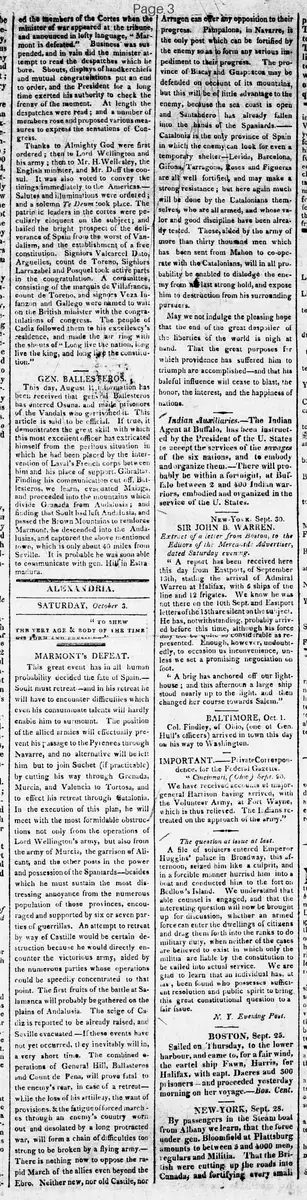
MARMONT'S DEFEAT.
This great event has in all human probability decided the fate of Spain.—Soult must retreat—and in his retreat he will have to encounter difficulties which even his consummate talents will hardly enable him to surmount. The position of the allied armies will effectually prevent his passage to the Pyrenees through Navarre, and no alternative will be left him but to join Suchet (if practicable) by cutting his way through Grenada, Murcia, and Valencia to Tortosa, and to effect his retreat through Catalonia.
In the execution of this plan, he will meet with the most formidable obstructions not only from the operations of Lord Wellington's army, but also from the army of Murcia, the garrison of Alicante and the other posts in the power and possession of the Spaniards—besides which he must sustain the most distressing annoyance from the numerous population of those provinces, encouraged and supported by six or seven parties of guerrillas. An attempt to retreat by way of Castile would be certain destruction because he would directly encounter the victorious army, aided by the numerous parties whose operations could be speedily concentrated to that point. The first fruits of the battle at Salamanca will probably be gathered on the plains of Andalusia. The siege of Cadiz is reported to be already raised, and Seville evacuated—If these events have not yet occurred, they inevitably will in a very short time. The combined operations of General Hill, Ballesteros and Count de Pena, will prove fatal to the enemy's rear, in case of a retreat—while the loss of his artillery, the want of provisions, & the fatigue of forced marches through an enemy's country worn out and desolated by a long protracted war, will form a chain of difficulties too strong to be broken by a flying army.—
There is nothing now to oppose the rapid march of the allies even beyond the Ebro. Neither new, nor old Castile, nor Arragon can offer any opposition to their progress. Pampelona, in Navarre, is the only post which can be fortified by the enemy so as to form any serious impediment to their progress. The province of Biscay and Guipuscoa may be defended on account of its mountains, but this will be of little advantage to the enemy, because the sea coast is open and Santander has already fallen into the hands of the Spaniards.—
Catalonia is the only province of Spain in which the enemy can look for even a temporary shelter—Lerida, Barcelona, Girona, Tarragona, Roses and Figueras are all well fortified, and may make a strong resistance; but here again much will be done by the Catalonians themselves, who are all armed, and whose valor and good discipline have been already tested. These, aided by the army of more than thirty thousand men which has been sent from Mahon to co-operate with the Catalonians, will in all probability be enabled to dislodge the enemy from a last strong hold, and expose him to destruction from his surrounding pursuers.
May we not indulge the pleasing hope that the end of the great despoiler of the liberties of the world is nigh at hand. That the great purposes for which providence has suffered him to triumph are accomplished—and that his baleful influence will cease to blast, the honor, the interest, and the happiness of nations.
SATURDAY, October 3.
"TO SHEW
THE VERY AGE & BODY OF THE TIME"
MARMONT'S DEFEAT.
This great event has in all human probability decided the fate of Spain.—Soult must retreat—and in his retreat he will have to encounter difficulties which even his consummate talents will hardly enable him to surmount. The position of the allied armies will effectually prevent his passage to the Pyrenees through Navarre, and no alternative will be left him but to join Suchet (if practicable) by cutting his way through Grenada, Murcia, and Valencia to Tortosa, and to effect his retreat through Catalonia.
In the execution of this plan, he will meet with the most formidable obstructions not only from the operations of Lord Wellington's army, but also from the army of Murcia, the garrison of Alicante and the other posts in the power and possession of the Spaniards—besides which he must sustain the most distressing annoyance from the numerous population of those provinces, encouraged and supported by six or seven parties of guerrillas. An attempt to retreat by way of Castile would be certain destruction because he would directly encounter the victorious army, aided by the numerous parties whose operations could be speedily concentrated to that point. The first fruits of the battle at Salamanca will probably be gathered on the plains of Andalusia. The siege of Cadiz is reported to be already raised, and Seville evacuated—If these events have not yet occurred, they inevitably will in a very short time. The combined operations of General Hill, Ballesteros and Count de Pena, will prove fatal to the enemy's rear, in case of a retreat—while the loss of his artillery, the want of provisions, & the fatigue of forced marches through an enemy's country worn out and desolated by a long protracted war, will form a chain of difficulties too strong to be broken by a flying army.—
There is nothing now to oppose the rapid march of the allies even beyond the Ebro. Neither new, nor old Castile, nor Arragon can offer any opposition to their progress. Pampelona, in Navarre, is the only post which can be fortified by the enemy so as to form any serious impediment to their progress. The province of Biscay and Guipuscoa may be defended on account of its mountains, but this will be of little advantage to the enemy, because the sea coast is open and Santander has already fallen into the hands of the Spaniards.—
Catalonia is the only province of Spain in which the enemy can look for even a temporary shelter—Lerida, Barcelona, Girona, Tarragona, Roses and Figueras are all well fortified, and may make a strong resistance; but here again much will be done by the Catalonians themselves, who are all armed, and whose valor and good discipline have been already tested. These, aided by the army of more than thirty thousand men which has been sent from Mahon to co-operate with the Catalonians, will in all probability be enabled to dislodge the enemy from a last strong hold, and expose him to destruction from his surrounding pursuers.
May we not indulge the pleasing hope that the end of the great despoiler of the liberties of the world is nigh at hand. That the great purposes for which providence has suffered him to triumph are accomplished—and that his baleful influence will cease to blast, the honor, the interest, and the happiness of nations.
What sub-type of article is it?
War Or Peace
Military Affairs
Foreign Affairs
What keywords are associated?
Marmont Defeat
Soult Retreat
Peninsular War
Wellington Army
Guerrilla Resistance
Napoleon Downfall
Spanish Provinces
Allied Advance
What entities or persons were involved?
Marmont
Soult
Lord Wellington
Suchet
General Hill
Ballesteros
Count De Pena
Napoleon
Editorial Details
Primary Topic
Marmont's Defeat And French Retreat In Spain
Stance / Tone
Optimistic About Allied Victory And End Of Napoleon's Influence
Key Figures
Marmont
Soult
Lord Wellington
Suchet
General Hill
Ballesteros
Count De Pena
Napoleon
Key Arguments
Marmont's Defeat Decides Fate Of Spain
Soult Must Retreat Through Difficult Terrain
Allied Armies Block Passage To Pyrenees
Guerrillas And Spanish Forces Will Obstruct Retreat
Siege Of Cadiz Raised And Seville Evacuated
Catalonia Offers Temporary Shelter But Will Fall
Providence Has Accomplished Napoleon's Purposes And His End Is Near