Thank you for visiting SNEWPapers!
Sign up free
Story
December 10, 1943
Nogales International
Nogales, Santa Cruz County, Arizona
What is this article about?
Southern Pacific appeals to civilians to restrict non-essential holiday travel from December 17 to January 10 to prioritize accommodations for furloughed service personnel and their families, amid expected high demand.
Clipping
OCR Quality
95%
Excellent
Full Text
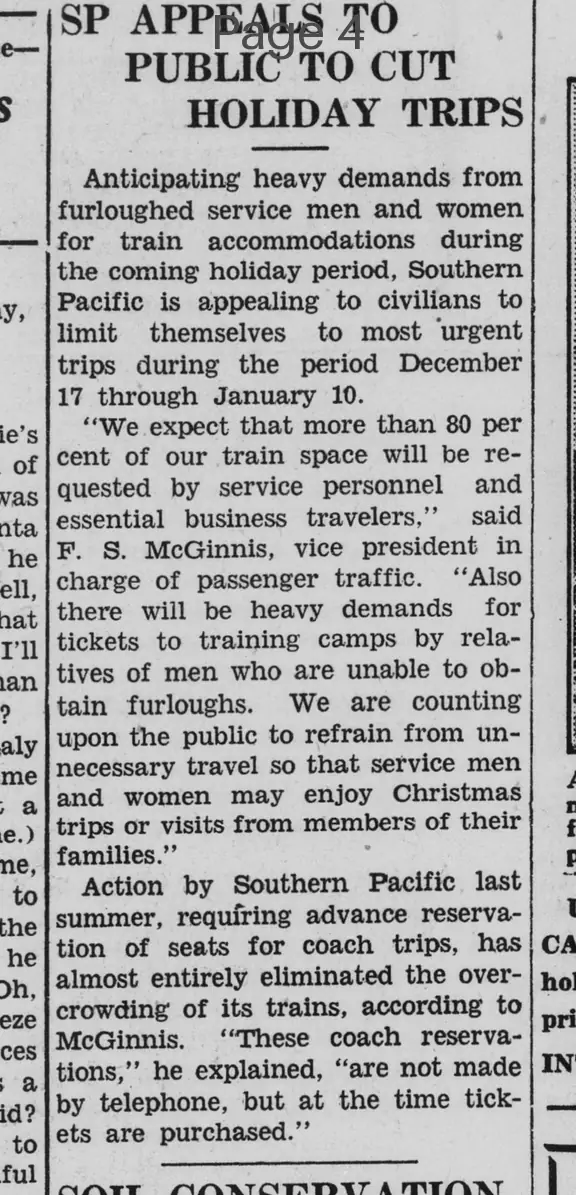
PUBLIC TO CUT
HOLIDAY TRIPS
Anticipating heavy demands from
furloughed service men and women
for train accommodations during
the coming holiday period, Southern
Pacific is appealing to civilians to
limit themselves to most urgent
trips during the period December
17 through January 10.
"We expect that more than 80 per
cent of our train space will be re-
quested by service personnel and
essential business travelers," said
F. S. McGinnis, vice president in
charge of passenger traffic. "Also
there will be heavy demands for
tickets to training camps by rela-
tives of men who are unable to ob-
tain furloughs. We are counting
upon the public to refrain from un-
necessary travel so that service men
and women may enjoy Christmas
trips or visits from members of their
families."
Action by Southern Pacific last
summer, requiring advance reserva-
tion of seats for coach trips, has
almost entirely eliminated the over-
crowding of its trains, according to
McGinnis.
"These coach reserva-
tions," he explained, are not made
by telephone, but at the time tick-
ets are purchased."
HOLIDAY TRIPS
Anticipating heavy demands from
furloughed service men and women
for train accommodations during
the coming holiday period, Southern
Pacific is appealing to civilians to
limit themselves to most urgent
trips during the period December
17 through January 10.
"We expect that more than 80 per
cent of our train space will be re-
quested by service personnel and
essential business travelers," said
F. S. McGinnis, vice president in
charge of passenger traffic. "Also
there will be heavy demands for
tickets to training camps by rela-
tives of men who are unable to ob-
tain furloughs. We are counting
upon the public to refrain from un-
necessary travel so that service men
and women may enjoy Christmas
trips or visits from members of their
families."
Action by Southern Pacific last
summer, requiring advance reserva-
tion of seats for coach trips, has
almost entirely eliminated the over-
crowding of its trains, according to
McGinnis.
"These coach reserva-
tions," he explained, are not made
by telephone, but at the time tick-
ets are purchased."
What sub-type of article is it?
Historical Event
What themes does it cover?
Moral Virtue
What keywords are associated?
Holiday Travel
Wartime Restrictions
Southern Pacific
Service Personnel
Train Accommodations
What entities or persons were involved?
F. S. Mcginnis
Story Details
Key Persons
F. S. Mcginnis
Event Date
December 17 Through January 10
Story Details
Southern Pacific appeals to civilians to limit urgent trips during the holiday period to accommodate service personnel and families, citing high demand and advance reservation policies that reduced overcrowding.