Thank you for visiting SNEWPapers!
Sign up free
American Watchman And Delaware Advertiser
Wilmington, New Castle County, Delaware
What is this article about?
Andrew Jackson defends his 1825 letter to Carter Beverly against Henry Clay's denial, explaining a conversation with James Buchanan about alleged overtures from Clay's friends to support Adams for Secretary of State in exchange for election aid, and notes Clay's avoidance of earlier congressional inquiry.
Merged-components note: Merged continuous letter/statement by Andrew Jackson responding to Mr. Clay across pages 2 and 3; relabeled from 'story' to 'letter_to_editor' as it is a personal public response.
Clippings
1 of 2
OCR Quality
Full Text
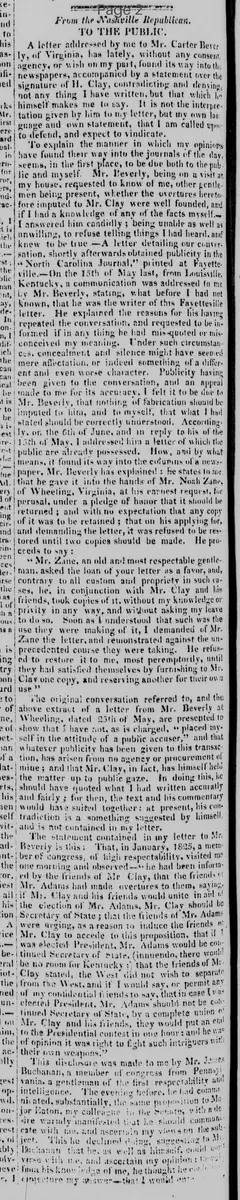
TO THE PUBLIC
A letter addressed by me to Mr. Carter Beverly, of Virginia, has lately, without any consent, agency, or wish on my part, found its way into the newspapers, accompanied by a statement over the signature of H. Clay, contradicting and denying not any thing I have written, but that which he himself makes me to say. It is not the interpretation given by him to my letter, but my own language and own statement, that I am called upon to defend, and expect to vindicate.
To explain the manner in which my opinions have found their way into the journals of the day, seems, in the first place, to be due both to the public and myself. Mr. Beverly, being on a visit at my house, requested to know of me, other gentlemen being present, whether the overtures heretofore imputed to Mr. Clay were well founded, and if I had a knowledge of any of the facts myself. I answered him candidly; being unable as well as unwilling, to refuse telling things I had heard, and knew to be true. A letter detailing our conversation, shortly afterwards obtained publicity in the "North Carolina Journal," printed at Fayetteville. On the 15th of May last, from Louisville Kentucky, a communication was addressed to me by Mr. Beverly, stating, what before I had not known, that he was the writer of this Fayetteville letter. He explained the reasons for his having repeated the conversation, and requested to be informed if in any thing he had mis-quoted or mis conceived my meaning. Under such circumstances, concealment and silence might have seemed mere affectation, or indeed something of a different and even worse character. Publicity having been given to the conversation, and an appeal made to me for its accuracy, I felt it to be due to Mr. Beverly, that nothing of fabrication should be imputed to him, and to myself, that what I had stated should be correctly understood. Accordingly, on the 6th of June, and in reply to his of the 15th of May, I addressed him a letter of which the public are already possessed. How, and by what means, it found its way into the columns of a newspaper, Mr. Beverly has explained: he states to me that he gave it into the hands of Mr. Noah Zane, of Wheeling, Virginia, at his earnest request, for perusal, under a pledge of honor that it should be returned; and with no expectation that any copy of it was to be retained; that on his applying for, and demanding the letter, it was refused to be restored until two copies should be made. He proceeds to say:
"Mr. Zane, an old and most respectable gentleman, asked the loan of your letter as a favor, and, contrary to all custom and propriety in such cases, he, in conjunction with Mr. Clay and his friends, took copies of it, without my knowledge or privity in any way and without asking my leave to do so. Soon as I understood that such was the use they were making of it, I demanded of Mr. Zane the letter, and remonstrated against the unprecedented course they were taking. He refused to restore it to me, most peremptorily, until they had satisfied themselves by furnishing to Mr. Clay one copy, and reserving another for their own use"
The original conversation referred to, and the above extract of a letter from Mr. Beverly at Wheeling, dated 25th of May, are presented to show that I have not, as is charged, "placed myself in the attitude of a public accuser." and that whatever publicity has been given to this transaction, has arisen from no agency or procurement of mine; and that Mr. Clay, in fact, has himself held the matter up to public gaze. In doing this, he should have quoted what I had written accurately and fairly; for then, the text and his commentary would have suited together: at present, his contradiction is a something suggested by himself, and is not contained in my letter.
The statement contained in my letter to Mr. Beverly is this: That, in January, 1825, a member of congress, of high respectability, visited me one morning and observed—"he had been informed by the friends of Mr Clay, that the friends of Mr. Adams had made overtures to them, saying if Mr. Clay and his friends would unite in aid of the election of Mr. Adams, Mr. Clay should be Secretary of State; that the friends of Mr. Adams were urging, as a reason to induce the friends of Mr. Clay to accede to this proposition, that if I was elected President, Mr. Adams would be continued Secretary of state. (innuendo, there would be no room for Kentucky :) that the friends of Mr. Clay stated, the West did not wish to separate from the West. and if I would say, or permit any of my confidential friends to say, that in case I was elected President, Mr. Adams should not be continued Secretary of State, by a complete union of Mr. Clay and his friends, they would put an end to the Presidential contest in one hour: and he was of opinion it was right to fight such intriguers with their own weapons."
This disclosure was made to me by Mr. James Buchanan, a member of congress from Pennsylvania, a gentleman of the first respectability and intelligence. The evening before, he had communicated, substantially, the same proposition to Major Eaton, my colleague in the senate, with desire warmly manifested that he should communicate with me, and ascertain my views on the subject Buchanan that he, as well as himself, could converse with me, and ascertain my opinion : from his knowledge of me, he thought he knew my answer—that I would one
Arrangements whatever. It was the morning succeeding this interview, after Major Eaton had objected to converse with me on the subject, and before I had set out from my lodging for the capitol, that Mr. Buchanan came to visit me, and when the conversation I have stated, took place. The answer returned, has already been published, and need not here be repeated.
To be thus approached by a gentleman of Mr. Buchanan's high character and standing, with an apology proffered at the time for what he was about to remark to one who, as I understood, had always, to that moment, been on familiar and friendly terms with Mr. Clay, assuring me that on certain terms and conditions being assented to on my part, then, "by a union of Mr. Clay and his friends, they would put an end to the Presidential contest in one hour," what other conclusion or inference was to be made, than that he spoke by authority, either of Mr. Clay himself or some of his confidential friends? The character of Mr. Buchanan, with me forbids the idea that he was acting on his own responsibility, or that, under any circumstances, he could have been induced to propose an arrangement, unless possessed of satisfactory assurances, that, if accepted, it would be carried fully into effect. A weak mind would seldom or ever be thus disposed to act, an intelligent one never.
Under all the circumstances appearing at that time, I did not resist the impression that Mr. Buchanan had approached me on the cautiously submitted proposition of some authorized person; and, therefore, in giving him my answer, did request him "to say to Mr. Clay and his friends," what that answer had been. Whether the communication was made to Mr. Clay and his friends I know not; thus, though, I do know, that while the opinions and course of Mr. Clay as to the election, were but matter of conjecture with many at and before this time, very shortly after this conversation took place, his, and his friends' opinion became forthwith matter of certainty and general knowledge. Still I have not said, nor do I now say, that the proposal made to me was "with the privity and consent," of Mr. Clay; nor, either, have I said that his friends in congress made propositions to me. These are Mr. Clay's interpretations of my letter to Mr. Beverley, and not what that letter itself contains. What I have stated, are the facts of a conversation between myself and a member of congress of high respectability. The conclusion and inference from that conversation—the time—manner—and all the circumstances—satisfied my mind that it was not unauthorized. So I have thought, and so I still think: and yet, I again repeat that in this supposition I may have possibly done Mr. Clay injustice. If he should be able to sustain the averments he has made, and acquit himself of any agency and participation in the matter, I beg leave to assure him that, so far from affording me pain, it will give me pleasure. I certainly can have no desire that the character of my country, through the acts of a prominent citizen, shall rest under any serious imputation: for the honor of that country, I should greatly prefer, that any inference I have made, may turn out to be denied.
Mr. Clay declares his great satisfaction, that this matter has at last been brought to light, and to public consideration. He feels rejoiced "that a specific accusation by a responsible accuser has at length appeared." To this a passing notice is due. It must be recollected, that in consequence of a letter from Mr. George Kremer in January, 1825, an inquiry was set on foot in Congress upon the application of Mr. Clay himself.
On this memorable occasion, of guilt imputed on the one hand, and innocence maintained on the other, Mr. McDuffie, it will be recollected, submitted for consideration to the House of Representatives, as matter of instruction to the committee, the following resolution: "that the said committee be instructed to enquire whether the friends of Mr. Clay have hinted, that they would fight for those who would pay best, or any thing to that effect: and whether overtures were said to have been made by the friends of Adams to the friends of Mr. Clay, offering the appointment of Secretary of State for his aid to elect Adams: and whether the friends of Clay gave this information to the friends of Jackson, and hinted that if his friends would offer the same price they would close with them: and whether Henry Clay has transferred, or resolved to transfer, his interest to John Q. Adams; and whether it was said and believed that as a consideration for this abandonment of duty to his constituents, Clay was to be appointed Secretary of State, and that the said committee be authorized to send for persons and papers, and to compel the persons so sent for to answer upon oath."
Now here is a resolution, officially submitted, covering more than the ground of my communication to Mr. Beverly: and resting in connexion with an accusation publicly charged in the newspapers; and yet, Mr. Clay, at this late period, professes to be rejoiced, that "a specific accusation, by a responsible accuser, has at length appeared." Certainly more than two years ago, an accuser respectable, and an accusation specific, were both before him—were both within his reach, and might have been met, had he been at all disposed to the interview, or rejoiced at the prospect of meeting an accuser. Had Mr. McDuffie believed the charge groundless and untrue, he is a man of too high sense of honor to have pressed upon the consideration of the committee an instruction clothed in the pointed phraseology that this is; nor can it be inferred, that in a matter so serious, the friends of Mr. Clay would have voted against extending this asked for power to the Committee. An innocent man before an impartial tribunal fears not to meet the exercise of any power that competent authority gives; and far less should he distrust that exercise, when in the hands of correct and honorable men. Innocence never seeks for safety through covert ways and hidden ambuscades; she fights by day and in the open plain, and proud in her own strength, meets her enemy fearlessly. In the proposition submitted by Mr. McDuffie, there was nothing to alarm, nothing that innocence should have doubted about: it was neither more nor less, than a call of the attention of the committee to particular enquiries, with an application for power to ferret out the truth, through an appeal to the oath of those who might be called upon to depose before them.
Without documents, and unacquainted with the number of Mr. Clay's friends in the House, I cannot assert that they were in opposition to Mr. McDuffie's resolution. Yet it is obvious, that the influence he possessed would have been amply sufficient to produce a different result, had Mr. Clay been at all desirous that a different one should have been produced. The resolution contained strong imputations, and serious charges—Mr. Clay and his friends were both implicated. Can it be presumed, under such a state of general excitement, that if Mr. Clay desired it, he could not have found present and at hand, some friend to ask in his behalf, that the resolution should be adopted and full powers extended to the committee? And, moreover, can it be thought, that such an indulgence, if desired by Mr. Clay, or any of his friends, could or would have been denied? And yet, it was denied, inasmuch as the resolution was rejected, and the power asked for, refused to the committee.
A solicitude to find "a specific accusation, by a responsible accuser," could not have been so seriously entertained then, as it is earnestly expressed now, or else so excellent an opportunity being afforded to encounter both, both could not have been so carelessly regarded—so contemned, and so thrown away. A controversy with me can no more disclose or render apparent Mr. Clay's innocence, than could the controversy placed within his reach two and a half years ago; and yet, while the one was avoided, or at any rate not embraced with a zeal corresponding with the necessity of the occasion, at the prospects presented by the other, exceeding joy seems to be manifested. Then, as now, a specific accusation, was before him.
One further remark and I am done, with a hope that, on this subject, I may not be under any necessity of again appearing in the newspapers. In saying what I have, all the circumstances considered, I have felt it was due to myself, and to the public. My wish would have been, to avoid having any thing to say or do in this matter, from an apprehension well conceived, that persons will not be wanting who may charge, whatever is done, to a desire to affect others, and benefit myself. My own feelings, though, are of higher importance and value to me, than the opinion of those who impose censure where it is believed not to be deserved. I have been actuated by no such design, nor governed by any such consideration. The origin—the beginning of this matter, was at my own house and fireside: where surely a freeman may be permitted to speak on public topics without having ascribed to him improper designs. I have not gone into the highways and market places, to proclaim my opinions, and in this, feel that I have differed from some, who, even at public dinner tables, have not scrupled to consider me as a legitimate subject for a speech, and the entertainment of the company. Yet, for this, who has heard me complain? No one. Trusting to the justice of an intelligent people, I have been content to rely for security on their decision, against the countless assaults and slanders, which so repeatedly are sought to be palmed upon them, without seeking to present myself in my own defence, and still less, to become "the responsible accuser" of Mr. Clay or any other person.
ANDREW JACKSON
Hermitage, July 18th, 1827.
What sub-type of article is it?
What themes does it cover?
What keywords are associated?
What entities or persons were involved?
Letter to Editor Details
Author
Andrew Jackson
Recipient
To The Public
Main Argument
jackson clarifies that he did not directly accuse henry clay of involvement in 1825 election overtures but reported a conversation with james buchanan suggesting such propositions from clay's friends; he defends the publication of his letter to beverly as unintended and criticizes clay for misinterpreting it and avoiding earlier congressional scrutiny.
Notable Details