Thank you for visiting SNEWPapers!
Sign up free
Literary
July 25, 1874
The Donaldsonville Chief
Donaldsonville, Gonzales, Ascension County, Louisiana
What is this article about?
In a dialogue, Abou ben Adhem defines remorse as the humiliating sense of failure, illustrated through his Persian gambling experiences with drah-poquier and later regrets over excessive drinking, suggesting remorse arises mainly from painful consequences rather than moral regret. Attributed to D. R. Locke in National Monthly.
Clipping
OCR Quality
95%
Excellent
Full Text
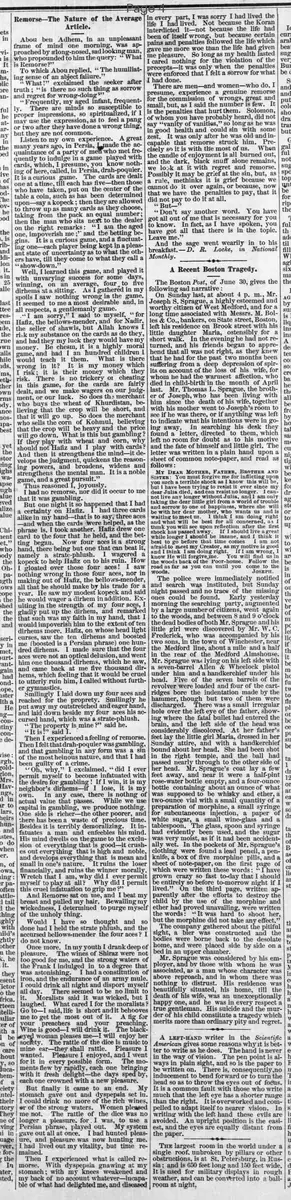
Abou ben Adhem, in an unpleasant frame of mind one morning, was approached by a long-nosed, sad looking man, who propounded to him the query: "What is Remorse?" To which Abou replied, "The humiliating sense of an abject failure." "What!" exclaimed the seeker after truth; "is there no such thing as sorrow and regret for wrong-doing?" "Frequently, my aged infant, frequently. There are minds so susceptible to proper impressions, so spiritualized, if I may use the expression, as to feel a pang or two after they have done a wrong thing, but they are not common. Listen to my own experience. A great many years ago, in Persia, I made the acquaintance of a party of men who met frequently to indulge in a game played with cards, which, I presume, you know nothing of here, called, in Persia, drah-poquier. It is a curious game. The cards are dealt one at a time, till each has five—then those who have taken, put on the center of the table a coin, such as has been determined upon—say a kopeck: then they are allowed to throw up as many cards as they choose, taking from the pack an equal number: then the man who sits next to the dealer on the right remarks: "I am the aged one, impoverish me;" and the betting begins. It is a curious game, and a fluctuating one—each player being kept in a pleasant state of uncertainty as to what the others have, till they come to what they call a "show-down." Well, I learned this game, and played it with unvarying success for some days, winning, on an average, four to five dirhems at a sitting. As I gathered in my spoils I saw nothing wrong in the game. It seemed to me a most desirable and, in all respects, a gentlemanly game. "I am sorry," I said to myself, "for Hafiz, the bellows-mender, and for Nadir, the seller of shawls, but Allah knows I risk my substance on the cards as do they, and had they my luck they would have my money. Be chesm, it is a highly moral game, and had I an hundred children I would teach it them. What is there wrong in it? It is my money which I risk; it is their money which they risk. There is no trickery or cheating in this game, for the cards are fairly dealt, and we make wagers on our judgment, or our luck. So does the merchant who buys the wheat of Khurdistan, believing that the crop will be short, and that it will go up. So does the merchant who sells the corn of Kohmul, believing that the crop will be heavy and the price will go down. What is this but gambling? If they play with wheat and corn, why should not Hafiz and I play with cards? And then it strengthens the mind—it develops the judgment, quickens the reasoning powers, and broadens, widens and strengthens the mental man. It is a noble game, and a great pursuit." Thus reasoned I, joyously. I had no remorse, nor did it occur to me that it was gambling. But one night it so happened that I had a certainty on Hafiz. I had three cards alike in my hand—that is to say, three aces—and when the cards were helped, as the phrase is, I took another. Hafiz drew one card to the four that he held, and the betting began. Now four aces is a strong hand, there being but one that can beat it, namely a straight-flush. I wagered a kopeck to help Hafiz on to his ruin. How I gloated over those four aces! I saw nothing wrong in those four aces, nor in making out of Hafiz, the bellows-mender, all that he should make by his trade for a year. He saw my modest kopeck and said he would wager a dirhem in addition. Exulting in the strength of my four aces, I gladly put up the dirhem, and remarked that such was my faith in my hand, that I would impoverish him to the extent of ten dirhems more. Hafiz, on whose head light curses, saw the ten dirhems and boosted me (boosted is a Persian phrase) one hundred dirhems. I made sure that the four aces were not an optical delusion, and went him one thousand dirhems, which he saw, and came back at me five thousand dirhems, which feeling that it would be cruel to utterly ruin him, I called without further gymnastics. Smilingly I laid down my four aces and reached for the property. Smilingly he put away my outstretched and eager hand, and laid down beside my four aces his accursed hand, which was a straight-flush. "The property is mine?" said he. "It is!" said I. Then I experienced a feeling of remorse. Then I felt that drah-poquier was gambling, and that gambling in any form was a sin of the most heinous nature, and that I had been guilty of a crime. Oh, why," I exclaimed, "did I ever permit myself to become infatuated with the desire for gambling! If I win, it is my neighbor's dirhems—if I lose, it is my own. In any case, there is nothing of actual value that passes. While we use capital in gambling, we produce nothing. One side is richer—the other poorer, and there has been a waste of precious time. Besides it is terribly demoralizing. It infatuates a man and enfeebles his mind. His mind dwells on the game to the exclusion of everything that is good—it crushes out everything that is high and noble, and develops everything that is mean and small in one's nature. It ruins the loser financially, and ruins the winner morally. Wretch that I am, why did I ever permit myself to play at all? Why did I permit this cruel infatuation to grip me?" And Remorse sat on me, and I beat my breast and pulled my hair. Bewailing my wickedness, I determined to purge myself of the unholy thing. Would I have so thought and so done had I held the straight flush, and the accursed bellows-mender the four aces? I do not know. Once more. In my youth I drank deep of pleasure. The wines of Shiraz were not too good for me, and the strong waters of the Frank I indulged in to a degree that was astonishing. I had a constitution of iron, and the endurance of an army mule. I could drink all night and disport myself all day. There seemed to be no limit to it. Moralists said it was wicked, but I laughed. What cared I for the moralists? Go to—I said, life is short and it behooves me to get the most out of it. A fig for your preachers and your preaching. Wine is good—I will drink it. The black eyed woman pleases me—I will enjoy her society. The rattle of the dice is music to mine ear—they shall rattle. Pleasure I wanted. Pleasure I enjoyed, and I went for it in every possible form. The moments flew by rapidly, each one bringing with it fresh delight—the days sped by, each one crowned with a new pleasure. But finally it came to an end. My stomach gave out and dyspepsia set in. I could drink no more of the rich wines, or of the strong waters. Women pleased me not. The rattle of the dice was no longer a pleasure, for I was, to use a Persian phrase, played out. My system gave out all at once. I had hunted pleasure, and pleasure was now hunting me. I had lived out my vitality, but time remained. Then I experienced what is called remorse. With dyspepsia gnawing at my stomach; with my knees weakened and my back of no account whatever—incapable of what had delighted me, and diseased in every part, I was sorry I had lived the life I had lived. Not because the Koran interdicted it—not because the life had been of itself wrong, but because certain pains and penalties followed the life which gave me more woe than the life had given me pleasure. So long as my health lasted I cared nothing for the violation of the precepts—it was only when the penalties were enforced that I felt a sorrow for what I had done. There are men—and women—who do, I presume, experience a genuine remorse for the commission of wrongs, great and small, but, as I said the number is few. It is the penalties that hurt them. Solomon, of whom you have probably heard, did not say "vanity of vanities," so long as he was in good health and could sin with some zest. It was only after he was old and incapable that remorse struck him. Precisely so it is with the most of us. When the candle of enjoyment is all burned out, and the dark, black snuff alone remains, we look at it with regret and remorse. Possibly it may be grief at the sin, but, as a rule, methinks it is grief because we cannot do it over again, or because, now that we have the penalties to pay, that it did not pay to do it at all. "But—" "Don't say another word. You have got all out of me that is necessary for you to know. In fact, as I have spoken, you have got all that there is in the topic. Leave me." And the sage went wearily in to his breakfast.—D. R. Locke, in National Monthly.
What sub-type of article is it?
Satire
Dialogue
Essay
What themes does it cover?
Moral Virtue
Temperance
What keywords are associated?
Remorse
Gambling
Drah Poquier
Indulgence
Persia
Morality
Temperance
What entities or persons were involved?
D. R. Locke, In National Monthly
Literary Details
Author
D. R. Locke, In National Monthly
Subject
What Is Remorse?
Key Lines
"The Humiliating Sense Of An Abject Failure."
"If I Win, It Is My Neighbor's Dirhems—If I Lose, It Is My Own."
It Is The Penalties That Hurt Them.