Thank you for visiting SNEWPapers!
Sign up free
Editorial
February 17, 1804
Berkeley And Jefferson Intelligencer
Martinsburg, Berkeley County, Virginia
What is this article about?
Editorial warns of French invasion threat, stresses protecting public credit as vital to national stability, urges personal participation in defense, and calls for unity across parties, drawing on historical precedents to inspire Britons.
Clipping
OCR Quality
95%
Excellent
Full Text
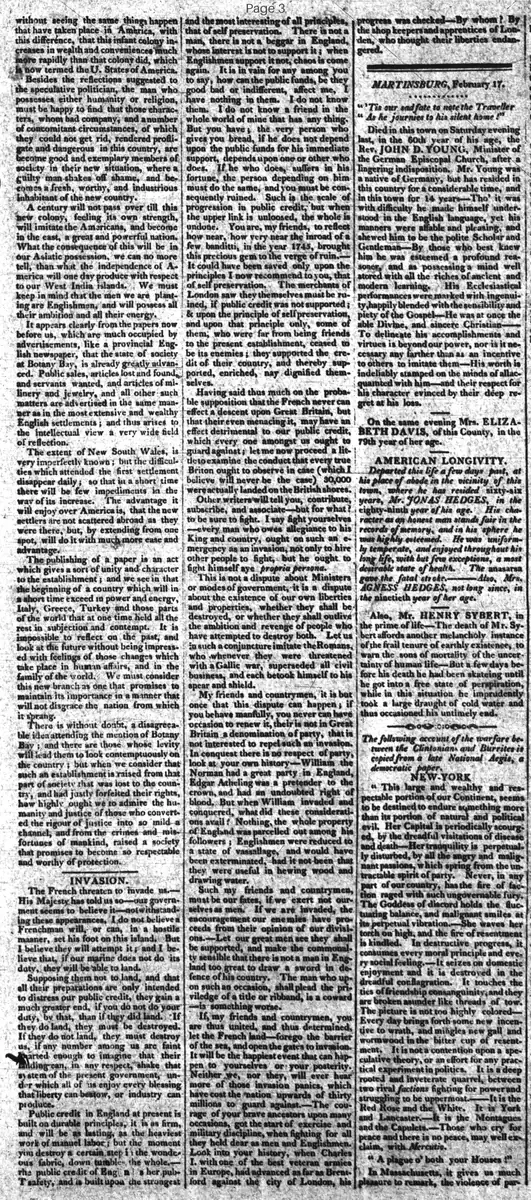
INVASION
The French threaten to invade us. His Majesty has told us so—our government seems to believe it—notwithstanding these appearances, I do not believe a Frenchman will, or can, in a hostile manner, set his foot on this island. But I believe they will attempt it; and I believe that, if our marine does not do its duty, they will be able to land.
Supposing them not to land and that all their preparations are only intended to distress our public credit, they gain a much greater end, if you do not do your duty, by that, than if they did land. If they do land, they must be destroyed. If they do not land, they must destroy us, if any number among us are faint hearted enough to imagine that their embargo can, in any respect, shake that system of the present government, under which all of us enjoy every blessing that liberty can bestow, or industry can produce.
Public credit in England at present is built on durable principles, it is as firm, and will be as lasting, as the heaviest work of manual labour; but the moment you destroy a certain step in the wondrous fabric, down tumbles the whole. The public credit of Britain is her public safety, and is built upon the strongest and the most interesting of all principles, that of self preservation. There is not a man, there is not a beggar in England, whose interest is not to support it; when Englishmen support it not chaos is come again. It is in vain for any among you to say, how can the public funds, be they good bad or indifferent, affect me. I have nothing in them. I do not know them. I do not know a friend in the whole world of mine that has any thing. But you have; the very person who gives you bread, if he does not depend upon the public funds for his immediate support, depends upon one or other who does. If he who does, suffers in his fortune the person depending on him must do the same, and you must be consequently ruined. Such is the scale of progression in public credit, but when the upper link is unloosed, the whole is undone. You are, my friends, to reflect how near how very near the inroad of a few banditti, in the year 1745, brought this precious gem to the verge of ruin. It could have been saved only upon the principles I now recommend to you, that of self preservation. The merchants of London saw they themselves must be ruined if public credit was not supported; and upon the principle of self preservation, and upon that principle only, some of them, who were far from being friends to the present establishment, ceased to be its enemies; they supported the credit of their country, and thereby supported, enriched, nay dignified themselves.
Having said thus much on the probable supposition that the French never can effect a descent upon Great Britain, but that their even menacing it, may have an effect detrimental to our public credit, which every one amongst us ought to guard against: let me now proceed a little to examine the conduct that every true Briton ought to observe in case (which I believe will never be the case) 30,000 were actually landed on the British shores. Other writers will tell you, contribute, subscribe, and associate—but for what? to be sure to fight. I say fight yourselves—every man who owes allegiance to his King and country, ought on such an emergency as an invasion, not only to hire other people to fight, but he ought to fight himself in proper person.
This is not a dispute about Ministers or modes of government, it is a dispute about the existence of our own liberties and properties, whether they shall be destroyed, or whether they shall outlive the ambition and revenge of people who have attempted to destroy both. Let us in such a conjuncture imitate the Romans, who whenever they were threatened with a Gallic war superseded all civil business, and each betook himself to his spear and shield.
My friends and countrymen, it is but once that this dispute can happen; if you behave manfully, you never can have occasion to renew it, there is not in Great Britain a denomination of party, that is not interested to repel such an invasion. In conquest there is no respect of party. Look at your own history—William the Norman had a great party in England, Edgar Atheling was a pretender to the crown, and had an undoubted right of blood. But when William invaded and conquered, what did these considerations avail? Nothing, the whole property of England was parcelled out among his followers; Englishmen were reduced to a state of vassalage and would have been exterminated—had it not been that they were useful in hewing wood and drawing water.
Such my friends and countrymen must be our fates, if we exert not ourselves as men. If we are invaded, the encouragement our enemies have proceeds from their opinion of our divisions. Let our great men see they shall be supported, and make the commonality sensible that there is not a man in England too great to draw a sword in defence of his country. The man who upon such an occasion, shall plead the privilege of a title or ribband, is a coward—is something worse.
If my friends and countrymen, you are thus united, and thus determined let the French land forego the barrier of the sea, and open the gates to invasion. It will be the happiest event that can happen to yourselves or, your posterity. Neither we nor they will ever hear more of those invasion panics, which have cost the nation upwards of thirty millions to guard against. The courage of your brave ancestors upon many occasions, got the start of exercise and military discipline, when fighting for all they held dear as men and Englishmen. Look into your history, when Charles I. with one of the best veteran armies in Europe, had advanced as far as Brentford against the city of London, his progress was checked By whom? By the shop keepers and apprentices of London, who thought their liberties endangered.
The French threaten to invade us. His Majesty has told us so—our government seems to believe it—notwithstanding these appearances, I do not believe a Frenchman will, or can, in a hostile manner, set his foot on this island. But I believe they will attempt it; and I believe that, if our marine does not do its duty, they will be able to land.
Supposing them not to land and that all their preparations are only intended to distress our public credit, they gain a much greater end, if you do not do your duty, by that, than if they did land. If they do land, they must be destroyed. If they do not land, they must destroy us, if any number among us are faint hearted enough to imagine that their embargo can, in any respect, shake that system of the present government, under which all of us enjoy every blessing that liberty can bestow, or industry can produce.
Public credit in England at present is built on durable principles, it is as firm, and will be as lasting, as the heaviest work of manual labour; but the moment you destroy a certain step in the wondrous fabric, down tumbles the whole. The public credit of Britain is her public safety, and is built upon the strongest and the most interesting of all principles, that of self preservation. There is not a man, there is not a beggar in England, whose interest is not to support it; when Englishmen support it not chaos is come again. It is in vain for any among you to say, how can the public funds, be they good bad or indifferent, affect me. I have nothing in them. I do not know them. I do not know a friend in the whole world of mine that has any thing. But you have; the very person who gives you bread, if he does not depend upon the public funds for his immediate support, depends upon one or other who does. If he who does, suffers in his fortune the person depending on him must do the same, and you must be consequently ruined. Such is the scale of progression in public credit, but when the upper link is unloosed, the whole is undone. You are, my friends, to reflect how near how very near the inroad of a few banditti, in the year 1745, brought this precious gem to the verge of ruin. It could have been saved only upon the principles I now recommend to you, that of self preservation. The merchants of London saw they themselves must be ruined if public credit was not supported; and upon the principle of self preservation, and upon that principle only, some of them, who were far from being friends to the present establishment, ceased to be its enemies; they supported the credit of their country, and thereby supported, enriched, nay dignified themselves.
Having said thus much on the probable supposition that the French never can effect a descent upon Great Britain, but that their even menacing it, may have an effect detrimental to our public credit, which every one amongst us ought to guard against: let me now proceed a little to examine the conduct that every true Briton ought to observe in case (which I believe will never be the case) 30,000 were actually landed on the British shores. Other writers will tell you, contribute, subscribe, and associate—but for what? to be sure to fight. I say fight yourselves—every man who owes allegiance to his King and country, ought on such an emergency as an invasion, not only to hire other people to fight, but he ought to fight himself in proper person.
This is not a dispute about Ministers or modes of government, it is a dispute about the existence of our own liberties and properties, whether they shall be destroyed, or whether they shall outlive the ambition and revenge of people who have attempted to destroy both. Let us in such a conjuncture imitate the Romans, who whenever they were threatened with a Gallic war superseded all civil business, and each betook himself to his spear and shield.
My friends and countrymen, it is but once that this dispute can happen; if you behave manfully, you never can have occasion to renew it, there is not in Great Britain a denomination of party, that is not interested to repel such an invasion. In conquest there is no respect of party. Look at your own history—William the Norman had a great party in England, Edgar Atheling was a pretender to the crown, and had an undoubted right of blood. But when William invaded and conquered, what did these considerations avail? Nothing, the whole property of England was parcelled out among his followers; Englishmen were reduced to a state of vassalage and would have been exterminated—had it not been that they were useful in hewing wood and drawing water.
Such my friends and countrymen must be our fates, if we exert not ourselves as men. If we are invaded, the encouragement our enemies have proceeds from their opinion of our divisions. Let our great men see they shall be supported, and make the commonality sensible that there is not a man in England too great to draw a sword in defence of his country. The man who upon such an occasion, shall plead the privilege of a title or ribband, is a coward—is something worse.
If my friends and countrymen, you are thus united, and thus determined let the French land forego the barrier of the sea, and open the gates to invasion. It will be the happiest event that can happen to yourselves or, your posterity. Neither we nor they will ever hear more of those invasion panics, which have cost the nation upwards of thirty millions to guard against. The courage of your brave ancestors upon many occasions, got the start of exercise and military discipline, when fighting for all they held dear as men and Englishmen. Look into your history, when Charles I. with one of the best veteran armies in Europe, had advanced as far as Brentford against the city of London, his progress was checked By whom? By the shop keepers and apprentices of London, who thought their liberties endangered.
What sub-type of article is it?
War Or Peace
Foreign Affairs
Military Affairs
What keywords are associated?
French Invasion
Public Credit
British Defense
National Unity
Self Preservation
Personal Duty
Historical Examples
What entities or persons were involved?
French
His Majesty
Government
Merchants Of London
Romans
William The Norman
Edgar Atheling
Charles I
Editorial Details
Primary Topic
Defense Against French Invasion Threat
Stance / Tone
Patriotic Exhortation To Unity And Vigilance
Key Figures
French
His Majesty
Government
Merchants Of London
Romans
William The Norman
Edgar Atheling
Charles I
Key Arguments
French Threat To Invade Unlikely But Possible If Marine Fails
Threat To Public Credit More Damaging Than Landing
Public Credit Essential For National Safety And Self Preservation
Every Briton Must Fight Personally In Invasion
Unity Across Parties To Repel Invaders
Historical Examples Show Conquest Disregards Parties
Courage Of Ancestors Can Overcome Invasion Without Formal Military