Thank you for visiting SNEWPapers!
Sign up free
Editorial
March 31, 1849
Columbus Democrat
Columbus, Lowndes County, Mississippi
What is this article about?
This editorial critiques the portrayal of General Taylor as a 'second Washington,' contrasting their military backgrounds, presidencies, and characters, arguing the comparison is a failure and profanation.
Clipping
OCR Quality
95%
Excellent
Full Text
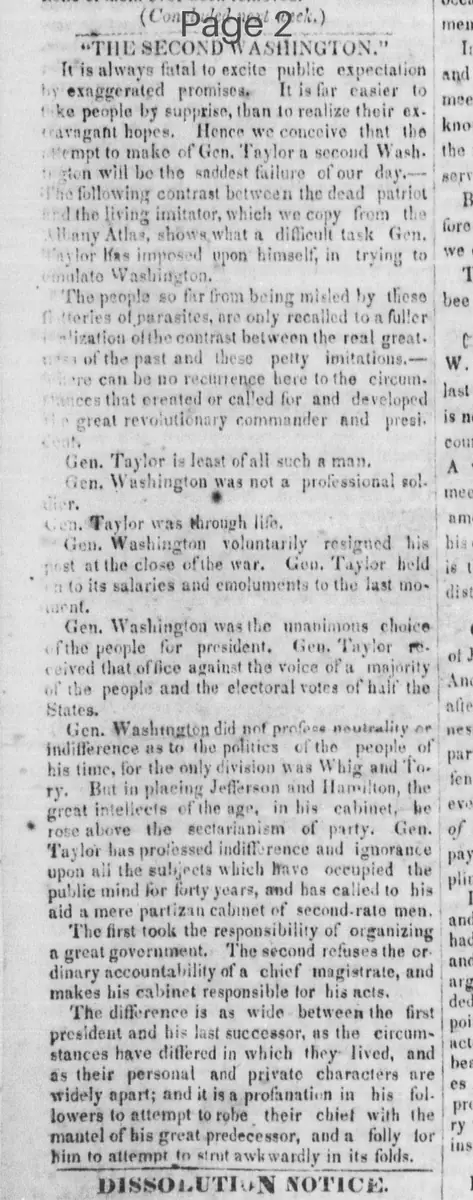
"THE SECOND WASHINGTON."
It is always fatal to excite public expectation by exaggerated promises. It is far easier to keep people by surprise, than to realize their extravagant hopes. Hence we conceive that the attempt to make of Gen. Taylor a second Washington will be the saddest failure of our day.
The following contrast between the dead patriot and the living imitator, which we copy from the Lady's Atlas, shows what a difficult task Gen. Taylor has imposed upon himself, in trying to emulate Washington.
The people so far from being misled by these flatteries of parasites, are only recalled to a fuller realization of the contrast between the real greatness of the past and these petty imitations.
There can be no recurrence here to the circumstances that created or called for and developed a great revolutionary commander and president. Gen. Taylor is least of all such a man.
Gen. Washington was not a professional soldier.
Gen. Taylor was through life.
Gen. Washington voluntarily resigned his post at the close of the war. Gen. Taylor held on to its salaries and emoluments to the last moment.
Gen. Washington was the unanimous choice of the people for president. Gen. Taylor received that office against the voice of a majority of the people and the electoral votes of half the States.
Gen. Washington did not profess neutrality or indifference as to the politics of the people of his time, for the only division was Whig and Tory. But in placing Jefferson and Hamilton, the great intellects of the age, in his cabinet, he rose above the sectarianism of party. Gen. Taylor has professed indifference and ignorance upon all the subjects which have occupied the public mind for forty years, and has called to his aid a mere partizan cabinet of second-rate men.
The first took the responsibility of organizing a great government. The second refuses the ordinary accountability of a chief magistrate, and makes his cabinet responsible for his acts.
The difference is as wide between the first president and his last successor, as the circumstances have differed in which they lived, and as their personal and private characters are widely apart; and it is a profanation in his followers to attempt to robe their chief with the mantle of his great predecessor, and a folly for him to attempt to strut awkwardly in its folds.
It is always fatal to excite public expectation by exaggerated promises. It is far easier to keep people by surprise, than to realize their extravagant hopes. Hence we conceive that the attempt to make of Gen. Taylor a second Washington will be the saddest failure of our day.
The following contrast between the dead patriot and the living imitator, which we copy from the Lady's Atlas, shows what a difficult task Gen. Taylor has imposed upon himself, in trying to emulate Washington.
The people so far from being misled by these flatteries of parasites, are only recalled to a fuller realization of the contrast between the real greatness of the past and these petty imitations.
There can be no recurrence here to the circumstances that created or called for and developed a great revolutionary commander and president. Gen. Taylor is least of all such a man.
Gen. Washington was not a professional soldier.
Gen. Taylor was through life.
Gen. Washington voluntarily resigned his post at the close of the war. Gen. Taylor held on to its salaries and emoluments to the last moment.
Gen. Washington was the unanimous choice of the people for president. Gen. Taylor received that office against the voice of a majority of the people and the electoral votes of half the States.
Gen. Washington did not profess neutrality or indifference as to the politics of the people of his time, for the only division was Whig and Tory. But in placing Jefferson and Hamilton, the great intellects of the age, in his cabinet, he rose above the sectarianism of party. Gen. Taylor has professed indifference and ignorance upon all the subjects which have occupied the public mind for forty years, and has called to his aid a mere partizan cabinet of second-rate men.
The first took the responsibility of organizing a great government. The second refuses the ordinary accountability of a chief magistrate, and makes his cabinet responsible for his acts.
The difference is as wide between the first president and his last successor, as the circumstances have differed in which they lived, and as their personal and private characters are widely apart; and it is a profanation in his followers to attempt to robe their chief with the mantle of his great predecessor, and a folly for him to attempt to strut awkwardly in its folds.
What sub-type of article is it?
Partisan Politics
What keywords are associated?
Gen Taylor
Gen Washington
Presidential Comparison
Political Criticism
Whig Party
Cabinet Choices
What entities or persons were involved?
Gen. Washington
Gen. Taylor
Jefferson
Hamilton
Editorial Details
Primary Topic
Critique Of Comparing Gen. Taylor To Washington
Stance / Tone
Critical Of Gen. Taylor And His Supporters
Key Figures
Gen. Washington
Gen. Taylor
Jefferson
Hamilton
Key Arguments
Attempt To Make Gen. Taylor A Second Washington Is A Failure
Washington Was Not A Professional Soldier, Unlike Taylor
Washington Resigned Post Voluntarily, Taylor Clung To Salary
Washington Unanimously Elected, Taylor Against Majority
Washington Rose Above Party By Choosing Jefferson And Hamilton, Taylor Indifferent And Chose Partisan Cabinet
Washington Took Responsibility, Taylor Shifts To Cabinet
Comparison Profanes Washington's Legacy