Thank you for visiting SNEWPapers!
Sign up free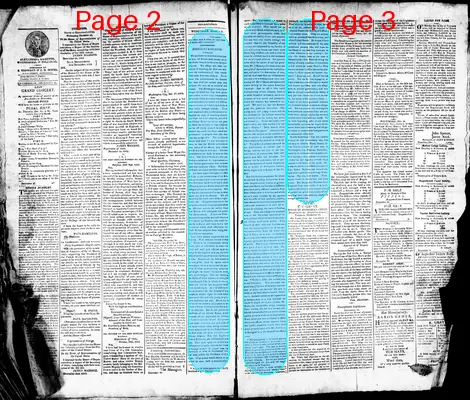
Alexandria Gazette, Commercial And Political
Alexandria, Virginia
What is this article about?
This editorial, continuing commentary on the President's message, criticizes U.S. war policy against Britain over impressment of seamen, urging a law to bar British subjects from American ships. It decries foreign immigrants as disruptive influences in politics and society, advocating native population growth and leadership by native-born figures like Washington over Madison's favoritism toward foreigners.
Merged-components note: Continuation of the editorial on the President's message and foreign influence across pages; text explicitly indicates 'To be continued.'
Clippings

1 of 2
OCR Quality
Full Text
"TO SHEW
THE VERY AGE & BODY OF THE TIME
HIS FORM AND PRESSURE."
PRESIDENT'S MESSAGE.
Continued.
We proclaim our intention to continue the war, till Britain shall consent not to search our vessels on the ocean for their subjects.
We allege that under the pretext of searching for their own subjects the commanders of their vessels often seize American citizens. To remove this inconvenience we demand that they shall not reclaim their own subjects who may be on board of our vessels. The British government have always declared that they have given their orders to their naval commanders not to take native American citizens, and have expressed a readiness and willingness to release, on demand, such as have been taken through mistake. They have expressed also, a willingness to relinquish the right of searching American ships for their subjects, provided the United States can invent any plan by which the services of their subjects can be effectually secured to them in another way-and they have asked our government to prepare their plan that they may judge of it. Till the United States shall state the plan they have in view, so that the British government may judge of its efficacy they refuse to take any step on their part. The two governments are fairly at issue on this point. The United States say they can furnish a substitute for impressment.- The British government wish to know what that substitute will be. The United States are bound therefore to specify it. Let them digest their plan and offer it fairly to the consideration of the British government, and to our own people.
The President has declared that it shall effectually prevent British subjects from being employed in our navigation. But he has not condescended to say in what mode this shall be effected. We all know that the mode must be by a legislative act. Congress must act on the subject-and until congress shall adopt an effectual system, we cannot hope that Britain will relinquish the power that she possesses. If then the President and Congress be sincerely desirous of a speedy pacification, they ought instantly to digest and enact into a law provisions which shall effectually exclude British subjects from being employed in our navigation.
First then, justice requires this act from us Next. does our interest forbid it ? There is no circumstance which would give an individual so much of violence and such just offence as an attempt in his neighbor to decoy his children or his servants from their obedience to him. Nations are not less sensitive on this point. And the nation which attempts to decoy to its banner the subjects of other governments, deserves and ought to expect resistance from such governments. This act violating the rights of other nations, is wrongful in itself-and folly is added to wrong, when the violator has not power sufficient to enforce it. As it is dishonorable, so it cannot be the interest of any people to violate right, for such violations never fail, and very justly, to produce retaliation and war. Above all, it cannot be the interest of a nation to attempt a wrong which it has not the power to maintain. But in the particular condition of the United States. is the increase of our population by foreign emigration necessary to us? Emigrants from other countries are generally of the most restless class, hating restraint every where-and in the United States we find them the most turbulent and riotous citizens. The late flagitious riots at Baltimore, are evidences of this fact. This stain upon our nation was inflicted, not by native citizens, but those of foreign birth. It cannot then be necessary or wise to incorporate into our body politic, the feculence of Europe. Wise policy would dictate to us rather to shun such a contaminating
*A part of these persons have lately mutinied in gen. Smyth's camp
Union. But why should we resort to such expedients to increase the number of our citizens? Why should we resort to expedients which are sure to offend other governments, while they blemish the purity of our own systems? Let any man who travels through our country observe the fecundity of our women, not surpassed by the fertility of our soil; every house, nay every cabin filled with children—on such a view he must be satisfied that it is not necessary for us to import citizens. Let government adopt the advice of our late president, Mr. Jefferson,—let them direct the energies of the nation to the multiplication, and not to the destruction of man, and we shall soon find our wildernesses peopled with a homogeneous race, possessing all the mildness and generosity which belong to the native American character. And to effect this rapid multiplication of our citizens, there is no other incentive necessary, but a continuance of that peace and prosperity which our country has heretofore enjoyed. We need not like the Romans grant the jus trium liberorum. Our young men and young women will do this business for us without receiving any bounty from the nation, but peace and commerce. Is our navigation profitable—why not then confine it to our native citizens? Why bestow these benefits on foreigners? Above all, why involve the natives in the calamities of war, to secure to foreigners privileges which ought to be confined to them only? The policy at present pursued by our government, is neither just to foreign nations, nor just to our own country—it is incompatible both with justice and with our interests. The present war is undertaken, not to promote the interests of native Americans, but to secure to foreigners, benefits which ought only to belong to the former.
But this foreign population for whom we are now fighting, is injurious in another respect—their notions of government and liberty are founded on different principles and a different practice, from those which exist in America, and which are as it were imbibed by our natives with the milk of their mothers—coming from monarchical governments generally—they are accustomed to view all restraint as violating the natural freedom of man. They are indisposed to submit even to the wholesome restraint of the laws, without which no society can exist, and liberty itself must perish. They disturb by their wild and factious conduct the happy equilibrium of our governments—they keep the states and United States in a state of continual fluctuation and change—they permit no regular, systematic & permanent course of action. This foreign influence is felt in a great degree in every state. For every where foreigners are the most active politicians—they besiege our public offices—they occupy a very great portion of our commerce, navigation & manufactures—but above all, they have usurped the press—these powerful machines to move & direct public opinion. They have acquired visibly an undue influence over even our rulers at Washington. Gallatin holds the second post to our President. The new made citizen Colvin* is one of the under secretaries of state, and employs his pen to write at the beck of government whatever is deemed necessary ad captandum vulgus. And in a late instance, we ought to acquit our native citizen, Mr. Rush, the comptroller of the treasury, from lending his aid to a certain celebrated communication—a native citizen cannot stoop to such venal employment. If any other pen was necessary to assist the brave officer whose name it bears, the public suspicion would have been more properly pointed to Mr. Colvin.—A foreigner is at the head of the official press—he has become the herald of the President he is entrusted with the secrets of the cabinet—Why need we mention Duane; the favorite of Jefferson—et multos alios. They are strewed thick as autumnal leaves in every part of the United States. By means of their activity and the command of the most prominent presses, who will have the hardihood to say that they have not an undue influence in our country? Let him who doubts look at the state of Pennsylvania—See Binns directing the destiny of nearly a million of inhabitants—Ask where he came from? Who knows his birth?—Who knows his education? Who knows his former character? None can tell. But all feel his power. Did we for this engage in an eight years war—that foreigners should lord it over us—Men who owe allegiance to another government, and who may be obliged to perform its duties, if they put their heads out of our territory, the castle which protects them.—Shame to the native genius of America that it should submit to such an usurpation. But not content with drawing the most precious nutriment from our soil these exotic plants require that we shall nurture their roots with our blood. To fix their degrading yoke on our necks interminable war must be waged by the native American citizens against the government to which these foreigners owe an unalienable allegiance.
Native Americans! Can you consent to carry on this unnecessary war, that you may be ruled by Binns, Duane, Irvine, Gales—instead of such men as Washington, Jay, Pinckney, Marshall—whose birth we know—whose great services have been felt—whose virtues shed a lustre on our country—whose fame extends to the limits of the earth. But it may be asked, is not Madison a native? Yes: James Madison was born in the state which gave birth to George Washington. But alas, how unlike. Washington loved his native land, and loved it only. But whom does Madison love? Fugitives from other lands, bask in his smiles—He trusts to this unnatural band to uphold his power—as tyrants of old, dreading their own subjects, employed foreign mercenaries.
To be continued.
What sub-type of article is it?
What keywords are associated?
What entities or persons were involved?
Editorial Details
Primary Topic
Critique Of Continuing War Over Impressment And Foreign Population Influence
Stance / Tone
Strongly Anti War And Nativist
Key Figures
Key Arguments