Thank you for visiting SNEWPapers!
Sign up free
Letter to Editor
August 8, 1815
Daily National Intelligencer
Washington, District Of Columbia
What is this article about?
A letter responding to 'Zeno' argues against the proliferation of banks without solid capital like gold, silver, or stocks, claiming it depletes specie reserves, causes depreciation of notes, and harms society, while supporting well-capitalized banks.
Clipping
OCR Quality
95%
Excellent
Full Text
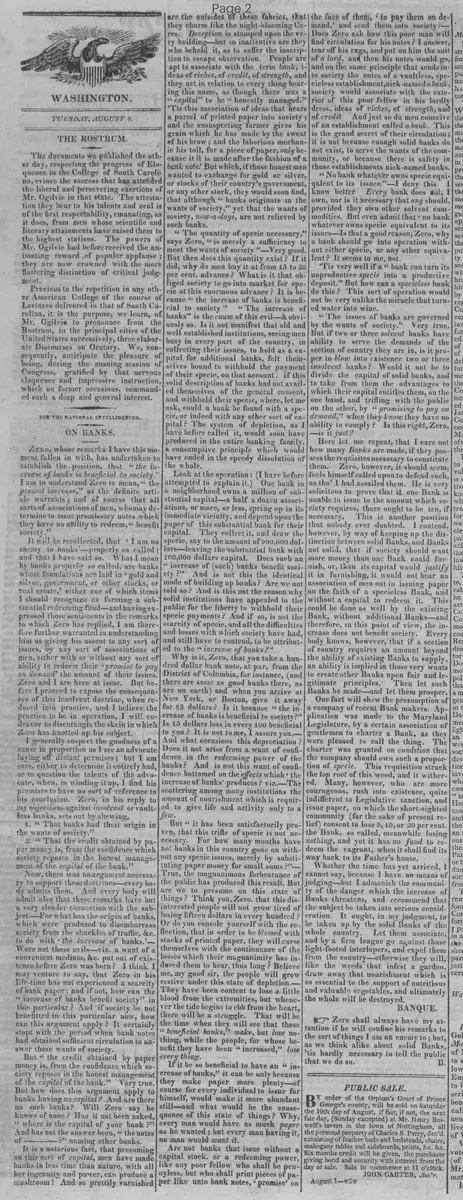
FOR THE NATIONAL INTELLIGENCER.
ON BANKS.
Zeno, whose remarks I have this moment fallen in with, has undertaken to establish the position, that "the increase of banks is beneficial to society." I am to understand Zeno to mean, "the present increase," as the definite article warrants; and of course that all sorts of associations of men, who may determine to issue promissory notes which they have no ability to redeem, "benefit society."
It will be recollected, that I am no enemy to banks--properly so called; and that I have said so. What I mean by banks properly so called, are banks whose foundations are laid in gold and silver, government, or other stocks, or real estate, either one of which items I should recognize as forming a substantial redeeming fund--and having expressed those sentiments in the remarks to which Zeno has replied, I am therefore further warranted in understanding him as giving his assent to any sort of issues, by any sort of associations of men, either with or without any sort of ability to redeem their "promise to pay on demand" the amount of their issues.
Zeno and I are here at issue. But before I proceed to expose the consequences of this insolvent doctrine, when reduced into practice, and I believe the practice to be in operation, I will endeavor to disentangle the skein in which Zeno has knotted up his subject.
I generally suspect the goodness of a cause in proportion as I see an advocate laying off distant premises; but I am sure, either to determine it entirely bad, or to question the talents of the advocate, when, in winding it up, I find his premises to have no sort of reference to his conclusion. Zeno, in his reply to my objections against insolvent or vaultless banks, sets out by shewing,
1. "That banks had their origin in the wants of society."
2. "That the credit obtained by paper money is, from the confidence which society reposes in the honest management of the capital of the bank."
Now, there was no argument necessary to support these doctrines--every body admits them. And every body will admit also that these remarks have but a very slender connection with the subject.--For what has the origin of banks, which were produced to disembarrass society from the shackles of traffic, &c. to do with 'the increase of banks.' Were not those evils--viz. a want of a convenient medium, &c. put out of existence before Zeno was born? I think I may venture to say, that Zeno in his life-time has not experienced a scarcity of bank paper: and if not, how can the "increase of banks benefit society" in this particular? And if society be not benefitted in this particular now, how can this argument apply? It certainly stopt with the period when bank notes had obtained sufficient circulation to answer these wants of society.
But "the credit obtained by paper money is, from the confidence which society reposes in the honest management of the capital of the bank." Very true. But how does this argument apply to banks having no capital? And are there no such banks? Will Zeno say he knows of none? Has it not been asked. "where is the capital of your bank?" And has not the answer been, "the notes of ----p" naming other banks.
It is a notorious fact, that presuming on this sort of capital, men have made banks in less time than nature, with all her ingenuity and power, can produce a mushroom! And so prettily varnished
are the outsides of these fabrics, that they charm like the night-blooming Cereus. Deception is stamped upon the very building--but so inattentive are they who behold it, as to suffer the inscription to escape observation. People are apt to associate with the term bank, ideas of riches, of credit, of strength, and they act in relation to every thing bearing this name, as though there was a "capital" to be "honestly managed."
It is this association of ideas that bears a parcel of printed paper into society; and the unsuspecting farmer gives his grain which he has made by the sweat of his brow; and the laborious mechanic his toil, for a piece of paper, only because it is made after the fashion of a bank note! But which, if those honest men wanted to exchange for gold or silver, or stocks of their country's government, or any other stock, they would soon find, that although "banks originate in the wants of society," yet that the wants of society, now-a-days, are not relieved by such banks.
"The quantity of specie necessary," says Zeno, "is merely a sufficiency to meet the wants of society"--Very good. But then does this quantity exist? If it did, why do men buy it at from 15 to 20 per cent. advance? What is it that obliged society to go into market for specie at this enormous advance? It is because "the increase of banks is beneficial to society" "The increase of banks" is the cause of this evil & obviously so. Is it not manifest that old and well established institutions, seeing men busy in every part of the country, in collecting their issues, to hold as a capital for additional banks, felt themselves bound to withhold the payment of their specie, on that account. if this solid description of banks had not availed themselves of the general consent, and withheld their specie, where, let me ask, could a bank be found with a specie, or indeed with any other sort of capital? The system of depletion, as I have before called it, would soon have produced in the entire banking family, a consumptive principle which would have ended in the speedy dissolution of the whole.
Look at the operation: (I have before attempted to explain it.) One bank in a neighborhood owns a million of substantial capital--a half a dozen associations, or more, or less, spring up in its immediate vicinity, and depend upon the paper of this substantial bank for their capital. They collect it, and draw the specie, say to the amount of 900,000 dollars--leaving the substantial bank with 100,000 dollars capital. Does such an "increase of (such) banks benefit society?" And is not this the identical mode of building up banks? Are we not told so? And is this not the reason why solid institutions have appealed to the public for the liberty to withhold their specie payments? And if so, is not the scarcity of specie, and all the difficulties and losses with which society have had, and still have to contend, to be attributed to the "increase of banks?"
Why is it, Zeno, that you take a hundred dollar bank note, at par, from the District of Columbia, for instance, (and there are some as good banks there, as are on earth) and when you arrive at New York, or Boston, give it away for 85 dollars? Is it because "the increase of banks is beneficial to society?" Is 15 dollars loss in every 100 beneficial to you? It is not to me, I assure you.-- And what occasions this depreciation? Does it not arise from a want of confidence in the redeeming power of the banks? And is not this want of confidence bottomed on the effects which 'the increase of banks' produces? viz.--The scattering among many institutions the amount of nourishment which is required to give life and activity only to a few.
But "it has been satisfactorily proved, that this trifle of specie is not necessary. For how many months have not banks in this country gone on without any specie issues, merely by substituting paper money for small sums?" True, the magnanimous forbearance of the public has produced this result. But are we to presume on this state of things? Think you, Zeno, that this disinterested people will not grow tired of losing fifteen dollars in every hundred? Or do you console yourself with the reflection, that in order to be blessed with stacks of printed paper, they will curse themselves with the continuance of the losses which their magnanimity has induced them to bear, thus long? Believe me, my good sir, the people will grow restive under this state of depletion.-- They have been content to lose a little blood from the extremities, but whenever the tide begins to ebb from the heart, there will be a struggle. That will be the time when they will see that these "beneficial banks," make, but lose nothing, while the people, for whose benefit they have been "increased," lose every thing.
If it be so beneficial to have an "increase of banks," it can be only because they make paper more plenty--of course for every individual to issue for himself, would make it more abundant still--and what would be the consequence of this state of things? Why, every man would have as much paper as he wanted; but every man having it, no man would want it.
Are not banks that issue without a capital stock, or a redeeming power, like any poor fellow who shall be pennyless, but who shall print pieces of paper like unto bank notes, 'promise on
the face of them, to pay them on demand,' and send them into society-- Does Zeno ask how this poor man will find circulation for his notes? I answer tear off his rags, and put on him the suit of a lord. and then his notes would go. and on the same principle that sends into society the notes of a vaultless, spe-ciceless establishment, nick-named a bank. society would associate with the exterior of this poor fellow in his lordly dress, ideas of riches, of strength, and of credit And just so do men conceive of an establishment called a bank. This is the grand secret of their circulation: it is not because enough solid banks do not exist, to serve the wants of the community, or because there is safety in those establishments nick-named banks.
"No bank whatever owns specie equivalent to its issues." I deny this. I know better Every bank does own, nor is it necessary that any should. provided they own other solvent commodities. But even admit that 'no bank whatever owns specie equivalent to its issues--Is that a good reason, Zeno, why a bank should go into operation without either specie, or any other equivalent? It seems to me, not.
Tis very well if a "bank can turn its unproductive specie into a productive deposit." But how can a specieless bank do this? This sort of operation would not be very unlike the miracle that turned water into wine.
"The issues of banks are governed by the wants of society." Very true. But if two or three solvent banks have ability to serve the demands of the section of country they are in, is it proper to blow into existence two or three insolvent banks? Would it not be to divide the capital of solid banks, and to take from them the advantages to which their capital entitles them, on the one hand, and trifling with the public on the other, by "promising to pay on demand," when they know they have no ability to comply? Is this right, Zeno. -is it just?
Here let me repeat, that I care not how many Banks are made, if they possess the requisites necessary to constitute them. Zeno, however, it should seem. feels himself called upon to defend such, as tho' I had assailed them. He is very solicitous to prove that if one Bank is unable to issue to the amount which society requires, there ought to be ten, if necessary. This is another position that nobody ever doubted. I contend. however, by way of keeping up the distinction between solid Banks, and Banks not solid, that if society should want more money than one Bank could furnish, or, than its capital would justify it in furnishing, it would not bear an association of men out in issuing paper on the faith of a specieless Bank, and without a capital to redeem it. This could be done as well by the existing Bank, without additional Banks--and therefore, in this point of view, the increase does not benefit society. Every body knows, however, that if a section of country requires an amount beyond the ability of existing Banks to supply, an ability is implied in those very wants to create other Banks upon fair and legitimate principles. Then let such Banks be made and let them prosper.
One fact will shew the presumption of a company of recent Bank makers. Application was made to the Maryland Legislature, by a certain association of gentlemen to charter a Bank, as they were pleased to call the thing. The charter was granted on condition that the company should own such a proportion of specie. This requisition struck the top root of this weed, and it withered. Many, however, who are more courageous, rush into existence, quite indifferent to Legislative sanction, and issue paper, on which the short-sighted community (for the sake of present relief) consent to lose 5, 10, or 20 per cent. the Bank, so called, meanwhile losing nothing, and yet it has no fund to redeem the vagrant, when it shall find its way back to its Father's house.
Whether the time has yet arrived, I cannot say, because I have no means of judging--but I admonish the community of the danger which the increase of Banks threatens, and recommend that the subject be taken into serious consideration. It ought, in my judgment, to be taken up by the solid Banks of the whole country. Let them associate, and by a firm league go against those light-footed interlopers, and expel them from the country--otherwise they will, like the weeds that infest a garden. draw away that nourishment which is so essential to the support of nutritious and valuable vegetables, and ultimately the whole will be destroyed.
BANQUE.
Zeno shall always have my attention if he will confine his remarks to the sort of things I am an enemy to; but, as we think alike about solid Banks, 'tis hardly necessary to tell the public that we do so.
B.
ON BANKS.
Zeno, whose remarks I have this moment fallen in with, has undertaken to establish the position, that "the increase of banks is beneficial to society." I am to understand Zeno to mean, "the present increase," as the definite article warrants; and of course that all sorts of associations of men, who may determine to issue promissory notes which they have no ability to redeem, "benefit society."
It will be recollected, that I am no enemy to banks--properly so called; and that I have said so. What I mean by banks properly so called, are banks whose foundations are laid in gold and silver, government, or other stocks, or real estate, either one of which items I should recognize as forming a substantial redeeming fund--and having expressed those sentiments in the remarks to which Zeno has replied, I am therefore further warranted in understanding him as giving his assent to any sort of issues, by any sort of associations of men, either with or without any sort of ability to redeem their "promise to pay on demand" the amount of their issues.
Zeno and I are here at issue. But before I proceed to expose the consequences of this insolvent doctrine, when reduced into practice, and I believe the practice to be in operation, I will endeavor to disentangle the skein in which Zeno has knotted up his subject.
I generally suspect the goodness of a cause in proportion as I see an advocate laying off distant premises; but I am sure, either to determine it entirely bad, or to question the talents of the advocate, when, in winding it up, I find his premises to have no sort of reference to his conclusion. Zeno, in his reply to my objections against insolvent or vaultless banks, sets out by shewing,
1. "That banks had their origin in the wants of society."
2. "That the credit obtained by paper money is, from the confidence which society reposes in the honest management of the capital of the bank."
Now, there was no argument necessary to support these doctrines--every body admits them. And every body will admit also that these remarks have but a very slender connection with the subject.--For what has the origin of banks, which were produced to disembarrass society from the shackles of traffic, &c. to do with 'the increase of banks.' Were not those evils--viz. a want of a convenient medium, &c. put out of existence before Zeno was born? I think I may venture to say, that Zeno in his life-time has not experienced a scarcity of bank paper: and if not, how can the "increase of banks benefit society" in this particular? And if society be not benefitted in this particular now, how can this argument apply? It certainly stopt with the period when bank notes had obtained sufficient circulation to answer these wants of society.
But "the credit obtained by paper money is, from the confidence which society reposes in the honest management of the capital of the bank." Very true. But how does this argument apply to banks having no capital? And are there no such banks? Will Zeno say he knows of none? Has it not been asked. "where is the capital of your bank?" And has not the answer been, "the notes of ----p" naming other banks.
It is a notorious fact, that presuming on this sort of capital, men have made banks in less time than nature, with all her ingenuity and power, can produce a mushroom! And so prettily varnished
are the outsides of these fabrics, that they charm like the night-blooming Cereus. Deception is stamped upon the very building--but so inattentive are they who behold it, as to suffer the inscription to escape observation. People are apt to associate with the term bank, ideas of riches, of credit, of strength, and they act in relation to every thing bearing this name, as though there was a "capital" to be "honestly managed."
It is this association of ideas that bears a parcel of printed paper into society; and the unsuspecting farmer gives his grain which he has made by the sweat of his brow; and the laborious mechanic his toil, for a piece of paper, only because it is made after the fashion of a bank note! But which, if those honest men wanted to exchange for gold or silver, or stocks of their country's government, or any other stock, they would soon find, that although "banks originate in the wants of society," yet that the wants of society, now-a-days, are not relieved by such banks.
"The quantity of specie necessary," says Zeno, "is merely a sufficiency to meet the wants of society"--Very good. But then does this quantity exist? If it did, why do men buy it at from 15 to 20 per cent. advance? What is it that obliged society to go into market for specie at this enormous advance? It is because "the increase of banks is beneficial to society" "The increase of banks" is the cause of this evil & obviously so. Is it not manifest that old and well established institutions, seeing men busy in every part of the country, in collecting their issues, to hold as a capital for additional banks, felt themselves bound to withhold the payment of their specie, on that account. if this solid description of banks had not availed themselves of the general consent, and withheld their specie, where, let me ask, could a bank be found with a specie, or indeed with any other sort of capital? The system of depletion, as I have before called it, would soon have produced in the entire banking family, a consumptive principle which would have ended in the speedy dissolution of the whole.
Look at the operation: (I have before attempted to explain it.) One bank in a neighborhood owns a million of substantial capital--a half a dozen associations, or more, or less, spring up in its immediate vicinity, and depend upon the paper of this substantial bank for their capital. They collect it, and draw the specie, say to the amount of 900,000 dollars--leaving the substantial bank with 100,000 dollars capital. Does such an "increase of (such) banks benefit society?" And is not this the identical mode of building up banks? Are we not told so? And is this not the reason why solid institutions have appealed to the public for the liberty to withhold their specie payments? And if so, is not the scarcity of specie, and all the difficulties and losses with which society have had, and still have to contend, to be attributed to the "increase of banks?"
Why is it, Zeno, that you take a hundred dollar bank note, at par, from the District of Columbia, for instance, (and there are some as good banks there, as are on earth) and when you arrive at New York, or Boston, give it away for 85 dollars? Is it because "the increase of banks is beneficial to society?" Is 15 dollars loss in every 100 beneficial to you? It is not to me, I assure you.-- And what occasions this depreciation? Does it not arise from a want of confidence in the redeeming power of the banks? And is not this want of confidence bottomed on the effects which 'the increase of banks' produces? viz.--The scattering among many institutions the amount of nourishment which is required to give life and activity only to a few.
But "it has been satisfactorily proved, that this trifle of specie is not necessary. For how many months have not banks in this country gone on without any specie issues, merely by substituting paper money for small sums?" True, the magnanimous forbearance of the public has produced this result. But are we to presume on this state of things? Think you, Zeno, that this disinterested people will not grow tired of losing fifteen dollars in every hundred? Or do you console yourself with the reflection, that in order to be blessed with stacks of printed paper, they will curse themselves with the continuance of the losses which their magnanimity has induced them to bear, thus long? Believe me, my good sir, the people will grow restive under this state of depletion.-- They have been content to lose a little blood from the extremities, but whenever the tide begins to ebb from the heart, there will be a struggle. That will be the time when they will see that these "beneficial banks," make, but lose nothing, while the people, for whose benefit they have been "increased," lose every thing.
If it be so beneficial to have an "increase of banks," it can be only because they make paper more plenty--of course for every individual to issue for himself, would make it more abundant still--and what would be the consequence of this state of things? Why, every man would have as much paper as he wanted; but every man having it, no man would want it.
Are not banks that issue without a capital stock, or a redeeming power, like any poor fellow who shall be pennyless, but who shall print pieces of paper like unto bank notes, 'promise on
the face of them, to pay them on demand,' and send them into society-- Does Zeno ask how this poor man will find circulation for his notes? I answer tear off his rags, and put on him the suit of a lord. and then his notes would go. and on the same principle that sends into society the notes of a vaultless, spe-ciceless establishment, nick-named a bank. society would associate with the exterior of this poor fellow in his lordly dress, ideas of riches, of strength, and of credit And just so do men conceive of an establishment called a bank. This is the grand secret of their circulation: it is not because enough solid banks do not exist, to serve the wants of the community, or because there is safety in those establishments nick-named banks.
"No bank whatever owns specie equivalent to its issues." I deny this. I know better Every bank does own, nor is it necessary that any should. provided they own other solvent commodities. But even admit that 'no bank whatever owns specie equivalent to its issues--Is that a good reason, Zeno, why a bank should go into operation without either specie, or any other equivalent? It seems to me, not.
Tis very well if a "bank can turn its unproductive specie into a productive deposit." But how can a specieless bank do this? This sort of operation would not be very unlike the miracle that turned water into wine.
"The issues of banks are governed by the wants of society." Very true. But if two or three solvent banks have ability to serve the demands of the section of country they are in, is it proper to blow into existence two or three insolvent banks? Would it not be to divide the capital of solid banks, and to take from them the advantages to which their capital entitles them, on the one hand, and trifling with the public on the other, by "promising to pay on demand," when they know they have no ability to comply? Is this right, Zeno. -is it just?
Here let me repeat, that I care not how many Banks are made, if they possess the requisites necessary to constitute them. Zeno, however, it should seem. feels himself called upon to defend such, as tho' I had assailed them. He is very solicitous to prove that if one Bank is unable to issue to the amount which society requires, there ought to be ten, if necessary. This is another position that nobody ever doubted. I contend. however, by way of keeping up the distinction between solid Banks, and Banks not solid, that if society should want more money than one Bank could furnish, or, than its capital would justify it in furnishing, it would not bear an association of men out in issuing paper on the faith of a specieless Bank, and without a capital to redeem it. This could be done as well by the existing Bank, without additional Banks--and therefore, in this point of view, the increase does not benefit society. Every body knows, however, that if a section of country requires an amount beyond the ability of existing Banks to supply, an ability is implied in those very wants to create other Banks upon fair and legitimate principles. Then let such Banks be made and let them prosper.
One fact will shew the presumption of a company of recent Bank makers. Application was made to the Maryland Legislature, by a certain association of gentlemen to charter a Bank, as they were pleased to call the thing. The charter was granted on condition that the company should own such a proportion of specie. This requisition struck the top root of this weed, and it withered. Many, however, who are more courageous, rush into existence, quite indifferent to Legislative sanction, and issue paper, on which the short-sighted community (for the sake of present relief) consent to lose 5, 10, or 20 per cent. the Bank, so called, meanwhile losing nothing, and yet it has no fund to redeem the vagrant, when it shall find its way back to its Father's house.
Whether the time has yet arrived, I cannot say, because I have no means of judging--but I admonish the community of the danger which the increase of Banks threatens, and recommend that the subject be taken into serious consideration. It ought, in my judgment, to be taken up by the solid Banks of the whole country. Let them associate, and by a firm league go against those light-footed interlopers, and expel them from the country--otherwise they will, like the weeds that infest a garden. draw away that nourishment which is so essential to the support of nutritious and valuable vegetables, and ultimately the whole will be destroyed.
BANQUE.
Zeno shall always have my attention if he will confine his remarks to the sort of things I am an enemy to; but, as we think alike about solid Banks, 'tis hardly necessary to tell the public that we do so.
B.
What sub-type of article is it?
Persuasive
Political
Informative
What themes does it cover?
Economic Policy
Commerce Trade
What keywords are associated?
Banks
Increase Of Banks
Capital
Specie
Paper Money
Insolvent Banks
Redemption
Depreciation
What entities or persons were involved?
B.
For The National Intelligencer
Letter to Editor Details
Author
B.
Recipient
For The National Intelligencer
Main Argument
the increase of banks without proper capital like gold, silver, stocks, or real estate is harmful to society, causing specie scarcity, note depreciation, and public losses, while well-capitalized banks are beneficial.
Notable Details
Responds To Zeno's Arguments On Bank Origins And Credit
Criticizes 'Vaultless' Or 'Specieless' Banks
References Maryland Legislature Charter Denial
Uses Metaphors Like Mushrooms, Night Blooming Cereus, Weeds In Garden