Thank you for visiting SNEWPapers!
Sign up free
The New Hampshire Gazette And Historical Chronicle
Portsmouth, Greenland, Rockingham County, New Hampshire
What is this article about?
A massive fire broke out on August 17, 1769, in St. John's, Antigua, destroying much of the town center, including homes, stores, the guard-house, arsenal, market-house, jail, and Custom-house. One man died from explosion injuries; total losses estimated at over 300,000 pounds sterling, leaving the prosperous colonial port in ruins.
Clipping
OCR Quality
Full Text
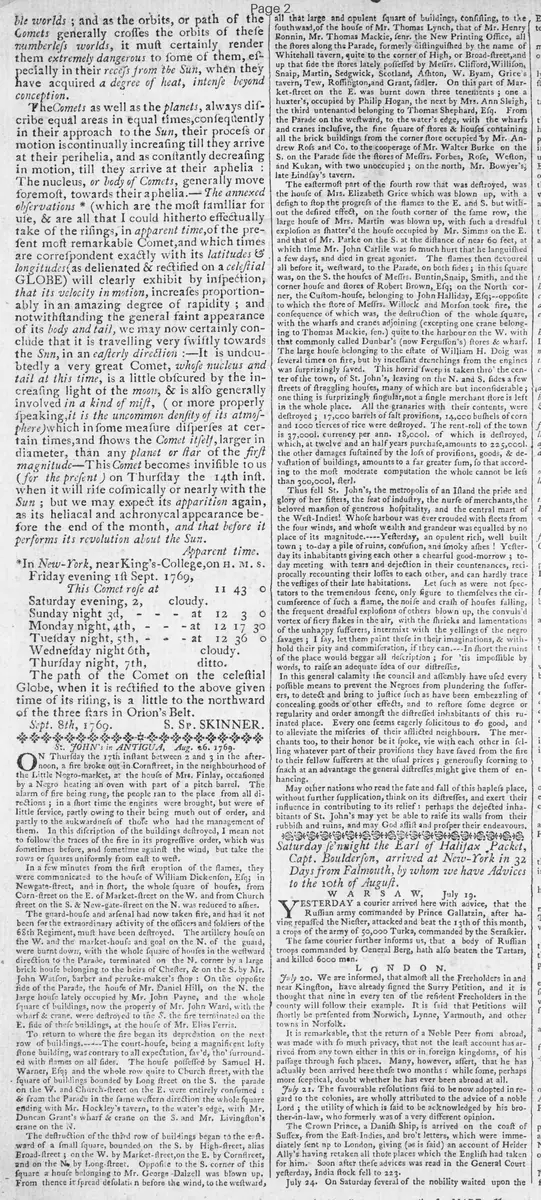
On Thursday the 17th instant between 2 and 3 in the afternoon, a fire broke out in Corn-street, in the neighbourhood of the Little Negro-market, at the house of Mrs. Finlay, occasioned by a Negro heating an oven with part of a pitch barrel. The alarm of fire being rung, the people ran to the place from all directions; in a short time the engines were brought, but were of little service, partly owing to their being much out of order, and partly to the awkwardness of those who had the management of them. In this description of the buildings destroyed, I mean not to follow the traces of the fire in its progressive order, which was sometimes before, and sometime against the wind, but take the rows or squares uniformly from east to west.
In a few minutes from the first eruption of the flames, they were communicated to the house of William Dickinson, Esq; in Newgate-street, and in short, the whole square of houses, from Corn-street on the E. of Market-street on the W. and from Church street on the S. & New-gate-street on the N. was reduced to ashes.
The guard-house and arsenal had now taken fire, and had it not been for the extraordinary activity of the officers and soldiers of the 60th Regiment, must have been destroyed. The artillery house on the W. and the market-house and goal on the N. of the guard, were burnt down, with the whole square of houses in the westward direction to the Parade, terminated on the N. corner by a large brick house belonging to the heirs of Chester, & on the S. by Mr. John Watson, barber and peruke-maker's shop: On the opposite side of the Parade, the house of Mr. Daniel Hill, on the N. the large house lately occupied by Mr. John Payne, and the whole square of buildings, now the property of Mr. John Ward, with the wharf & crane, were destroyed to the S. the fire terminated on the E. side of these buildings, at the house of Mr. Elias Ferris.
To return to where the fire began its depredation on the next row of buildings.--The court-house, being a magnificent lofty stone building, was contrary to all expectation, saved, tho' surrounded with flames on all sides. The house possessed by Samuel H. Warner, Esq; and the whole row quite to Church street, with the square of buildings bounded by Long street on the S. the parade on the W. and Church-street on the E. were entirely consumed: & from the Parade in the same western direction the whole square ending with Mr. Hockley's tavern, to the water's edge, with Mr. Duncan Grant's wharf & crane on the S. and Mr. Livingston's crane on the N.
The destruction of the third row of buildings began to the eastward of a small square, bounded on the S. by High-street, alias Broad-street; on the W. by Market-street, on the E. by Corn-street, and on the N by Long-street. Opposite to the S. corner of this square a house belonging to Mr. George Dalzell was blown up. From thence it spread desolation before the wind, to the westward, all that large and opulent square of buildings, consisting, to the southward, of the house of Mr. Thomas Lynch, that of Mr. Henry Ronain, Mr. Thomas Mackie, jun. the New Printing Office, all the stores along the Parade, formerly distinguished by the name of Whitehall tavern, quite to the corner of High, or Broad-street, and up that side the stores lately possessed by Messrs. Clifford, Willison, Snapp, Martin, Sedgwick, Scotland, Ashton, W. Byam, Grice's tavern, Tew, Roington, and Grant, jun. On this part of Market-street on the E. was burnt down three tenements; one a huckster's, occupied by Philip Hogan, the next by Mrs. Ann Sleigh, the third untenanted belonging to Thomas Shephard, Esq. From the Parade on the westward, to the water's edge, with the wharfs and cranes inclusive, the fine square of stores & houses containing all the brick buildings from the corner store occupied by Mr. Andrew Ross and Co. to the cooperage of Mr. Walter Burke on the S. on the Parade side the stores of Messrs. Forbes, Rose, Weston, and Kukam, with two unoccupied; on the north, Mr. Bowyer's late Lindsay's tavern.
The easternmost part of the fourth row that was destroyed, was the house of Mrs. Elizabeth Grice which was blown up, with a design to stop the progress of the flames to the E. and S. but without the desired effect, on the south corner of the same row, the large house of Mrs. Martin was blown up, with such a dreadful explosion as shattered the house occupied by Mr. Simms on the E. and that of Mr. Parke on the S. at the distance of near 60 feet, at which time Mr. John Carlisle was so much hurt that he languished a few days, and died in great agonies. The flames then devoured all before it, westward, to the Parade, on both sides; in this square was, on the S. the houses of Messrs. Buntin, Snapp, Smith, and the corner house and stores of Robert Brown, Esq; on the North corner, the Custom-house, belonging to John Halliday, Esq;--opposite to which the store of Messrs. Willock and Morison took fire, the consequence of which was, the destruction of the whole square, with the wharfs and cranes adjoining (excepting one crane belonging to Thomas Mackie, jun.) quite to the harbour on the W. with that commonly called Dunbar's (now Fergusson's) stores & wharf.
The large house belonging to the estate of William H. Doig was several times on fire, but by incessant drenchings from the engines was surprisingly saved. This horrid sweep is taken thro' the center of the town, of St. John's, leaving on the N. and S. sides a few streets of straggling houses, many of which are but inconsiderable; one thing is surprisingly singular, not a single merchant store is left in the whole place. All the granaries with their contents, were destroyed; 17,000 barrels of salt provisions, 14,000 bushels of corn and 1000 tierces of rice were destroyed. The rent-roll of the town is 37,000l. currency per ann. 18,000l. of which is destroyed, which, at twelve and an half years purchase, amounts to 225,000l. the other damages sustained by the loss of provisions, goods, & devastation of buildings, amounts to a far greater sum, so that according to the most moderate computation the whole cannot be less than 300,000l. sterling.
Thus fell St. John's, the metropolis of an Island the pride and glory of her sisters, the seat of industry, the nurse of merchants, the beloved mansion of generous hospitality, and the central mart of the West-Indies! Whose harbour was ever crowded with fleets from the four winds, and whose wealth and grandeur was equalled by no place of its magnitude.----Yesterday, an opulent rich, well built town; to-day a pile of ruins, confusion, and smoky ashes! Yesterday its inhabitants giving each other a cheerful good-morrow; to-day meeting with tears and dejection in their countenances, reciprocally recounting their losses to each other, and can hardly trace the vestiges of their late habitations. Let such as were not spectators to the tremendous scene, only figure to themselves the circumference of such a flame, the noise and crash of houses falling, the frequent dreadful explosions of others blown up, the convulsed vortex of fiery flakes in the air, with the shrieks and lamentations of the unhappy sufferers, intermixt with the yellings of the negro savages; I say, let them paint these in their imaginations, & withhold their pity and commiseration, if they can.---In short the ruins of the place would beggar all description; for 'tis impossible by words, to raise an adequate idea of our distress.
In this general calamity the council and assembly have used every possible means to prevent the Negroes from plundering the sufferers, to detect and bring to justice such as have been embezzling of concealing goods or other effects, and to restore some degree of regularity and order amongst the distressed inhabitants of this ruinated place. Every one seems eagerly solicitous to do good, and to alleviate the miseries of their afflicted neighbours. The merchants too, to their honor be it spoke, vie with each other in selling whatever part of their provisions they have saved from the fire to their fellow sufferers at the usual prices; generously scorning to snatch at an advantage the general distresses might give them of enhancing.
May other nations who read the fate and fall of this hapless place, without further supplication, think on its distresses, and exert their influence in contributing to its relief: perhaps the dejected inhabitants of St. John's may yet be able to raise its walls from their rubbish and ruins, and may God assist and prosper their endeavours.
What sub-type of article is it?
What keywords are associated?
What entities or persons were involved?
Where did it happen?
Foreign News Details
Primary Location
St. John's In Antigua
Event Date
Thursday The 17th Instant, 1769
Key Persons
Outcome
one death: mr. john carlisle from explosion injuries. destruction of town center including homes, stores, guard-house, arsenal, market-house, jail, custom-house, and wharves; 17,000 barrels of salt provisions, 14,000 bushels of corn, 1000 tierces of rice lost; total damages estimated at over 300,000l. sterling.
Event Details
Fire started at Mrs. Finlay's house in Corn-street due to a Negro heating an oven with pitch barrel. Spread rapidly despite engines, destroying multiple squares of buildings from east to west, including merchant stores, wharves, and public structures. Houses blown up to stop spread but failed; court-house miraculously saved. 60th Regiment saved guard-house and arsenal. No plundering by Negroes; merchants sold saved provisions at usual prices.