Thank you for visiting SNEWPapers!
Sign up free
Editorial
July 27, 1791
Gazette Of The United States
New York, New York County, New York
What is this article about?
An editorial critique by Publicola of Thomas Paine's arguments favoring the French constitution over English and American ones, defending legislative powers on game laws, monopolies, and exclusion of placemen from representation. From Columbian Centinel, Boston, July 13.
Clipping
OCR Quality
98%
Excellent
Full Text
FROM THE COLUMBIAN CENTINEL.
MR. RUSSELL,
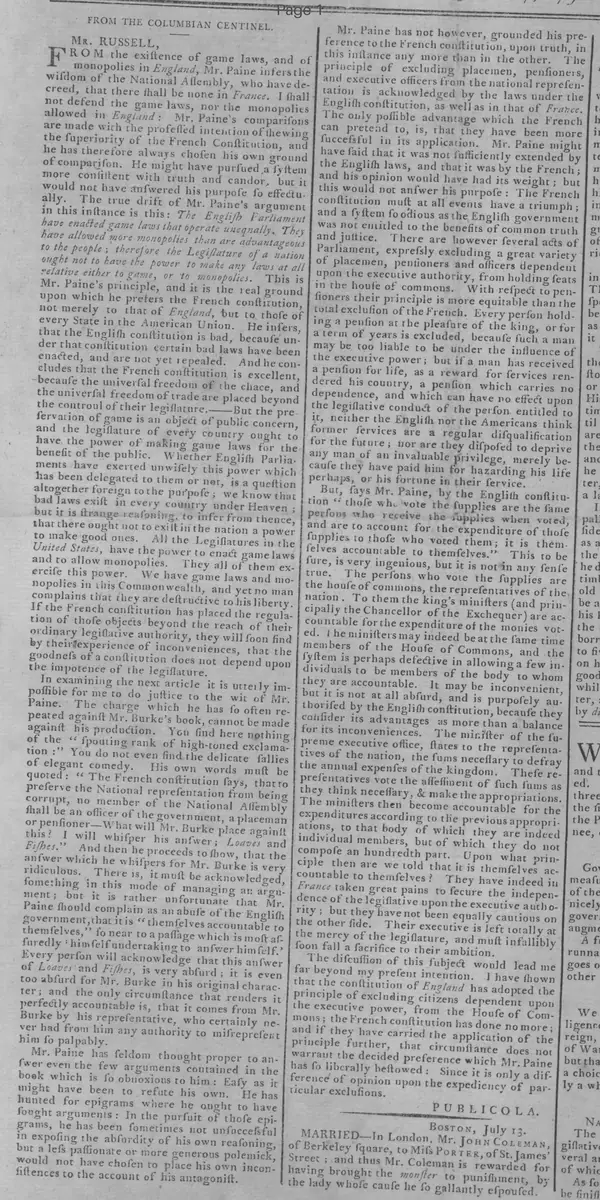
From the existence of game laws, and of monopolies in England, Mr. Paine infers the wisdom of the National Assembly, who have decreed, that there shall be none in France. I shall not defend the game laws, nor the monopolies allowed in England: Mr. Paine's comparisons are made with the professed intention of showing the superiority of the French Constitution, and he has therefore always chosen his own ground of comparison. He might have pursued a system more consistent with truth and candor, but it would not have answered his purpose so effectually. The true drift of Mr. Paine's argument in this instance is this: The English Parliament have enacted game laws that operate unequally. They have allowed more monopolies than are advantageous to the people; therefore the Legislature of a nation ought not to have the power to make any laws at all relative either to game, or to monopolies. This is Mr. Paine's principle, and it is the real ground upon which he prefers the French constitution, not merely to that of England, but to those of every State in the American Union. He infers, that the English constitution is bad, because under that constitution certain bad laws have been enacted, and are not yet repealed. And he concludes that the French constitution is excellent,—because the universal freedom of the chase, and the universal freedom of trade are placed beyond the controul of their legislature.—But the preservation of game is an object of public concern, and the legislature of every country ought to have the power of making game laws for the benefit of the public. Whether English Parliaments have exerted unwisely this power which has been delegated to them or not, is a question altogether foreign to the purpose; we know that bad laws exist in every country under Heaven; but it is strange reasoning, to infer from thence, that there ought not to exist in the nation a power to make good ones. All the Legislatures in the United States, have the power to enact game laws and to allow monopolies. They all of them exercise this power. We have game laws and monopolies in this Commonwealth, and yet no man complains that they are destructive to his liberty. If the French constitution has placed the regulation of those objects beyond the reach of their ordinary legislative authority, they will soon find by their experience of inconveniences, that the goodness of a constitution does not depend upon the impotence of the legislature.
In examining the next article it is utterly impossible for me to do justice to the wit of Mr. Paine. The charge which he has so often repeated against Mr. Burke's book, cannot be made against his production. You find here nothing of the "pouting rank of high-toned exclamation:" You do not even find the delicate sallies of elegant comedy. His own words must be quoted: "The French constitution says, that to preserve the National representation from being corrupt, no member of the National Assembly shall be an officer of the government, a placeman or pensioner—What will Mr. Burke place against this? I will whisper his answer; Loaves and Fishes." And then he proceeds to show, that the answer which he whispers for Mr. Burke is very ridiculous. There is, it must be acknowledged, something in this mode of managing an argument; but it is rather unfortunate that Mr. Paine should complain as an abuse of the English government, that it is "themselves accountable to themselves," so near to a passage which is most assuredly 'himself undertaking to answer himself.' Every person will acknowledge that this answer of Loaves and Fishes, is very absurd; it is even too absurd for Mr. Burke in his original character; and the only circumstance that renders it perfectly accountable is, that it comes from Mr. Burke by his representative, who certainly never had from him any authority to misrepresent him so palpably.
Mr. Paine has seldom thought proper to answer even the few arguments contained in the book which is so obnoxious to him: Easy as it might have been to refute his own. He has hunted for epigrams where he ought to have sought arguments: In the pursuit of those epigrams, he has been sometimes not unsuccessful in exposing the absurdity of his own reasoning, but a less passionate or more generous polemic, would not have chosen to place his own inconsistencies to the account of his antagonist.
Mr. Paine has not however, grounded his preference to the French constitution, upon truth, in this instance any more than in the other. The principle of excluding placemen, pensioners, and executive officers from the national representation is acknowledged by the laws under the English constitution, as well as in that of France. The only possible advantage which the French can pretend to, is, that they have been more successful in its application. Mr. Paine might have said that it was not sufficiently extended by the English laws, and that it was by the French; and his opinion would have had its weight; but this would not answer his purpose: The French constitution must at all events have a triumph; and a system so odious as the English government was not entitled to the benefits of common truth and justice. There are however several acts of Parliament, expressly excluding a great variety of placemen, pensioners and officers dependent upon the executive authority, from holding seats in the house of commons. With respect to pensioners their principle is more equitable than the total exclusion of the French. Every person holding a pension at the pleasure of the king, or for a term of years is excluded, because such a man may be too liable to be under the influence of the executive power; but if a man has received a pension for life, as a reward for services rendered his country, a pension which carries no dependence, and which can have no effect upon the legislative conduct of the person entitled to it, neither the English nor the Americans think former services are a regular disqualification for the future; nor are they disposed to deprive any man of an invaluable privilege, merely because they have paid him for hazarding his life perhaps, or his fortune in their service.
But, says Mr. Paine, by the English constitution those who vote the supplies are the same persons who receive the supplies when voted and are to account for the expenditure of those supplies to those who voted them; it is themselves accountable to themselves." This to be sure, is very ingenious, but it is not in any sense true. The persons who vote the supplies are the house of commons, the representatives of the nation. To them the king's ministers (and principally the Chancellor of the Exchequer) are accountable for the expenditure of the monies voted. The ministers may indeed be at the same time members of the House of Commons, and the system is perhaps defective in allowing a few individuals to be members of the body to whom they are accountable. It may be inconvenient, but it is not at all absurd, and is purposely authorised by the English constitution, because they consider its advantages as more than a balance for its inconveniences. The minister of the supreme executive office, states to the representatives of the nation, the sums necessary to defray the annual expences of the kingdom. These representatives vote the assessment of such sums as they think necessary, & make the appropriations. The ministers then become accountable for the expenditures according to the previous appropriations, to that body of which they are indeed individual members, but of which they do not compose an hundredth part. Upon what principle then are we told that it is themselves accountable to themselves? They have indeed in France taken great pains to secure the independence of the legislative upon the executive authority; but they have not been equally cautious on the other side. Their executive is left totally at the mercy of the legislature, and must infallibly soon fall a sacrifice to their ambition.
The discussion of this subject would lead me far beyond my present intention. I have shown that the constitution of England has adopted the principle of excluding citizens dependent upon the executive power, from the House of Commons; the French constitution has done no more; and if they have carried the application of the principle further, that circumstance does not warrant the decided preference which Mr. Paine has so liberally bestowed: Since it is only a difference of opinion upon the expediency of particular exclusions.
PUBLICOLA.
BOSTON, July 13.
MR. RUSSELL,
From the existence of game laws, and of monopolies in England, Mr. Paine infers the wisdom of the National Assembly, who have decreed, that there shall be none in France. I shall not defend the game laws, nor the monopolies allowed in England: Mr. Paine's comparisons are made with the professed intention of showing the superiority of the French Constitution, and he has therefore always chosen his own ground of comparison. He might have pursued a system more consistent with truth and candor, but it would not have answered his purpose so effectually. The true drift of Mr. Paine's argument in this instance is this: The English Parliament have enacted game laws that operate unequally. They have allowed more monopolies than are advantageous to the people; therefore the Legislature of a nation ought not to have the power to make any laws at all relative either to game, or to monopolies. This is Mr. Paine's principle, and it is the real ground upon which he prefers the French constitution, not merely to that of England, but to those of every State in the American Union. He infers, that the English constitution is bad, because under that constitution certain bad laws have been enacted, and are not yet repealed. And he concludes that the French constitution is excellent,—because the universal freedom of the chase, and the universal freedom of trade are placed beyond the controul of their legislature.—But the preservation of game is an object of public concern, and the legislature of every country ought to have the power of making game laws for the benefit of the public. Whether English Parliaments have exerted unwisely this power which has been delegated to them or not, is a question altogether foreign to the purpose; we know that bad laws exist in every country under Heaven; but it is strange reasoning, to infer from thence, that there ought not to exist in the nation a power to make good ones. All the Legislatures in the United States, have the power to enact game laws and to allow monopolies. They all of them exercise this power. We have game laws and monopolies in this Commonwealth, and yet no man complains that they are destructive to his liberty. If the French constitution has placed the regulation of those objects beyond the reach of their ordinary legislative authority, they will soon find by their experience of inconveniences, that the goodness of a constitution does not depend upon the impotence of the legislature.
In examining the next article it is utterly impossible for me to do justice to the wit of Mr. Paine. The charge which he has so often repeated against Mr. Burke's book, cannot be made against his production. You find here nothing of the "pouting rank of high-toned exclamation:" You do not even find the delicate sallies of elegant comedy. His own words must be quoted: "The French constitution says, that to preserve the National representation from being corrupt, no member of the National Assembly shall be an officer of the government, a placeman or pensioner—What will Mr. Burke place against this? I will whisper his answer; Loaves and Fishes." And then he proceeds to show, that the answer which he whispers for Mr. Burke is very ridiculous. There is, it must be acknowledged, something in this mode of managing an argument; but it is rather unfortunate that Mr. Paine should complain as an abuse of the English government, that it is "themselves accountable to themselves," so near to a passage which is most assuredly 'himself undertaking to answer himself.' Every person will acknowledge that this answer of Loaves and Fishes, is very absurd; it is even too absurd for Mr. Burke in his original character; and the only circumstance that renders it perfectly accountable is, that it comes from Mr. Burke by his representative, who certainly never had from him any authority to misrepresent him so palpably.
Mr. Paine has seldom thought proper to answer even the few arguments contained in the book which is so obnoxious to him: Easy as it might have been to refute his own. He has hunted for epigrams where he ought to have sought arguments: In the pursuit of those epigrams, he has been sometimes not unsuccessful in exposing the absurdity of his own reasoning, but a less passionate or more generous polemic, would not have chosen to place his own inconsistencies to the account of his antagonist.
Mr. Paine has not however, grounded his preference to the French constitution, upon truth, in this instance any more than in the other. The principle of excluding placemen, pensioners, and executive officers from the national representation is acknowledged by the laws under the English constitution, as well as in that of France. The only possible advantage which the French can pretend to, is, that they have been more successful in its application. Mr. Paine might have said that it was not sufficiently extended by the English laws, and that it was by the French; and his opinion would have had its weight; but this would not answer his purpose: The French constitution must at all events have a triumph; and a system so odious as the English government was not entitled to the benefits of common truth and justice. There are however several acts of Parliament, expressly excluding a great variety of placemen, pensioners and officers dependent upon the executive authority, from holding seats in the house of commons. With respect to pensioners their principle is more equitable than the total exclusion of the French. Every person holding a pension at the pleasure of the king, or for a term of years is excluded, because such a man may be too liable to be under the influence of the executive power; but if a man has received a pension for life, as a reward for services rendered his country, a pension which carries no dependence, and which can have no effect upon the legislative conduct of the person entitled to it, neither the English nor the Americans think former services are a regular disqualification for the future; nor are they disposed to deprive any man of an invaluable privilege, merely because they have paid him for hazarding his life perhaps, or his fortune in their service.
But, says Mr. Paine, by the English constitution those who vote the supplies are the same persons who receive the supplies when voted and are to account for the expenditure of those supplies to those who voted them; it is themselves accountable to themselves." This to be sure, is very ingenious, but it is not in any sense true. The persons who vote the supplies are the house of commons, the representatives of the nation. To them the king's ministers (and principally the Chancellor of the Exchequer) are accountable for the expenditure of the monies voted. The ministers may indeed be at the same time members of the House of Commons, and the system is perhaps defective in allowing a few individuals to be members of the body to whom they are accountable. It may be inconvenient, but it is not at all absurd, and is purposely authorised by the English constitution, because they consider its advantages as more than a balance for its inconveniences. The minister of the supreme executive office, states to the representatives of the nation, the sums necessary to defray the annual expences of the kingdom. These representatives vote the assessment of such sums as they think necessary, & make the appropriations. The ministers then become accountable for the expenditures according to the previous appropriations, to that body of which they are indeed individual members, but of which they do not compose an hundredth part. Upon what principle then are we told that it is themselves accountable to themselves? They have indeed in France taken great pains to secure the independence of the legislative upon the executive authority; but they have not been equally cautious on the other side. Their executive is left totally at the mercy of the legislature, and must infallibly soon fall a sacrifice to their ambition.
The discussion of this subject would lead me far beyond my present intention. I have shown that the constitution of England has adopted the principle of excluding citizens dependent upon the executive power, from the House of Commons; the French constitution has done no more; and if they have carried the application of the principle further, that circumstance does not warrant the decided preference which Mr. Paine has so liberally bestowed: Since it is only a difference of opinion upon the expediency of particular exclusions.
PUBLICOLA.
BOSTON, July 13.
What sub-type of article is it?
Constitutional
Partisan Politics
What keywords are associated?
Thomas Paine
French Constitution
English Constitution
Game Laws
Monopolies
Placemen Exclusion
Legislative Power
Edmund Burke
What entities or persons were involved?
Thomas Paine
Edmund Burke
English Parliament
French National Assembly
American Legislatures
House Of Commons
Editorial Details
Primary Topic
Critique Of Thomas Paine's Preference For French Constitution Over English And American Models
Stance / Tone
Defensive Of English And American Constitutional Principles Against Paine's Advocacy
Key Figures
Thomas Paine
Edmund Burke
English Parliament
French National Assembly
American Legislatures
House Of Commons
Key Arguments
Existence Of Bad Laws Like Game Laws And Monopolies Does Not Justify Removing Legislative Power Entirely
Principle Of Excluding Placemen And Pensioners From Representation Exists In English Law As Well As French
English System Holds Ministers Accountable To The House Of Commons, Not Themselves To Themselves
French Constitution Risks Executive Vulnerability To Legislative Ambition
Paine Misrepresents Burke And Prioritizes Wit Over Substantive Argument