Thank you for visiting SNEWPapers!
Sign up free
Story
August 3, 1928
The Weekly Gazette
East Hartford, Hartford County, Connecticut
What is this article about?
Experts warn of spectrum shortages for television, requiring 100-kilocycle bands for quality service, as told to the Federal Radio Commission by Dr. Goldsmith of RCA.
Clipping
OCR Quality
98%
Excellent
Full Text
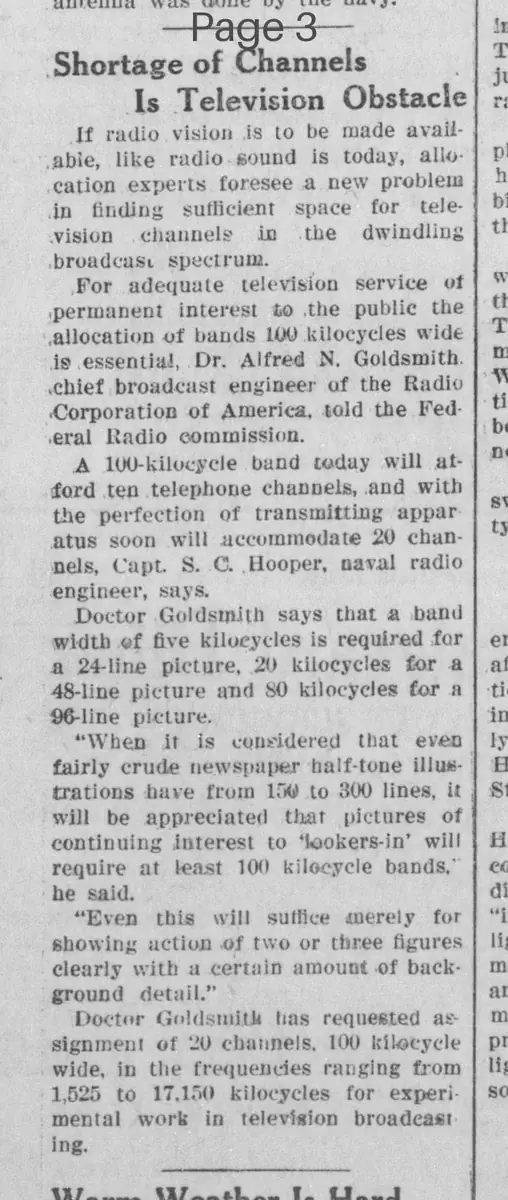
Shortage of Channels
Is Television Obstacle
If radio vision is to be made available, like radio sound is today, allocation experts foresee a new problem in finding sufficient space for television channels in the dwindling broadcast spectrum.
For adequate television service of permanent interest to the public the allocation of bands 100 kilocycles wide is essential, Dr. Alfred N. Goldsmith, chief broadcast engineer of the Radio Corporation of America, told the Federal Radio commission.
A 100-kil cycle band today will afford ten telephone channels, and with the perfection of transmitting apparatus soon will accommodate 20 channels, Capt. S. C. Hooper, naval radio engineer, says.
Doctor Goldsmith says that a band width of five kilocycles is required for a 24-line picture, 20 kilocycles for a 48-line picture and 80 kilocycles for a 96-line picture.
"When it is considered that even fairly crude newspaper half-tone illustrations have from 15 to 300 lines, it will be appreciated that pictures of continuing interest to lookers-in will require at least 100 kilocycle bands," he said.
"Even this will suffice merely for showing action of two or three figures clearly with a certain amount of background detail."
Doctor Goldsmith has requested assignment of 20 channels, 100 kilocycle wide, in the frequencies ranging from 1,525 to 17,150 kilocycles for experimental work in television broadcasting.
Is Television Obstacle
If radio vision is to be made available, like radio sound is today, allocation experts foresee a new problem in finding sufficient space for television channels in the dwindling broadcast spectrum.
For adequate television service of permanent interest to the public the allocation of bands 100 kilocycles wide is essential, Dr. Alfred N. Goldsmith, chief broadcast engineer of the Radio Corporation of America, told the Federal Radio commission.
A 100-kil cycle band today will afford ten telephone channels, and with the perfection of transmitting apparatus soon will accommodate 20 channels, Capt. S. C. Hooper, naval radio engineer, says.
Doctor Goldsmith says that a band width of five kilocycles is required for a 24-line picture, 20 kilocycles for a 48-line picture and 80 kilocycles for a 96-line picture.
"When it is considered that even fairly crude newspaper half-tone illustrations have from 15 to 300 lines, it will be appreciated that pictures of continuing interest to lookers-in will require at least 100 kilocycle bands," he said.
"Even this will suffice merely for showing action of two or three figures clearly with a certain amount of background detail."
Doctor Goldsmith has requested assignment of 20 channels, 100 kilocycle wide, in the frequencies ranging from 1,525 to 17,150 kilocycles for experimental work in television broadcasting.
What sub-type of article is it?
Curiosity
What themes does it cover?
Exploration
What keywords are associated?
Television Channels
Broadcast Spectrum
Frequency Allocation
Rca
Federal Radio Commission
What entities or persons were involved?
Dr. Alfred N. Goldsmith
Capt. S. C. Hooper
Story Details
Key Persons
Dr. Alfred N. Goldsmith
Capt. S. C. Hooper
Story Details
Experts discuss the need for wide frequency bands to support television broadcasting, highlighting spectrum shortages and recommending allocations for experimental work.