Thank you for visiting SNEWPapers!
Sign up free
Virginia Argus
Richmond, Virginia
What is this article about?
European intelligence from German papers to Nov 5 reports Prussian military encampments, Russian Emperor's visit to Berlin, French diplomatic courier, Italian campaign opening, Ulm capitulation with 34,000 Austrian prisoners, various troop movements, and advances in Tyrol and Salzburg amid Napoleonic Wars.
Merged-components note: Sequential reading order and text continuation of European intelligence report from Philadelphia.
Clipping
OCR Quality
Full Text
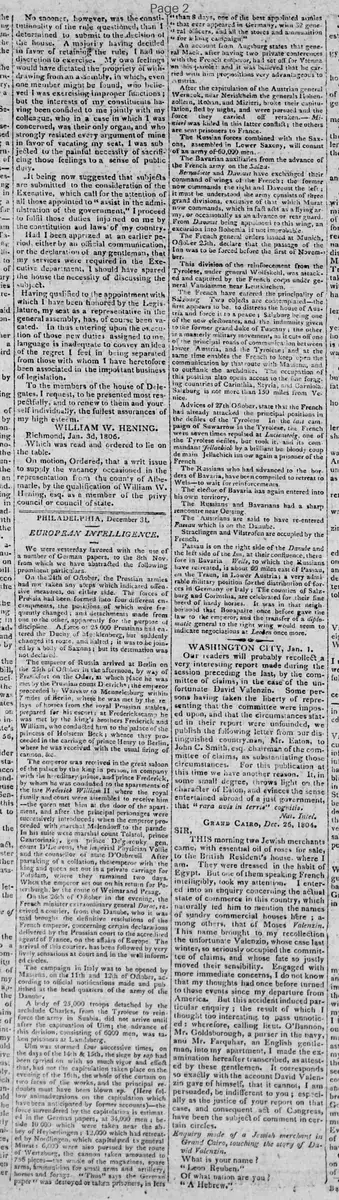
EUROPEAN INTELLIGENCE.
We were yesterday favored with the use of a number of German papers, to the 5th Nov. from which we have abstracted the following prominent particulars.
On the 24th of October, the Prussian armies had not taken any steps which indicated offensive measures, on either side. The forces of Prussia had been formed into four different encampments, the positions of which were frequently changed: and detachments made from one to the other, apparently for the purpose of discipline. A force of 25,000 Prussians had entered the Duchy of Mecklenberg, but suddenly changed its route, and halted; it was to be joined by a body of Saxons; but its destination was not declared.
The emperor of Russia arrived at Berlin on the 25th of October in the afternoon, by way of Frankfort on the Oder, at which place he was met by the Prussian count Dietrichs; the emperor proceeded by Warsaw to Memelburg within 7 miles of Berlin, where he was met by the relays of horses from the royal Prussian stables, prepared for his escort; at Frederickscamp he was met by the king's brothers Frederick and William, who conducted him to the palace of the princess of Holstein Beck; whence they proceeded in the carriage of prince Henry to Berlin, where he was received with the usual firing of cannon. &c.
The emperor was received in the great saloon of the palace by the king in person, in company with the hereditary prince, and prince Frederick, by whom he was conducted to the apartments of the late Frederick William II where the royal family and court were assembled to receive him --the queen met him at the door of the apartment, and after the principal personages were successively introduced; when the emperor proceeded with marshal Molendorf to the parade.
In his suite were marshal count Tolstoi, prince Czartorinsky, gen. prince Degorouky, gen. count D'Lewens, the imperial physician Vollie and the counsellor of state D'Oubreuil. After partaking of a collation, the emperor with the king and queen set out in a private carriage for Potsdam, where they remained two days.
When the emperor set out on his return for Petersburg, by the route of Weimar and Prag.
On the 26th of October in the evening, the French minister extraordinary general Duroc, received a courier, from the Danube, who it was said brought the definitive resolutions of the French emperor, concerning certain declarations delivered by the Prussian court to the accredited agents of France, on the affairs of Europe. The arrival of this courier, has been followed by very lively sensations at court and in the well informed circles.
The campaign in Italy was to be opened by Massena, on the 11th and 12th of October, according to official notifications made and published at the head quarters of the army of the Danube.
A body of 25,000 troops detached by the archduke Charles, from the Tyrolese to reinforce the army in Suabia, did not arrive until after the capitulation of Ulm; the advance of this division, consisting of 6000 men, was taken prisoners at Landsberg.
Ulm was stormed four successive times, on the days of the 14th & 15th, the siege by sap had been carried on with so much vigor and effect that, had not the capitulation taken place on the evening of the 16th, the whole of the curtain on two faces of the works, and the principal redoubts must have been blown up. (Here follow animadversions on the capitulation which have been anticipated by former accounts)-the force surrendered by the capitulation is estimated in the German papers, at 34,000 men; besides 10,000 which were taken near the abbey of Heyberlingen; 12,000 which had retreated by Nordlingen, which capitulated to general Murat: 6,000 were also pursued by the route of Wertzburg, the cannon taken amounted to 736 pieces--the whole of the magazines, spare arms, ammunition for small arms and artillery, horses and forage. "Thus" says the German paper "was destroyed or taken prisoners, in less
than 8 days, one of the best appointed armies that ever appeared in Germany, with 82 general officers, and all the stores and ammunition for a long campaign"
An account from Augsburg states that general Mack, after having two private conferences with the French emperor, had set off for Vienna on his parole: and it was believed that he carried with him propositions very advantageous to Austria.
After the capitulation of the Austrian general Werneck, near Neriskheim the generals Hohen zollern, Rohan, and Werneck, broke their capitulation, fled by night, and were pursued and the force they carried off retaken.--Mizieres was killed in this latter conflict; the others are sent prisoners to France.
The Russian forces combined with the Saxons, assembled in Lower Saxony, will consist of an army of 60,000 men.
The Bavarian auxiliaries from the advance of the French army on the Salza.
Bernadotte and Davoust have exchanged their command of wings of the French; the former now commands the right and Davoust the left: it must be understood the army consists of three grand divisions, exclusive of that which Murat now commands, which in fact acts as a flying army, or occasionally as an advance or rear guard.
From Davoust being appointed to this wing, an excursion into Bohemia is not improbable.
The French general orders issued at Munich, October 25th, declare that the passage of the Inn was to be forced before the first of November.
This division of the reinforcement from the Tyrolese, under general Woifskehl, was attacked and captured by the French corps under general Vandamme near Leutkirchen.
The French have entered the principality of Salzburg. Two objects are contemplated-the first appears to be, to distress the house of Austria and force it to a peace; Salzburg being one of the new electorates, and the indemnity given to the former grand Duke of Tuscany; the other is a masterly military movement, as it cuts off one of the principal roads of communication between lower Austria, and the Tyrolese; and at the same time enables the French to keep open the communication by that route with Massena, and to outflank the archduke. The occupation of this position also opens access to the rich foraging countries of Carinthia, Styria, and Carniola. Salzburg is not more than 150 miles from Venice.
Advices of 27th October, state that the French had already attacked the principal positions in the defiles of the Tyrolese. In the last campaign of Suwarrow in the Tyrolese, the French were seven times repulsed at Luicensteig, one of the Tyrolese defiles, but took it, and its commandant Jellachich by a brilliant but bloody coup de main. Jellachich is now again a prisoner of the French.
The Russians who had advanced to the borders of Bavaria, have been compelled to retreat to Wels—to wait for reinforcements.
The elector of Bavaria has again entered into his own territory.
The Russians and Bavarians had a sharp rencontre near Oessing.
The Austrians are said to have re-entered Passau which is on the Danube.
Straubingen and Vilshofen are occupied by the French.
Passau is on the right side of the Danube and the left side of the Inn, at their confluence, therefore in Bavaria. Wels, to which the Russians have retreated, is about 60 miles east of Passau, on the Traun, in Lower Austria; a very admirable military position for the distribution of forces in Germany or Italy; The counties of Salzburg and Carinthia, are celebrated for their fine breed of hardy horses. It was in that neighborhood that Bonaparte once before gave the law to the emperor, and the transfer of a diplomatic general to the right wing would seem to indicate negociations at Leoben once more.
What sub-type of article is it?
What keywords are associated?
What entities or persons were involved?
Where did it happen?
Foreign News Details
Primary Location
Germany
Event Date
October 1805
Key Persons
Outcome
ulm capitulation: 34,000 men surrendered, 10,000 taken near heyberlingen, 12,000 at nordlingen, 6,000 pursued to wertzburg, 736 cannon captured; generals hohen zollern, rohan, werneck captured after breaking parole; russian retreat to wels; french entry into salzburg.
Event Details
Prussian armies in encampments without offensive moves; 25,000 enter Mecklenburg to join Saxons. Russian Emperor arrives Berlin Oct 25, received by Prussian royals, visits Potsdam. French courier brings resolutions on Prussian declarations. Massena opens Italian campaign Oct 11-12. Archduke Charles's 25,000 reinforcements late for Ulm, advance 6,000 captured at Landsberg. Ulm stormed Oct 14-15, capitulated Oct 16. Mack confers with French emperor, heads to Vienna with propositions. Werneck capitulation broken, forces retaken. Russian-Saxon army 60,000 in Lower Saxony. Bernadotte and Davoust swap commands. French to force Inn passage by Nov 1. Woifskehl's division captured near Leutkirchen. French enter Salzburg, attack Tyrolese defiles. Russians retreat from Bavaria to Wels. Bavarian elector returns territory. Skirmish near Oessing. Austrians re-enter Passau; French occupy Straubingen, Vilshofen.