Thank you for visiting SNEWPapers!
Sign up free
Alexandria Gazette
Alexandria, Alexandria County, District Of Columbia
What is this article about?
In the U.S. Senate on the 10th, Mr. Robbins proposes a resolution to establish an educational institution in Washington using James Smithson's bequest for the 'increase and diffusion of knowledge.' He delivers a speech advocating for a new model of education inspired by ancient Athens to foster national literature and genius. Mr. Preston supports the resolution, praising Robbins.
Clipping
OCR Quality
Full Text
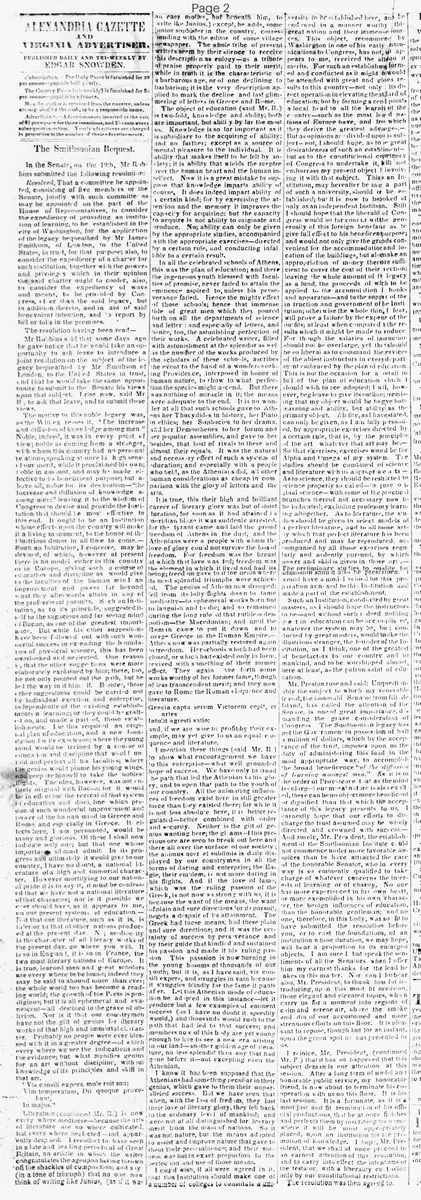
In the Senate, on the 10th, Mr. Robbins submitted the following resolution:
Resolved, That a committee be appointed, consisting of five members of the Senate, jointly with such committee as may be appointed on the part of the House of Representatives, to consider the expediency of providing an institution of learning, to be established in the city of Washington, for the application of the legacy bequeathed by Mr. James Smithson, of London, to the United States, in trust, for that purpose; also, to consider the expediency of a charter for such institution, together with the powers and privileges which in their opinion the said charter ought to confer, also, to consider the expediency of ways and means, to be provided by Congress, other than the said legacy, but in addition thereto, and in aid of said benevolent intention, and to report by bill or bills in the premises.
The resolution having been read—
Mr. Robbins said that some days ago he gave notice that he would take an opportunity to ask leave to introduce a joint resolution on the subject of the legacy bequeathed by Mr. Smithson of London, to the United States in trust, and that he would take the same opportunity to submit to the Senate his views upon that subject. I rise now, said Mr. R., to ask that leave, and to submit these views.
The motive to this noble legacy was, as the will expresses it, "the increase and diffusion of knowledge among men."
Noble, indeed, it was in every point of view; noble as coming from a stranger, with whom this country had no personal relations; speaking at once high sense of our merit, while it proclaimed his own; noble in amount, and may be made effective to its beneficent purpose; but above all, noble for its destination—"the increase and diffusion of knowledge among men;" leaving it to the wisdom of Congress to devise and provide the institution that should be most effective to this end. It ought to be an institution whose effects upon the country will make it a living monument, to the honor of the illustrious donor in all time to come.
Such an institution, I conceive, may be devised, of which, however at present there is no model either in this country or in Europe, giving such a course of education and discipline as would give to the faculties of the human mind an improvement and power far beyond what they afterwards attain in any of the professional pursuits. Such an institution, as to its principle, suggested itself to the sagacious and far-seeing mind of Bacon, as one of the greatest importance. But while his other suggestions have been followed out with such wonderful success in extending the boundaries of physical science, this has been overlooked and neglected. One reason is, that the other suggestions were more elaborately explained by him; there, too, he not only pointed out the path, but he led the way in it himself. Besides, those other suggestions could be carried out by individual exertion and enterprise, independently of the existing establishments of learning; or they could be grafted on, and made a part of, those establishments. But this required an original plan of education, and a new foundation for its execution; where the young mind would be trained by a course of education and discipline that would uplift and perfect all its faculties; where the genius would plume his young wings, and prepare himself to take the noblest flights. The idea, however, was not entirely original with Bacon; for it would be in effect but the revival of that system of education and discipline which produced such wonderful improvement and power of the human mind in Greece and Rome, and especially in Greece. It effects here, I am persuaded, would be many and glorious. Of these I shall now indicate only one; but that one whose importance all must admit. In its progress and ultimately it would give to our country, I have no doubt, a national literature of a high and immortal character. However mortifying to our national pride it is to say it, it must be confessed that we have not a national literature of that character; nor is it possible we ever should have, as it appears to me, on our present systems of education.
Not that our literature, such as it is, is inferior to that of other nations produced at the present day. No; mediocrity is the character of all literary works of the present day, go where you will. It is so in England, it is so in France, the two most literary nations of Europe. It is true, learned men and great scholars are everywhere to be found; indeed they may be said to abound more than ever; the whole world too has become a reading world; the growth of the Press is prodigious; but it is all ephemeral and evanescent—all destined to the grave of oblivion. Nor is it that our countrymen have not the gift of genius for literary works of that high and immortal character. Probably no people were ever blessed with it in a greater degree—of which everywhere we see the indications and the evidence; but what signifies genius for an art without discipline, without knowledge of its principles and skill in that art.
"Vis consili expers, mole ruit sua;
Vim temperatam di quoque proventunt.
In majus,"
Literature (continued Mr. R.) is now everywhere mediocre—because the arts of literature are nowhere cultivated, but everywhere neglected—and apparently despised. I recollect to have seen in a late and leading periodical of Great Britain, an article in which the writer congratulates the age upon having thrown off the shackles of composition; and says (in a tone of triumph) that no one now thinks of writing like Junius, (as if it was an easy matter to write like Junius,) except, he adds, some junior sophister in the country, corresponding with the editor of some village newspaper. The whole tribe of present writers seem by their silence to receive his description as eulogy—as a tribute of praise properly paid to their merit; while in truth it is the characteristic of a barbarous age, or of one declining to barbarism; it is the very description applied to mark the decline and last glimmering of letters in Greece and Rome.
The object of education (said Mr. R.) is two-fold, knowledge and ability; both are important, but ability by far the most so.
Knowledge is so far important as it is subsidiary to the acquiring of ability; and no further; except as a source of mental pleasure to the individual. It is ability that makes itself to be felt by society; it is ability that wields the sceptre over the human heart and the human intellect. Now it is a great mistake to suppose that knowledge imparts ability of course. It does indeed impart ability of a certain kind; for by exercising the attention and the memory it improves the capacity for acquiring; but the capacity to acquire is not ability to originate and produce. No; ability can only be given by the appropriate studies, accompanied with the appropriate exercises—directed by a certain rule, and conducting infallibly to a certain result.
In all the celebrated schools of Athens, this was the plan of education; and there the ingenious youth blessed with faculties of promise, never failed to attain the eminence aspired to, unless his perseverance failed. Hence the mighty effect of those schools; hence that immense tide of great men which they poured forth on all the departments of science and letters; and especially of letters, and hence, too, the astonishing perfection of their works. A celebrated writer, filled with astonishment at the splendor as well as the number of the works produced by the scholars of these schools, ascribes the event to the hand of a wonder-working Providence, interposed in honor of human nature, to show to what perfection the species might ascend. But there was nothing of miracle in it; the means were adequate to the end. It is no wonder at all that such schools gave to Athens her Thucydides in history, her Plato in ethics; her Sophocles to her drama, and her Demosthenes to her forum and her popular assemblies, and gave to her besides, that host of rivals to these and almost their equals. It was the natural and necessary effect of such a system of education; and especially with a people who held, as the Athenians did, all other human considerations as cheap in comparison with the glory of letters and the arts.
It is true, this their high and brilliant career of literary glory was but of short duration, for soon as it had attained its meridian blaze it was suddenly arrested, for the tyrant came and laid the proud freedom of Athens in the dust, and the Athenians were a people with whom the love of glory could not survive the loss of freedom. For freedom was the breast at which that love was fed; freedom was the element in which it lived and had its being; freedom gave to all its energies where its most splendid triumphs were achieved. The genius of Athens now drooped; fell from its lofty flights down to tame mediocrity—to ephemeral works born but to languish and to die; and so remained during the long rule of that ruthless despotism—the Macedonian; and until the Roman came to put it down and to merge Greece in the Roman Empire.
Athens now was partially restored again to freedom. Her schools which had been closed, or which had existed only in form, revived with something of their former effect. They again gave forth some works worthy of her former fame, though of less transcendent merit; and they now gave to Rome the Roman eloquence and literature.
"Græcia capta ferum victorem cepit, et artes
Intulit agresti Latio."
and, if we are wise to profit by their example, may yet give to us an equal eloquence and literature.
I mention these things (said Mr. R.) to show what encouragement we have to this enterprise—what well grounded hope of success. We have only to tread the path that led the Athenian to his glory, and to open that path to the youth of our country. All the animating influences of freedom exist here in still greater force than they existed there; for while it is not less absolute here, it is better regulated—better combined with order and security. Neither is the gift of genius wanting here; the gleams of this precious ore are seen to break out here and there all over the surface of our society; the animus acer et sublimis is daily displayed by our countrymen in all the forms of daring and enterprise; the Eagle, their emblem, is not more daring in his flights. And if the love of fame, which was the ruling passion of the Greek, is not now so strong with us, it is because the want of the means, the want of plain and sure directions for its pursuit, begets a despair of its attainment.
The Greek had these means, had these plain and sure directions; and it was the certainty of success by perseverance and by their guide that kindled and sustained his passion and made it his ruling passion. This passion is now burning in the young bosoms of thousands of our youth; but it is, as I have said, vis consili expers, and struggles in vain because it struggles blindly for the fame it pants after. Let this Athenian mode of education be adopted in this institution—let it produce but a few examples of eminent success (as I have no doubt it speedily would,) and thousands would rush to the path that had led to that success; and members now of this body are yet young enough to live to see a new era arising in our land—another golden age of literature, no less splendid than any that had gone before it—not excepting even the Athenian.
I know it has been supposed that the Athenians had something peculiar in their genius, which gave to them their unparalleled success. But we have seen that when, with the loss of freedom, they lost their love of literary glory, they fell back to the ordinary level of mankind; and were not at all distinguished for literary merit from the mass of nations. So it was not nature, but the means adopted to assist and improve nature that gave to them their pre-eminence; and their success was but in exact proportion to the perfection and use of those means.
I could wish, if all were agreed in it, that this institution should make one of a number of colleges to constitute a university to be established here, and endowed in a manner worthy this great nation and their immense resources. This object, recommended by Washington in one of his early communications to Congress, has not, as it appears to me, received the attention its merits. For such an establishment formed and conducted as it might be would be attended with great and glorious results to this country—not only in its direct operation in elevating the standard of education; but by forming a central point to all the learning of the country—such as the most learned nations of Europe have, and from which they derive the greatest advantages.
But as opinions are divided upon this subject—not, I should hope, as to its great desirableness—but as to the constitutional competency of Congress to undertake it, I will not embarrass my present object involving it with that subject. This an institution, may hereafter be made a part of such a university, should one be established; but it is now to be looked at only as an independent institution. Still I should hope that the liberality of Congress would so far concur with the generosity of this foreign benefactor as to give full effect to his beneficent purpose; and would not only give the grounds convenient for the accommodation and location of the buildings, but also make an appropriation of money therefor sufficient to cover the cost of their erection; leaving the whole amount of the legacy as a fund, the proceeds of which to be applied to the accumulation of books and apparatus—and to the support of the instruction and government of the institution; otherwise the whole thing, I fear, will prove a failure by the expense of the outfit; at least when compared to the results which it might be made to produce. For though the salaries of instruction should not be overlarge, yet they should be so liberal as to command the services of the ablest instructors in every department embraced by the plan of education.
This is not the occasion for a detail in full of the plan of education which I should wish to see adopted: I will, however, beg leave to give its outline; premising that my object would be to give both learning and ability, but ability as the primary object. Ability, as I have stated, can only be given, as I am fully persuaded, by appropriate exercises directed by a certain rule, that is, by the principles of the art whatever that art may be.
So that exercises, exercises would be the Alpha and Omega of my system. The studies should be combined of science and literature with appropriate arts—
As to science, they should be restricted to science properly so called—to pure or original science—with some of the practical branches thereof not necessary now to be indicated: excluding professional learning altogether. As to literature, the studies should be given to select models of a perfect literature, and to all those arts by which that perfect literature has been produced and may be reproduced, accompanied by all those exercises regularly and assiduously pursued, by which power and skill is given in those arts.
The preliminary studies to qualify for admission should also be prescribed. I would have a model school for this preparation annexed to this institution and made a part of the establishment.
Such an institution, conducted by great masters, as I should hope the instructors to be—and without such indeed nothing refined in education can be accomplished whatever the system may be; but conducted by great masters, would make the illustrious stranger, the founder of the institution, as I think, one of the greatest of benefactors to our country and to mankind, and to be worshiped almost here at least, as the patron saint of education.
Mr. Preston rose and said: Unquestionably the subject to which my venerable friend, the honorable Senator from Rhode Island, has called the attention of the Senate, is one of great importance, demanding the grave consideration of Congress. The Smithsonian legacy has put the Government in possession of half a million of dollars, which by the acceptance of the trust, imposes upon us the duty of administering this fund in the most appropriate way, to accomplish the broad beneficence "of the diffusion of learning amongst men." As it is the order of Providence that as the mind is enlarged upon moral nature is also exalted, there can be no object more beneficent or dignified than that which the acceptance of this legacy presents to us. I earnestly hope that our efforts to discharge the trust assumed may be wisely directed and crowned with success.
And surely, Mr. President, the establishment of the Smithsonian Institute could not commence under more favorable auspices than to have attracted the care of the honorable Senator, who in every way is so eminently qualified to take charge of whatever concerns the interests of learning or of charity. No one has more experienced in his own heart, or more exemplified in his own character, the benign influences of education, than the honorable gentleman; and no one, therefore, in this body, was so fit to have submitted the resolution before you, or to cast the foundations, of an institution whose duration, we may hope will bear a proportion to its enlarged objects. I am sure I but speak the sentiments of all the Senators when I offer him my earnest thanks for the lead he takes in this matter. Nor can I forbear also, Mr. President, to thank him for introducing, on this most fit occasion, those elegant and elevated topics, which carry us for a moment into regions of calm and serene air, above the smoke and din of our accustomed and more strenuous efforts on this floor. It is pleasant to repose, though but for an instant, upon the green spot he has presented to us.
I rejoice, Mr. President, (continued Mr. P.) that it has so happened that this subject demands our attention at this session. After a long term of useful and honorable public service, my honorable friend, is now about to terminate his co-operation with us on this floor. It is his last session. It is a fortunate, as it is a most just and fit termination of his official productions, that he at once finishes and perfects them by inscribing his name where it will be most appropriately placed, upon an institution for the promotion of knowledge. I hope, Mr. President, that we shall at once proceed to an earnest attention of this resolution, and to carry into effect the intentions of the testator, with a liberality controlled only by our constitutional restrictions.
The resolution was then agreed to.
What sub-type of article is it?
What themes does it cover?
What keywords are associated?
What entities or persons were involved?
Where did it happen?
Story Details
Key Persons
Location
City Of Washington
Event Date
On The 10th
Story Details
Mr. Robbins submits a resolution for a Senate committee to plan an educational institution using Smithson's legacy to promote knowledge diffusion, advocating an Athenian-inspired education to foster national literature. Mr. Preston praises Robbins and supports the resolution, which is agreed to.