Thank you for visiting SNEWPapers!
Sign up free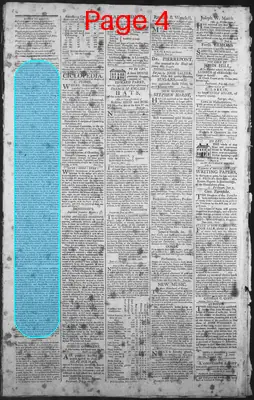
The New Hampshire Gazette
Portsmouth, Rockingham County, New Hampshire
What is this article about?
A letter critiques the spread of dissipation and luxury in American society, from cities to countryside, arguing it endangers the nation more than external threats or party politics. It laments extravagance ruining families, discouraging marriage among the talented, and calls for elite families to exemplify temperance to restore virtue.
Clipping

OCR Quality
Full Text
IF you think the following observations reasonable, or that they may induce some abler pen to take up the subject, they are at your service.
I hear a great cry about federalism and jacobinsm, and France and England, and all that:
But, Mr. Printer, it is my opinion, that our country is not in half so much danger from party spirit, nor the most formidable enemies without, as from dissipation and luxury, those destructive foes, within. These are imported evils; they came with hair dressers and dancing masters, and gew-gaws across the Atlantic; they have taken possession of our cities, and are advancing with rapid strides over the country. Extravagance in dress, in living, in amusements, pervades all ranks, as far as ability admits; and when it will not, to the ruin of many, as many a poor debtor can witness.
But to particularize a little.—Our opulent city gentlemen make entertainments, and their wives and daughters make tea parties; our city traders, city mechanics, &c. must also make entertainments, and their wives and daughters must have tea parties—This runs like wild-fire into the villages: Country doctors, country lawyers, country traders, and country mechanics, must make entertainments, and their wives and daughters must have tea parties too. City gentlemen have variety of meats, and expensive wines on their tables, and city ladies have foreign preserves and cordials at their parties.
—Country gentlemen must have as great a variety as they are able to procure, and country ladies must turn aside from their own orchards, where whole fruits would be a treat to a nobleman, and from their own currant bushes, swelling with delicious wines, and ransack the metropolis for outlandish sweetmeats and costly liquors, to regale their country neighbors with.
But this is not half:—A reputable man, who has lived forty or fifty years in the world, and saved money enough, in better days, to set up his sons in business, and portion his daughters, finds himself utterly incapable of doing either; for his purse must be drained to the bottom, that his family may appear like other people.
Girls, who ought to rise before the sun, to milk their fathers' cows, must be dizened out in lace and muslin, and stay till towards midnight at a party, because it would be vastly ungenteel to come home at other nine. A young man, who works hard all day to earn a dollar must have a ruffled shirt, silk stockings and morocco shoes, to appear in at night among the ladies.—His daily earnings will not support such expenses; he has no land to cultivate, nor any inclination to do it, if he had.
And what is the consequence? He is off at sea, or hires himself out behind some counter to learn the art of importing and vending those articles which are fast impoverishing his country.—Hence little trading shops in villages, as thick as bees in a tar barrel—farms neglected, men's wages (those few who are willing to labor) rise to an enormous height, and country produce of course in proportion.
But this is not all:—Another evil, which is in direct opposition to the establishment of Heaven, and the happiness of society, threatens this inconsiderate people. Let observation cast an eye around, and behold our young men of talents, education and spirit, who are now the ornaments, and ought to be the bulwarks of our nation—whose families might be nurseries of honor, virtue and religion, deterred from engaging in domestic connexions, by the excessive prodigality of the day.—Tho' able to live handsomely, they feel that they should be driven to desperation by the torrent of expense which they witness;—they therefore live single; the demands of custom are more imperious than those of principle.—What naturally follows? Libertinism or misanthropy. Thus is society deprived of a powerful incentive to goodness in the examples of conjugal faith, and parental affection;—and thus is one of the strongest bands of union among men left untwisted; for what patriot is so stable, what hero is so intrepid, as a husband, and a father.
Meantime those who are below ambition and destitute of information, marry apace, and are rearing a race of ignoramuses, whom they are scarce able to feed, much less educate—for what?—our future Presidents and Legislators! These are serious evils, and if not speedily remedied, will sap the foundation of our prosperity and happiness, and prostrate the fair fabric which was reared at the expense of so much blood, in irretrievable ruin. I don't wish to recommend the primeval simplicity of our forefathers, or advise the present generation to cut their meat on trenchers, or drink their milk out of wooden bowls; yet surely we might recall the temperance of those golden days which succeeded—the establishment of our excellent constitution.—What nation was so blessed with internal resources or external privileges? and what nation ever so wantonly abused their blessings?
But alas! how inadequate are the remonstrances of a solitary, obscure individual, to the cure of ills so extensive! the antidote, to be effectual, must be administered by the same hands which circulated the poison—and those are the principal families of our principal towns. Let them set an example, and the rest will follow—and although the progress of virtue may seem at first slow, compared with that of vice, yet in the end it is sure, and will certainly win the day.
r.Z.
What sub-type of article is it?
What themes does it cover?
What keywords are associated?
What entities or persons were involved?
Letter to Editor Details
Author
R.Z.
Recipient
Printer,
Main Argument
the greatest threats to the nation are internal dissipation and luxury, imported from europe, which foster extravagance across all classes, ruin families, discourage virtuous marriages, and undermine societal foundations; leading families must exemplify temperance to counteract these evils.
Notable Details