Thank you for visiting SNEWPapers!
Sign up free
Herald Of The United States
Warren, Bristol County, Rhode Island
What is this article about?
In the House of Lords on May 6, peers debated a bill allowing trade between the West Indies and America to support colonies during war, weighing Navigation Laws against practical necessities. Speakers included Duke of Clarence, Earl Camden, Lord Holland, and Lord Hawkesbury.
Merged-components note: Continuation of Imperial Parliament debate across pages.
Clippings
1 of 2
OCR Quality
Full Text
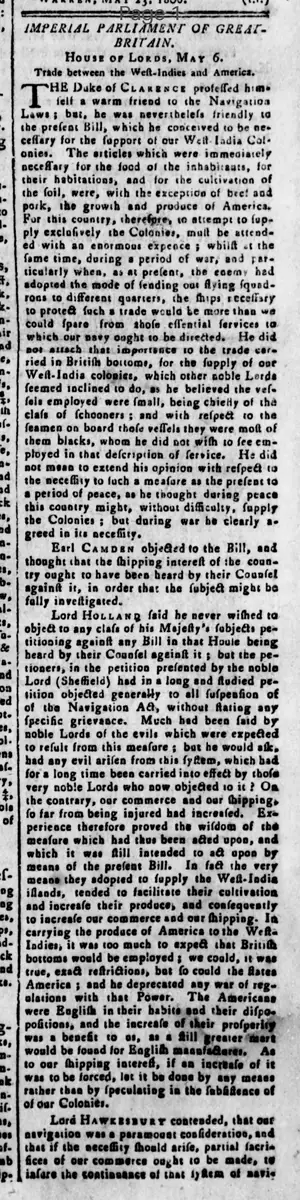
BRITAIN.
House of Lords, May 6.
Trade between the West-Indies and America.
The Duke of Clarence professed himself a warm friend to the Navigation Laws; but, he was nevertheless friendly to the present Bill, which he conceived to be necessary for the support of our West-India Colonies. The articles which were immediately necessary for the food of the inhabitants, for their habitations, and for the cultivation of the Soil, were, with the exception of beef and pork, the growth and produce of America.
For this country, therefore, to attempt to supply exclusively the Colonies, must be attended with an enormous expense; whilst at the same time, during a period of war, and particularly when, as at present, the enemy had adopted the mode of sending out flying squadrons to different quarters, the ships necessary to protect such trade would be more than we could spare from those essential services to which our navy ought to be directed. He did not attach that importance to the trade carried in British bottoms, for the supply of our West-India colonies, which other noble Lords seemed inclined to do, as he believed the vessels employed were small, being chiefly of the class of schooners; and with respect to the seamen on board those vessels they were most of them blacks, whom he did not wish to see employed in that description of service. He did not mean to extend his opinion with respect to the necessity to such a measure as the present to a period of peace, as he thought during peace this country might, without difficulty, supply the Colonies; but during war he clearly agreed in its necessity.
Earl Camden objected to the Bill, and thought that the shipping interest of the country ought to have been heard by their Counsel against it, in order that the subject might be fully investigated.
Lord Holland said he never wished to object to any class of his Majesty's Subjects petitioning against any Bill in that House being heard by their Counsel against it; but the petitioners, in the petition presented by the noble Lord (Sheffield) had in a long and studied petition objected generally to all suspension of the Navigation Act, without stating any specific grievance. Much had been said by noble Lords of the evils which were expected to result from this measure; but he would ask had any evil arisen from this System, which had for a long time been carried into effect by those very noble Lords who now objected to it? On the contrary, our commerce and our shipping, far from being injured had increased. Experience therefore proved the wisdom of the measure which had thus been acted upon, and which it was still intended to act upon by means of the present Bill. In fact the very means they adopted to supply the West-Indies islands, tended to facilitate their cultivation and increase their produce, and consequently to increase our commerce and our shipping. In carrying the produce of America to the West Indies, it was too much to expect that British bottoms would be employed; we could, it was true, exact restrictions, but so could the Americans; and he deprecated any war of regulations with that Power. The Americans were English in their habits and their dispositions, and the increase of their prosperity was a benefit to us, as a still greater mart would be found for English manufactures. As to our shipping interest, if an increase of it was to be forced, let it be done by any means rather than by Speculating in the Subsistence of our Colonies.
Lord Hawkesbury contended, that our navigation was a paramount consideration, and that if the necessity should arise, partial sacrifices of our commerce ought to be made, to ensure the continuance of that system of navigation Britain from whence had arisen all our maritime superiority. The present Bill, he maintained, was the first relaxation of the Navigation Laws enacted by a legislative act; it was a measure not called for by the necessity of the case, and might be productive of the greatest evils to the shipping interest of the country. He acknowledged there did, at times, exist a necessity for allowing the importation into our colonies, of articles essential to their use, in American bottoms; but he deprecated making a prospective regulation, and acknowledged the legality of such a trade. Objectionable as the mode certainly was, he still thought it better that the responsibility should rest with the Governors of our colonies, as it had hitherto done, of allowing such a trade, when they who were upon the spot should see the necessity of such a measure, than that such discretion should be vested in the Executive Government at home, who could not know when such a necessity existed in the Colonies. He agreed with his noble friend (Lord Holland) in much of what he had said with respect to America, but he thought that concessions on our part should rather be the result of negotiation, than talked of as if decided on in the first instance.
(To be concluded in our next.)
What sub-type of article is it?
What keywords are associated?
What entities or persons were involved?
Where did it happen?
Foreign News Details
Primary Location
West Indies
Event Date
May 6
Key Persons
Outcome
ongoing debate on bill allowing american trade to west indies during war; no final outcome reported, to be continued.
Event Details
Debate in House of Lords on bill relaxing Navigation Laws to permit direct trade from America to West-India colonies for essential supplies during wartime, balancing colonial needs against British shipping interests. Duke of Clarence supported for practicality; Earl Camden objected, wanting shipping interests heard; Lord Holland defended based on past success and benefits to commerce; Lord Hawkesbury opposed as unnecessary relaxation, preferring colonial governors' discretion.