Thank you for visiting SNEWPapers!
Sign up free
The Farmer And Mechanic
Raleigh, Wake County, North Carolina
What is this article about?
Biographical sketch of William Henry Hunt, Secretary of the Navy, detailing his background and four marriages: to Miss Andrews (short-lived), Miss Elizabeth Ridgely (happy, with children), Mrs. Harrison (divorced after brief marriage), and Miss Adams (validated against prior wife's adultery suit).
Clipping
OCR Quality
Full Text
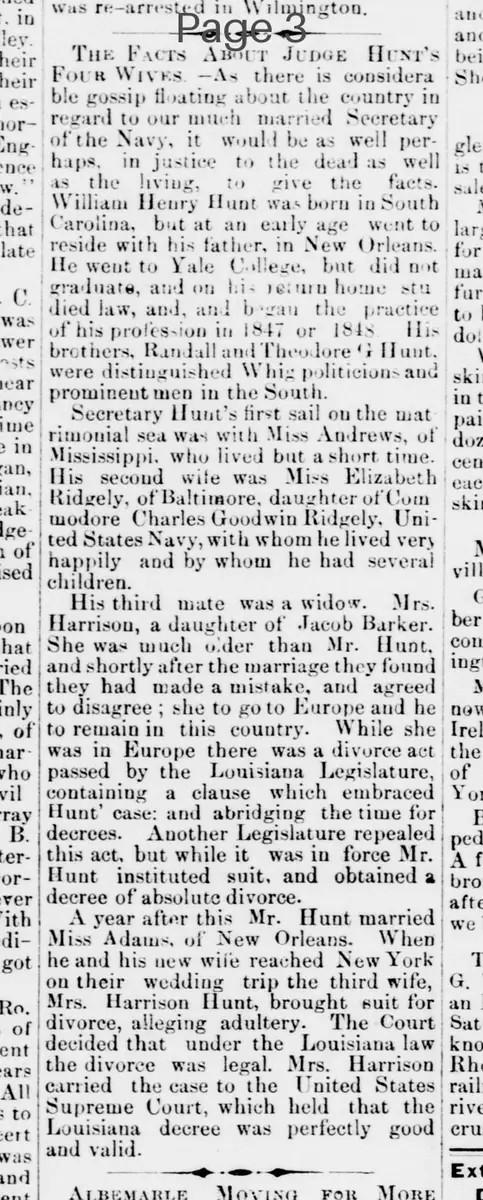
William Henry Hunt was born in South Carolina, but at an early age went to reside with his father, in New Orleans. He went to Yale College, but did not graduate, and on his return home studied law, and began the practice of his profession in 1847 or 1848. His brothers, Randall and Theodore G. Hunt, were distinguished Whig politicians and prominent men in the South.
Secretary Hunt's first sail on the matrimonial sea was with Miss Andrews, of Mississippi, who lived but a short time.
His second wife was Miss Elizabeth Ridgely, of Baltimore, daughter of Commodore Charles Goodwin Ridgely, United States Navy, with whom he lived very happily and by whom he had several children.
His third mate was a widow, Mrs. Harrison, a daughter of Jacob Barker. She was much older than Mr. Hunt, and shortly after the marriage they found they had made a mistake, and agreed to disagree; she to go to Europe and he to remain in this country. While she was in Europe there was a divorce act passed by the Louisiana Legislature containing a clause which embraced Hunt's case: and abridging the time for decrees. Another Legislature repealed this act, but while it was in force Mr. Hunt instituted suit, and obtained decree of absolute divorce.
A year after this Mr. Hunt married Miss Adams, of New Orleans. When he and his new wife reached New York on their wedding trip the third wife, Mrs. Harrison Hunt, brought suit for divorce, alleging adultery. The Court decided that under the Louisiana law the divorce was legal. Mrs. Harrison carried the case to the United States Supreme Court which held that the Louisiana decree was perfectly good and valid.
What sub-type of article is it?
What themes does it cover?
What keywords are associated?
What entities or persons were involved?
Where did it happen?
Story Details
Key Persons
Location
New Orleans, Louisiana
Event Date
1847 Or 1848
Story Details
William Henry Hunt's life and four marriages: first to short-lived Miss Andrews of Mississippi; second to happy union with Miss Elizabeth Ridgely of Baltimore, producing children; third to older widow Mrs. Harrison, daughter of Jacob Barker, ending in divorce via special Louisiana law, later validated by U.S. Supreme Court despite her adultery suit against his fourth marriage to Miss Adams of New Orleans.