Thank you for visiting SNEWPapers!
Sign up free
The Liberator
Boston, Suffolk County, Massachusetts
What is this article about?
Walter Savage Landor's letter to Daniel Webster urges dispassionate arbitration on the Oregon territory dispute, criticizes aggressive U.S. claims, warns of potential British strategies involving slave revolts, and advocates extending peace and cultural influence over force. Published in London Daily News, February (implied 1840s context).
Clipping
OCR Quality
Full Text
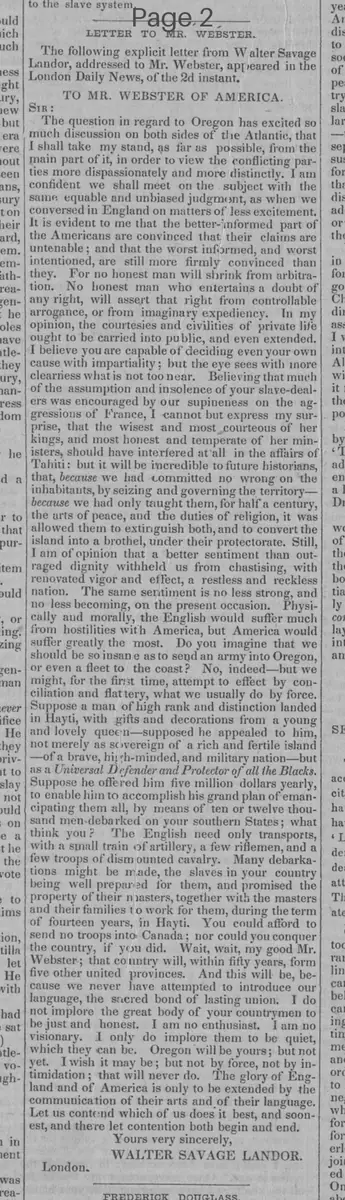
The following explicit letter from Walter Savage Landor, addressed to Mr. Webster, appeared in the London Daily News, of the 2d instant.
TO MR. WEBSTER OF AMERICA.
SIR:
The question in regard to Oregon has excited so much discussion on both sides of the Atlantic, that I shall take my stand, as far as possible, from the main part of it, in order to view the conflicting parties more dispassionately and more distinctly. I am confident we shall meet on the subject with the same equable and unbiased judgment, as when we conversed in England on matters of less excitement.
It is evident to me that the better-informed part of the Americans are convinced that their claims are untenable; and that the worst informed, and worst intentioned, are still more firmly convinced than they. For no honest man will shrink from arbitration. No honest man who entertains a doubt of any right, will assert that right from controllable arrogance, or from imaginary expediency. In my opinion, the courtesies and civilities of private life ought to be carried into public, and even extended.
I believe you are capable of deciding even your own cause with impartiality; but the eye sees with more clearness what is not too near. Believing that much of the assumption and insolence of your slave-dealers was encouraged by our supineness on the aggressions of France, I cannot but express my surprise, that the wisest and most courteous of her kings, and most honest and temperate of her ministers, should have interfered at all in the affairs of Tahiti: but it will be incredible to future historians, that, because we had committed no wrong on the inhabitants, by seizing and governing the territory— because we had only taught them, for half a century, the arts of peace, and the duties of religion, it was allowed them to extinguish both, and to convert the island into a brothel, under their protectorate. Still, I am of opinion that a better sentiment than outraged dignity withheld us from chastising, with renovated vigor and effect, a restless and reckless nation. The same sentiment is no less strong, and no less becoming, on the present occasion. Physically and morally, the English would suffer much from hostilities with America, but America would suffer greatly the most. Do you imagine that we should be so insane as to send an army into Oregon, or even a fleet to the coast? No, indeed-but we might, for the first time, attempt to effect by conciliation and flattery, what we usually do by force.
Suppose a man of high rank and distinction landed in Hayti, with gifts and decorations from a young and lovely queen—supposed he appealed to him, not merely as sovereign of a rich and fertile island —of a brave, high-minded, and military nation-but as a Universal Defender and Protector of all the Blacks. Suppose he offered him five million dollars yearly, to enable him to accomplish his grand plan of emancipating them all, by means of ten or twelve thousand men-debarked on your southern States; what think you? The English need only transports, with a small train of artillery, a few riflemen, and a few troops of dismounted cavalry. Many debarkations might be made, the slaves in your country being well prepared for them, and promised the property of their masters, together with the masters and their families to work for them, during the term of fourteen years, in Hayti. You could afford to send no troops into Canada; nor could you conquer the country, if you did. Wait, wait, my good Mr. Webster; that country will, within fifty years, form five other united provinces. And this will be, because we never have attempted to introduce our language, the sacred bond of lasting union. I do not implore the great body of your countrymen to be just and honest. I am no enthusiast. I am no visionary. I only do implore them to be quiet, which they can be. Oregon will be yours; but not yet. I wish it may be; but not by force, not by intimidation; that will never do. The glory of England and of America is only to be extended by the communication of their arts and of their language.
Let us contend which of us does it best, and soonest, and there let contention both begin and end.
Yours very sincerely,
WALTER SAVAGE LANDOR.
London.
What sub-type of article is it?
What themes does it cover?
What keywords are associated?
What entities or persons were involved?
Letter to Editor Details
Author
Walter Savage Landor
Recipient
Mr. Webster Of America
Main Argument
landor argues for a peaceful, impartial resolution to the oregon territorial dispute, asserting that american claims are untenable and war would harm both nations but america more; he warns against aggression by suggesting britain could incite slave revolts in the u.s. south instead of direct conflict.
Notable Details