Thank you for visiting SNEWPapers!
Sign up free
Daily National Intelligencer
Washington, District Of Columbia
What is this article about?
British Commons passes bill consolidating acts on longitude discovery, encouraging Northwest Passage and North Pole approaches. Adds scientists to Board of Longitude, addresses Nautical Almanac errors. Historical overview includes rewards from Queen Anne era, Harrison's chronometer success, and Newton's role.
Clipping
OCR Quality
Full Text
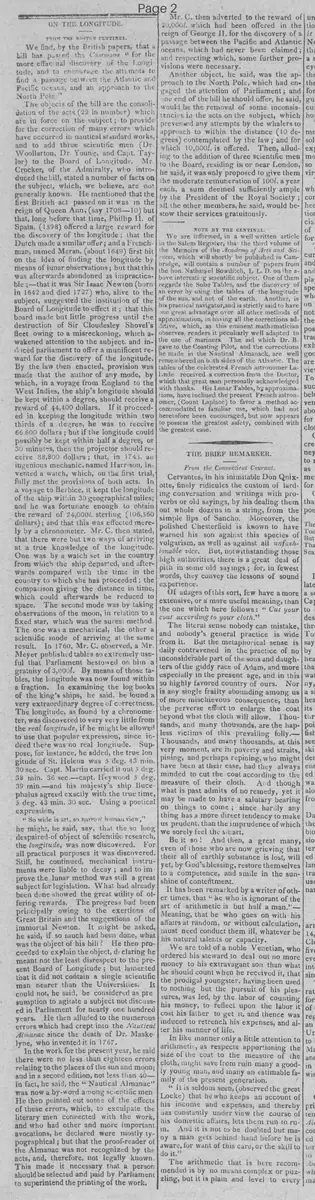
FROM THE STAR.
We find, by the British papers, that a bill has passed the Commons "for the more effectual discovery of the Longitude, and to encourage the attempts to find a passage between the Atlantic and Pacific oceans, and an approach to the North Pole."
The objects of the bill are the consolidation of the acts (22 in number) which are in force on the subject; to provide for the correction of many errors which have occurred in nautical standard works, and to add three scientific men (Dr. Woollarton, Dr. Young, and Capt. Taylor) to the Board of Longitude. Mr. Crocker, of the Admiralty, who introduced the bill, stated a number of facts on the subject, which, we believe, are not generally known. He mentioned that the first British act passed on it was in the reign of Queen Anne, (say 1700-10) but that, long before that time, Phillip II. of Spain, (1598) offered a large reward for the discovery of the longitude; that the Dutch made a similar offer; and a Frenchman, named Meran, (about 1640) first hit on the idea of finding the longitude by means of lunar observations; but that this was afterwards abandoned as impracticable;-that it was Sir Isaac Newton (born in 1642 and died 1727) who, alive to the subject, suggested the institution of the Board of Longitude to effect it : that this board made but little progress until the destruction of Sir Cloudesley Shovel's fleet owing to a misreckoning, which awakened attention to the subject. and induced parliament to offer a munificent reward for the discovery of the longitude. By the law then enacted, provision was made that the author of any mode, by which, in a voyage from England to the West Indies. the ship's longitude should be kept within a degree, should receive a reward of 10,000 pounds. If it proceeded in keeping the longitude within two thirds of a degree, he was to receive 15,000 pounds; but if the longitude could possibly be kept within half a degree, or 30 minutes, then the projector should receive 20,000 pounds; that. in 1745, an ingenious mechanic, named Harrison, invented a watch, which, on the first trial, fully met the provisions of both acts. In a voyage to Berbice, it kept the longitude of the ship within 30 geographical miles; and he was fortunate enough to obtain the reward of 10,000l. sterling (44,400 dollars); and that this was effected merely by a chronometer. Mr. C. then stated, that there were but two ways of arriving at a true knowledge of the longitude. One was by a watch set in the country from which the ship departed. and afterwards compared with the time in the country to which she has proceeded; the comparison giving the distance in time, which could afterwards be reduced to space. The second mode was by taking observations of the moon, in relation to a fixed star, which was the surest method. The one was a mechanical, the other a scientific mode of arriving at the same result. In 1760, Mr. C. observed, a Mr. Mayer published tables so extremely useful that Parliament bestowed on him a gratuity of 300l. By means of those tables, the longitude was now found within a fraction, In examining the log books of the king's ships, he said. he found a very extraordinary degree of correctness. The longitude, as found by a chronometer, was discovered to vary very little from the real longitude, if he might be allowed to use that popular expression, since indeed there was no real longitude. Suppose, for instance, he added, the true longitude of St. Helena was 5 deg. 43 min. 30 sec. Capt. Martin carried it out 5 deg. 38 min. 36 sec.--capt. Heywood 5 deg. 39 min --and his majesty's ship Bucephalus agreed exactly with the true time, 5 deg. 43 min. 30 sec. Using a poetical expression,
" So wide is art, so narrow human view,"
he might, he said, say, that the so long despaired-of object of scientific research, the longitude, was now discovered. For all practical purposes it was discovered. Still, he continued, mechanical instruments were liable to decay ; and to improve the lunar method was still a great subject for legislation. What had already been done showed the great utility of offering rewards. The progress had been principally owing to the exertions of Great Britain and the suggestions of the immortal Newton. It might be asked, he said, if so much had been done, what was the object of his bill ? He then proceeded to explain the object, declaring he meant not the least disrespect to the present Board of Longitude; but lamented that it did not contain a single scientific man nearer than the Universities. It could not, he said, be considered as presumption to agitate a subject not discussed in Parliament for nearly one hundred years. He then alluded to the numerous errors which had crept into the Nautical Almanac since the death of Dr. Maskelyne, who invented it in 1767. In the work for the present year, he said there were no less than eighteen errors relating to the places of the sun and moon; and in a second edition, not less than 40- in fact, he said, the " Nautical Almanac" was now a by-word among scientific men He then pointed out some of the effects of these errors, which, to exculpate the literary men connected with the work, and who had other and more important avocations, he declared were mostly typographical; but that the proof-reader of the Almanac was not recognized by the acts, and, therefore, not legally known. This made it necessary that a person should be selected and paid by Parliament to superintend the printing of the work.
What sub-type of article is it?
What keywords are associated?
What entities or persons were involved?
Where did it happen?
Foreign News Details
Primary Location
Britain
Key Persons
Outcome
bill passed consolidating 22 acts, adding three scientists to board of longitude, addressing errors in nautical almanac; historical rewards awarded, e.g., harrison received 10,000 pounds for chronometer keeping longitude within 30 miles.
Event Details
Bill passed in Commons for better longitude discovery, consolidating prior acts, correcting nautical errors, adding Dr. Woollarton, Dr. Young, Capt. Taylor to Board. Mr. Crocker detailed history: Spanish/Dutch rewards pre-1700, Newton's Board suggestion post-1640, post-Shovel fleet loss rewards (10,000-20,000 pounds for accuracy). Harrison's 1745 chronometer succeeded in Berbice voyage. Two methods: chronometer or lunar observations. Mayer's 1760 tables aided precision. Examples of ship log accuracy at St. Helena. Bill improves lunar method, fixes Almanac errors since Maskelyne's 1767 invention (18-40 errors in current edition).