Thank you for visiting SNEWPapers!
Sign up free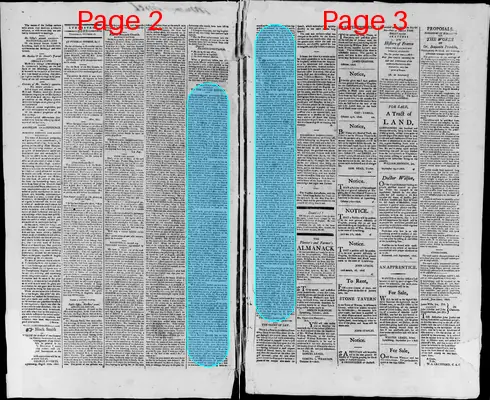
Lynchburg Star
Lynchburg, Virginia
What is this article about?
An American writing from Paris appeals to the British nation against their government's violations of neutral rights during wars, critiquing seizures of American ships, the Rule of 1756 on colonial trade, and urging respect for international law to avoid war.
Merged-components note: Continuation of the essay 'To the British Nation' on neutral rights and British maritime policies, spanning pages 2 and 3 with sequential reading order; relabeled from domestic_news and editorial to editorial as it is an argumentative opinion piece signed 'AN AMERICAN'.
Clippings

1 of 2
OCR Quality
Full Text
TO THE BRITISH NATION
Arrogant as your government has often shewn itself in moments of success, proud and domineering as is the character of your civil and military officers towards unarmed and defenceless nations, I have too much philanthropy to attribute to the mass of any nation the vices of its administration. I will still delight to believe, that there exists in the British Nation a fund of justice and humanity, ready to avenge the injured and threatened rights of peaceful and impartial neutrality. In making an appeal to your sense of equity, I am still aware that I enter into an unpitying career. The application is made to one of the coldest, against one of the most influential principles of human action. National glory, cupidity, patriotism, and self-love, will be all invoked to combat your jealousy, your sense of justice. Still, supported by truth, and animated by a strong sense of unmerited injury, I come boldly to the combat, and if there yet remain in British bosoms, more love of honor than of money, more regard to reputation than wealth—more respect for justice than passion for domination, I shall not make my appeal without effect.
During the whole course of the late & present wars it is well known to all Europe & to no part of it better than yourselves, that the conduct of your cruizers; & of your courts of admiralty have been marked by an uninterrupted series of violations of neutral rights. So long as these infractions were restrained within such bounds, that upon authentical calculations, neutral nations thought it cheaper to submit to injustice, rather than incur the expences and risques of the process necessary to redress, so long have they submitted to it as to an inevitable evil. But increasing insolence, & accumulated injury have finally proved the wisdom of the ancient maxim, "Obsta principiis," and have compelled us to adopt the sentiments of an elegant writer of your own country, "that a nation who weighs its purse against its rights, will in the end deserve to lose both."
In the early part of the late war, America made a stand, and it was a feeble one against your gigantic maritime pretensions, and 1,200,000 pounds sterling paid by you to her citizens, while it is a recorded proof of the injustice of your seizures, had perhaps the double and unfortunate effect of lulling her into security, and of exposing her in a defenceless state to the storm which appears to be now ready to burst upon her head.
Within a few months past, your cruizers and your obedient tribunals have overleaped the feeble boundaries which a sense of justice had hitherto opposed to rapacity, and the perusal of Doctors Commons would lead a stranger to believe, that America, and not France, was the object of your vengeance. Aware of the just indignation of a brave and loyal people, your ministry are endeavouring to shelter themselves from the tempest, and by rousing the avarice and resentment of the nation, to throw the responsibility from their own shoulders upon those of the people. A pamphlet, we learn, has lately appeared, under ministerial sanction, attempting to justify their unprincipled and unexampled aggressions, and preparing the public mind for what they know will be the effect of their perseverance, an open war.
Will you lend a patient ear to a stranger, while he examines one or two of the principles advanced by your courts styling themselves courts of justice—and in the second place, while he offers a brief reply to some of the ideas said to be advanced in the ministerial pamphlet in favour of a war with America.
Although from the nature of the case, there can be less precision, and certainty in discussing questions upon the law of nations, than upon those of municipal authority, founded upon decrees or statutes, yet the common consent of all the nations of Europe do adopt certain principles as laid down by certain able commentators on these laws, and the introduction of these writers, as authorities in the courts of admiralty, seem to have furnished a solid basis on which to rest our opinions—on any questions which may arise between conflicting nations.
Great Britain especially has no right to controvert the principles laid down by these writers: because she has uniformly received them as authorities in her courts and has always made them the basis of her claims on other nations, in her judicial and diplomatic relations. If on the other hand, there existed no such commentators, nor any positive conventions between nations, still the force and obligation of the laws of nations, founded on the immutable principles of justice and morality, would be equally great; but in this latter case we could only have recourse to the law of nature, and the dictates of common sense.
Course to the principles of natural law suggested and deduced by impartial reason.
--Let us examine the two great modern novel doctrines advanced, and attempted to be enforced by G. Britain, by either of these standards. And, first, as to her interdiction of the Colonial trade, either directly or indirectly. G. Britain contends that neutrals in time of war shall not carry on a trade between the colonies of her enemy and the mother country, which was not lawful in time of peace, although the trade be bona fide on neutral account at neutral risk, and for neutral profit.
On what authority is this extensive and important principle founded? Is there any decision in Pufendorf--in Grotius--in Vattel which justifies it? Is it supported by any convention explicit or implicit made between any nations of Europe? Have there been any usages in past wars, decisions of any courts of admiralty, which countenance it?
To all these questions we can boldly reply. None. Not a sentiment like this can be found in any writer; nor has any nation but G. Britain yet dared to offer such an affront to the rights of independent nations.
On the contrary, no principle can be more clearly settled than that neutrals may freely carry on their commerce with belligerent nations, with the single, well defined exceptions, of not giving relief to an invested and blockaded city or fortress, and of supplying the enemy with things appertaining to war, to which has been applied the appellation of contraband.
This privilege of neutrals is even carried so far, that neutral nations have the right to supply freely one of the belligerent nations with implements of war, provided its usual commerce in time of peace consisted in supplying such articles. Never did the question, whether the traffic was such a one as was allowed by the belligerent nation in time of peace, apply to any other than contraband articles, arise in any single instance, till the British, inspired by the same jealousy against the Dutch in 1756, as now actuates them against the Americans, chose to advance this monstrous doctrine.
And let me ask, what is it to G. Britain, if France or Holland should see fit during a war to relax their municipal regulations, in favour of other nations? If these nations supply them with none of those articles which are denominated contraband of war, what pretext could G. Britain have to complain of the indulgence? The enormous and preposterous principles set up by the British courts, would go the length to say, that no nation at war with her, could change her municipal laws, could alter her colonial regulations in time of war. Let us examine this point a little nearer as it respects G. Britain, and her own conduct, and see whether it comports with her principles. It is a well known fact, that by the standing laws of G. Britain, other nations have no right to supply the British colonies with provisions, or to carry on any trade therewith. Particular permission is, however, granted in time of war, by proclamation, from the governors of these islands, authorizing the importation of provisions during the existence of the scarcity only. Did G. Britain ever conceive, did any nation ever contend, that the American vessels which carry on this commerce were a lawful prize to the enemies of G. Britain? Miserable indeed would be the situation of the Caribbean Islands if such a construction had prevailed! Yet it must be admitted that the cases are perfectly analogous. It is a trade which the Americans were not free to exercise in time of peace, and which G. Britain allows only on account of her necessities in time of war.
To show that this principle set up in one case only by the British courts in the war of 1756, and afterwards wholly abandoned until the year 1794, is not one on the solidity of which, the British courts themselves place any great reliance, we will examine the history of its exercise and execution.
No one can doubt that, with the British power and with the British temper to maintain all their legal maritime rights, they have extended their principles as far and as fast as the laws of nations would warrant.
They set up this principle of the legality of the trade between the colony and the mother country, against the Americans in the year 1793. They founded it upon the ground, and the single ground, that the trade not having been lawful in time of peace, and being granted only on account of the inability of their enemies to carry it on themselves, was for that reason only unlawful. If this doctrine was founded in law, then the trade between America itself and those colonies, having been unlawful in time of peace; was equally illegal in time of war. But at no moment have they dared to start this odious idea, though on principles equally tenable. A few captures only were made before our treaty with Great Britain, and for these few ample compensation has been made by G. Britain, thus implicitly recognizing the injustice of the principle.
The residue in another number.
AN AMERICAN.
What sub-type of article is it?
What keywords are associated?
What entities or persons were involved?
Editorial Details
Primary Topic
Appeal Against British Violations Of American Neutral Rights In Wartime Colonial Trade
Stance / Tone
Strongly Critical Of British Maritime Policies And Advocacy For Neutral Rights
Key Figures
Key Arguments