Thank you for visiting SNEWPapers!
Sign up free
Editorial
January 31, 1840
The Liberator
Boston, Suffolk County, Massachusetts
What is this article about?
Editorial in The Liberator critiques Gerrit Smith's letter on political action for abolitionists, arguing against forming a third party to avoid dividing the movement, favoring influence on existing Whig and Democratic parties via moral suasion and strategic voting to advance anti-slavery goals.
Clipping
OCR Quality
98%
Excellent
Full Text
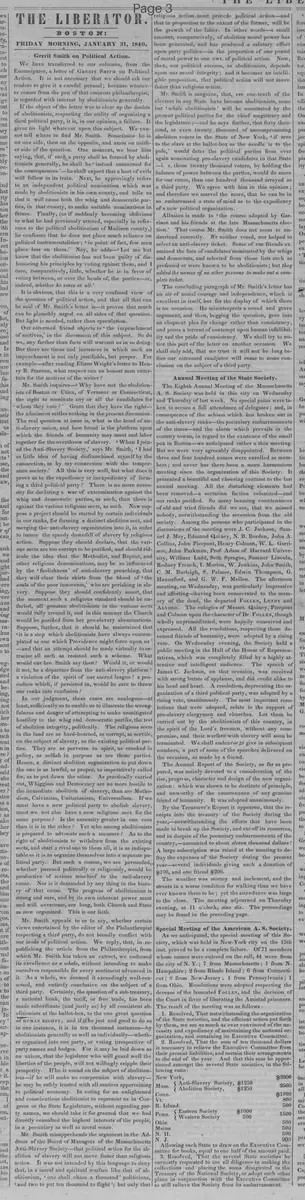
THE LIBERATOR.
BOSTON:
FRIDAY MORNING, JANUARY 31, 1840.
Gerrit Smith on Political Action.
We have transferred to our columns, from the Emancipator, a letter of Gerrit Smith on Political Action. It is not necessary that we should ask our readers to give it a careful perusal; because whatever comes from the pen of that eminent philanthropist, is regarded with interest by abolitionists generally.
If the object of the letter was to clear up the doubts of abolitionists, respecting the utility of organizing a third political party, it is, in our opinion, a failure. It gives no light whatever upon this subject. We cannot tell where to find Mr. Smith. Sometimes he is on one side, then on the opposite, and anon on neither side of the question. One moment, we hear him saying, that, if such a party shall be formed by abolitionists generally, he shall be 'indeed concerned for the consequences'—he shall expect that a host of evils will follow in its train. Next, he approvingly refers to an independent political nomination which was made by abolitionists in his own county, and tells us that it will cause both the whig and democratic parties, in that county, to make suitable nominations in future. Finally, (as if suddenly becoming oblivious to what he had previously uttered, especially in reference to the political abolitionism of Madison county,) he confesses that he does not place much reliance on political instrumentalities; 'in point of fact, few men place less on them.' Nay, he adds—'Let me but know that the abolitionist has not been guilty of dishonoring his principles by voting against them, and I care, comparatively, little, whether he is in favor of voting between, or over the heads of, the parties—or, indeed, whether he votes at all.'
It is obvious, that this is a very confused view of the question of political action, and that all that can be said of Mr. Smith's letter is—it proves that much can be plausibly urged on all sides of that question.
But light is needed, rather than speculation.
Our esteemed friend objects to 'the impeachment of motives,' in the discussion of this subject. So do we, any farther than facts will warrant us in so doing. But there are times and instances in which such an impeachment is not only justifiable, but proper. For example—after reading Elizur Wright's letter to Henry B. Stanton, what respect can an honest man entertain for the motives of the writer?
Mr. Smith inquires—Why have not the abolitionists of Boston or Utica, of Vermont or Connecticut, the right to nominate any or all the candidates for whom they vote? Grant that they have the right—the admission settles nothing in the present discussion. The real question at issue is, what is the bond of anti-slavery union, and how broad is the platform upon which the friends of humanity may meet and labor together for the overthrow of slavery. When I joined the Anti-Slavery Society,' says Mr. Smith, 'I had as little idea of having disfranchised myself by the connection, as by my connection with the temperance society.' All this is very well, but what does it prove as to the expediency or inexpediency of forming a third political party? There is no more necessity for declaring a war of extermination against the whig and democratic parties, as such, than there is against the various religious sects, as such. Now suppose a project should be started by certain individuals in our ranks, for forming a distinct abolition sect, and merging the anti-slavery organization into it, in order to insure the speedy downfall of slavery by religious action. Suppose they should declare, that the various sects are too corrupt to be purified, and should ridicule the idea that the Methodist, and Baptist, and other religious denominations, may be so influenced by the 'foolishness' of anti-slavery preaching, that they will clear their skirts from the blood of 'the souls of the poor innocents,' who are perishing in slavery. Suppose they should confidently assert, that the moment such a religious standard should be unfurled, all genuine abolitionists in the various sects would rally around it, and in this manner the Church would be purified from her pro-slavery abominations. Suppose, further, that it should be maintained that it is a step which abolitionists have always contemplated as one which Providence might force upon us—and that an attempt should be made virtually to ostracise all such as resisted such a scheme. What would our bro. Smith say then? Would it, or would it not, be a departure from the anti-slavery platform: a violation of the spirit of our sacred league? a procedure which, if persisted in, would be sure to throw our ranks into confusion?
In our judgment, these cases are analogous—at least, sufficiently so to enable us to illustrate the wrongfulness and danger of attempting to make unmitigated hostility to the whig and democratic parties, the test of abolition integrity, politically. The religious sects in the land are as hard-hearted, as corrupt, as servile, on the subject of slavery, as the existing political parties. They are as perverse in spirit, as crooked in policy, as selfish in purpose as are those parties. Hence, a distinct abolition organization to put down the one is as lawful, as proper, as imperatively called for, as to put down the other. As practically carried out, Whiggism and Democracy are no more hostile to the immediate abolition of slavery, than are Methodism, Calvinism, Unitarianism, Universalism. If we must have a new political party to abolish slavery, must we not also have a new religious sect for the same purpose? Is the necessity greater in one case than it is in the other? Yet who among abolitionists is prepared to advocate such a measure? As to the right of abolitionists to withdraw from the existing sects, and start a rival one to them all, it is as indisputable as it is to organize themselves into a separate political party. But such a course, we are persuaded, whether pursued politically or religiously, would be productive of serious mischief to the anti-slavery cause. Nor is it demanded by any thing in the history of that cause. The progress of abolitionism is strong and sure, and by its own inherent power must and will overcome, ere long, both Church and State as now organized. This is our faith.
Mr. Smith appeals to us to say, whether certain views entertained by the editor of the Philanthropist respecting a third party, do not broadly conflict with our mode of political action. We reply, that, in republishing the article from the Philanthropist, from which Mr. Smith has taken an extract, we endorsed its excellence as a whole, without intending to make ourselves responsible for every sentiment advanced in it. As a whole, we deemed it exceedingly well-reasoned, and entirely conclusive on the subject of a third party. Certainly, the question of a sub-treasury, a national bank, the tariff, or free trade, has been made subordinate (and justly so) by all consistent abolitionists at the ballot-box, to the one great question of HUMAN RIGHTS; and if it be just and good to do so in one instance, it is in ten thousand instances—by abolitionists generally as well as individually—whether organized into one party, or voting irrespective of party names and badges. For it may be laid down as an axiom, that the legislator who will guard well the liberties of the people, will not willingly cripple their prosperity. If he is sound on the subject of abolitionism—if he will make no compromise with slavery—he may be safely trusted with all matters appertaining to political economy. In voting for an enlightened and conscientious abolitionist to represent us in Congress or the State Legislature, without regarding party names, we should take it for granted that we had directly consulted the highest interests of the people, in a pecuniary as well as moral sense.
Mr. Smith misapprehends the argument in the Address of the Board of Managers of the Massachusetts Anti-Slavery Society—that political action for the abolition of slavery will not move faster than religious action. It was not intended by this language to deny that, in a moral and spiritual warfare like that of abolitionism, 'one shall chase a thousand' politicians, and two to put ten thousand to flight'; but only that religious action must precede political action—and that in proportion to the extent of the former, will be the growth of the latter. In other words—a small amount, comparatively, of abolition moral power has been generated, and has produced a salutary effect upon party politics—in the proportion of one pound of moral power to one cwt. of political action. Now, then, our political success, as abolitionists, depends upon our moral integrity; and it becomes an intelligible proposition, that political action will not move faster than religious action.
Mr. Smith is sanguine, that, ere one-tenth of the electors in any State have become abolitionists, none but 'whole abolitionists' will be nominated by the present political parties for the chief magistracy and the legislature;—and he says further, that forty thousand, or even twenty thousand of uncompromising abolition voters in the State of New York, if true to the slave at the ballot-box as the needle is to the pole,' would deter the political parties from ever again nominating pro-slavery candidates in that State—i. e. those twenty thousand voters, by holding the balance of power between the parties, would do more for our cause, than one hundred thousand arrayed as a third party. We agree with him in this opinion: and therefore we marvel the more, that he can be in so embarrassed a state of mind as to the expediency of a new political organization.
Allusion is made to 'the course adopted by Garrison and his friends at the late Massachusetts election.' That course Mr. Smith does not seem to understand correctly. We neither voted, nor helped to select an anti-slavery ticket. Some of our friends examined the lists of candidates nominated by the whigs and democrats, and selected from those lists such as professed or were known to be abolitionists; but they added the names of no other persons to make out a complete ticket.
The concluding paragraph of Mr. Smith's letter has an air of moral courage and independence, which is excellent in itself, but for the display of which there is no occasion. He misinterprets a sound and grave argument, and then, begging the question, goes into an eloquent plea for change rather than consistency, and pours a torrent of contempt upon human infallibility and the pride of consistency. We shall try to notice this part of the letter on another occasion. We shall only add, that we trust it will not be long before our esteemed coadjutor will come to some conclusion on the subject of a third party.
BOSTON:
FRIDAY MORNING, JANUARY 31, 1840.
Gerrit Smith on Political Action.
We have transferred to our columns, from the Emancipator, a letter of Gerrit Smith on Political Action. It is not necessary that we should ask our readers to give it a careful perusal; because whatever comes from the pen of that eminent philanthropist, is regarded with interest by abolitionists generally.
If the object of the letter was to clear up the doubts of abolitionists, respecting the utility of organizing a third political party, it is, in our opinion, a failure. It gives no light whatever upon this subject. We cannot tell where to find Mr. Smith. Sometimes he is on one side, then on the opposite, and anon on neither side of the question. One moment, we hear him saying, that, if such a party shall be formed by abolitionists generally, he shall be 'indeed concerned for the consequences'—he shall expect that a host of evils will follow in its train. Next, he approvingly refers to an independent political nomination which was made by abolitionists in his own county, and tells us that it will cause both the whig and democratic parties, in that county, to make suitable nominations in future. Finally, (as if suddenly becoming oblivious to what he had previously uttered, especially in reference to the political abolitionism of Madison county,) he confesses that he does not place much reliance on political instrumentalities; 'in point of fact, few men place less on them.' Nay, he adds—'Let me but know that the abolitionist has not been guilty of dishonoring his principles by voting against them, and I care, comparatively, little, whether he is in favor of voting between, or over the heads of, the parties—or, indeed, whether he votes at all.'
It is obvious, that this is a very confused view of the question of political action, and that all that can be said of Mr. Smith's letter is—it proves that much can be plausibly urged on all sides of that question.
But light is needed, rather than speculation.
Our esteemed friend objects to 'the impeachment of motives,' in the discussion of this subject. So do we, any farther than facts will warrant us in so doing. But there are times and instances in which such an impeachment is not only justifiable, but proper. For example—after reading Elizur Wright's letter to Henry B. Stanton, what respect can an honest man entertain for the motives of the writer?
Mr. Smith inquires—Why have not the abolitionists of Boston or Utica, of Vermont or Connecticut, the right to nominate any or all the candidates for whom they vote? Grant that they have the right—the admission settles nothing in the present discussion. The real question at issue is, what is the bond of anti-slavery union, and how broad is the platform upon which the friends of humanity may meet and labor together for the overthrow of slavery. When I joined the Anti-Slavery Society,' says Mr. Smith, 'I had as little idea of having disfranchised myself by the connection, as by my connection with the temperance society.' All this is very well, but what does it prove as to the expediency or inexpediency of forming a third political party? There is no more necessity for declaring a war of extermination against the whig and democratic parties, as such, than there is against the various religious sects, as such. Now suppose a project should be started by certain individuals in our ranks, for forming a distinct abolition sect, and merging the anti-slavery organization into it, in order to insure the speedy downfall of slavery by religious action. Suppose they should declare, that the various sects are too corrupt to be purified, and should ridicule the idea that the Methodist, and Baptist, and other religious denominations, may be so influenced by the 'foolishness' of anti-slavery preaching, that they will clear their skirts from the blood of 'the souls of the poor innocents,' who are perishing in slavery. Suppose they should confidently assert, that the moment such a religious standard should be unfurled, all genuine abolitionists in the various sects would rally around it, and in this manner the Church would be purified from her pro-slavery abominations. Suppose, further, that it should be maintained that it is a step which abolitionists have always contemplated as one which Providence might force upon us—and that an attempt should be made virtually to ostracise all such as resisted such a scheme. What would our bro. Smith say then? Would it, or would it not, be a departure from the anti-slavery platform: a violation of the spirit of our sacred league? a procedure which, if persisted in, would be sure to throw our ranks into confusion?
In our judgment, these cases are analogous—at least, sufficiently so to enable us to illustrate the wrongfulness and danger of attempting to make unmitigated hostility to the whig and democratic parties, the test of abolition integrity, politically. The religious sects in the land are as hard-hearted, as corrupt, as servile, on the subject of slavery, as the existing political parties. They are as perverse in spirit, as crooked in policy, as selfish in purpose as are those parties. Hence, a distinct abolition organization to put down the one is as lawful, as proper, as imperatively called for, as to put down the other. As practically carried out, Whiggism and Democracy are no more hostile to the immediate abolition of slavery, than are Methodism, Calvinism, Unitarianism, Universalism. If we must have a new political party to abolish slavery, must we not also have a new religious sect for the same purpose? Is the necessity greater in one case than it is in the other? Yet who among abolitionists is prepared to advocate such a measure? As to the right of abolitionists to withdraw from the existing sects, and start a rival one to them all, it is as indisputable as it is to organize themselves into a separate political party. But such a course, we are persuaded, whether pursued politically or religiously, would be productive of serious mischief to the anti-slavery cause. Nor is it demanded by any thing in the history of that cause. The progress of abolitionism is strong and sure, and by its own inherent power must and will overcome, ere long, both Church and State as now organized. This is our faith.
Mr. Smith appeals to us to say, whether certain views entertained by the editor of the Philanthropist respecting a third party, do not broadly conflict with our mode of political action. We reply, that, in republishing the article from the Philanthropist, from which Mr. Smith has taken an extract, we endorsed its excellence as a whole, without intending to make ourselves responsible for every sentiment advanced in it. As a whole, we deemed it exceedingly well-reasoned, and entirely conclusive on the subject of a third party. Certainly, the question of a sub-treasury, a national bank, the tariff, or free trade, has been made subordinate (and justly so) by all consistent abolitionists at the ballot-box, to the one great question of HUMAN RIGHTS; and if it be just and good to do so in one instance, it is in ten thousand instances—by abolitionists generally as well as individually—whether organized into one party, or voting irrespective of party names and badges. For it may be laid down as an axiom, that the legislator who will guard well the liberties of the people, will not willingly cripple their prosperity. If he is sound on the subject of abolitionism—if he will make no compromise with slavery—he may be safely trusted with all matters appertaining to political economy. In voting for an enlightened and conscientious abolitionist to represent us in Congress or the State Legislature, without regarding party names, we should take it for granted that we had directly consulted the highest interests of the people, in a pecuniary as well as moral sense.
Mr. Smith misapprehends the argument in the Address of the Board of Managers of the Massachusetts Anti-Slavery Society—that political action for the abolition of slavery will not move faster than religious action. It was not intended by this language to deny that, in a moral and spiritual warfare like that of abolitionism, 'one shall chase a thousand' politicians, and two to put ten thousand to flight'; but only that religious action must precede political action—and that in proportion to the extent of the former, will be the growth of the latter. In other words—a small amount, comparatively, of abolition moral power has been generated, and has produced a salutary effect upon party politics—in the proportion of one pound of moral power to one cwt. of political action. Now, then, our political success, as abolitionists, depends upon our moral integrity; and it becomes an intelligible proposition, that political action will not move faster than religious action.
Mr. Smith is sanguine, that, ere one-tenth of the electors in any State have become abolitionists, none but 'whole abolitionists' will be nominated by the present political parties for the chief magistracy and the legislature;—and he says further, that forty thousand, or even twenty thousand of uncompromising abolition voters in the State of New York, if true to the slave at the ballot-box as the needle is to the pole,' would deter the political parties from ever again nominating pro-slavery candidates in that State—i. e. those twenty thousand voters, by holding the balance of power between the parties, would do more for our cause, than one hundred thousand arrayed as a third party. We agree with him in this opinion: and therefore we marvel the more, that he can be in so embarrassed a state of mind as to the expediency of a new political organization.
Allusion is made to 'the course adopted by Garrison and his friends at the late Massachusetts election.' That course Mr. Smith does not seem to understand correctly. We neither voted, nor helped to select an anti-slavery ticket. Some of our friends examined the lists of candidates nominated by the whigs and democrats, and selected from those lists such as professed or were known to be abolitionists; but they added the names of no other persons to make out a complete ticket.
The concluding paragraph of Mr. Smith's letter has an air of moral courage and independence, which is excellent in itself, but for the display of which there is no occasion. He misinterprets a sound and grave argument, and then, begging the question, goes into an eloquent plea for change rather than consistency, and pours a torrent of contempt upon human infallibility and the pride of consistency. We shall try to notice this part of the letter on another occasion. We shall only add, that we trust it will not be long before our esteemed coadjutor will come to some conclusion on the subject of a third party.
What sub-type of article is it?
Slavery Abolition
Partisan Politics
What keywords are associated?
Third Party
Political Action
Abolitionism
Gerrit Smith
Anti Slavery Union
Whig Party
Democratic Party
Moral Suasion
What entities or persons were involved?
Gerrit Smith
Elizur Wright
Henry B. Stanton
Massachusetts Anti Slavery Society
Garrison
Whig Party
Democratic Party
Editorial Details
Primary Topic
Debate On Third Political Party For Abolitionists
Stance / Tone
Critical Of Third Party Formation, Favoring Influence On Existing Parties
Key Figures
Gerrit Smith
Elizur Wright
Henry B. Stanton
Massachusetts Anti Slavery Society
Garrison
Whig Party
Democratic Party
Key Arguments
Smith's Letter Fails To Clarify Utility Of Third Party
Forming Third Party Risks Dividing Abolitionists Like A New Religious Sect Would
Influence Existing Parties Through Moral Suasion And Balance Of Power Voting
Political Action Follows Religious/Moral Action In Abolitionism
Abolitionists Can Vote For Anti Slavery Candidates Across Party Lines