Thank you for visiting SNEWPapers!
Sign up free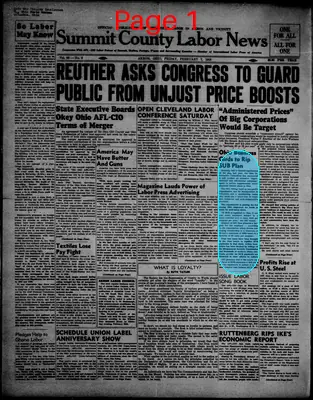
Story
February 7, 1958
Summit County Labor News
Akron, Summit County, Ohio
What is this article about?
The Ohio Information Committee, a non-profit group of business leaders, announces a campaign to block legalization of supplemental unemployment benefit (SUB) plans in Ohio, citing costs to employers and promising legislative action if courts rule in favor.
Clipping
OCR Quality
95%
Excellent
Full Text
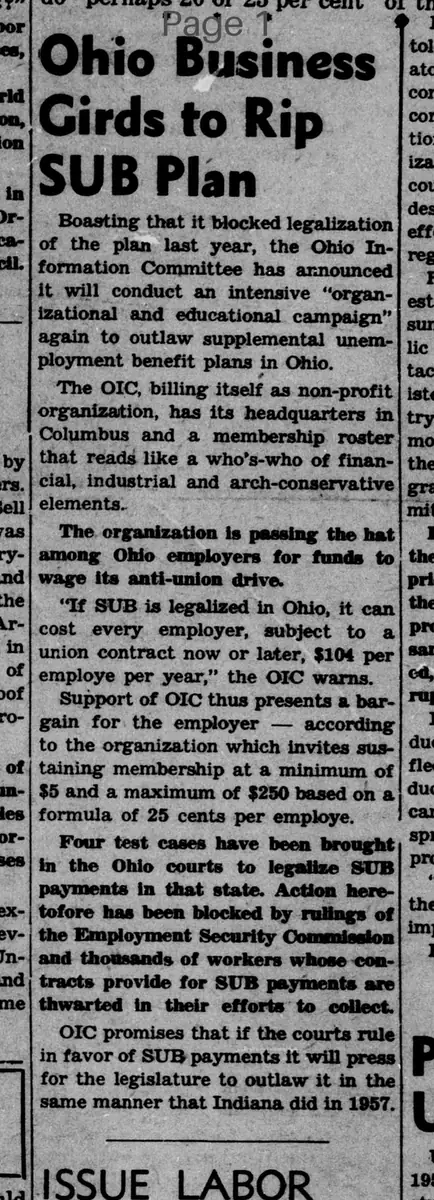
Ohio Business
Girds to Rip
SUB Plan
Boasting that it blocked legalization of the plan last year, the Ohio Information Committee has announced it will conduct an intensive "organizational and educational campaign" again to outlaw supplemental unemployment benefit plans in Ohio.
The OIC, billing itself as non-profit organization, has its headquarters in Columbus and a membership roster that reads like a who's-who of financial, industrial and arch-conservative elements.
The organization is passing the hat among Ohio employers for funds to wage its anti-union drive.
"If SUB is legalized in Ohio, it can cost every employer, subject to a union contract now or later, $104 per employee per year," the OIC warns.
Support of OIC thus presents a bargain for the employer -- according to the organization which invites sustaining membership at a minimum of $5 and a maximum of $250 based on a formula of 25 cents per employee.
Four test cases have been brought in the Ohio courts to legalize SUB payments in that state. Action heretofore has been blocked by rulings of the Employment Security Commission and thousands of workers whose contracts provide for SUB payments are thwarted in their efforts to collect.
OIC promises that if the courts rule in favor of SUB payments it will press for the legislature to outlaw it in the same manner that Indiana did in 1957.
Girds to Rip
SUB Plan
Boasting that it blocked legalization of the plan last year, the Ohio Information Committee has announced it will conduct an intensive "organizational and educational campaign" again to outlaw supplemental unemployment benefit plans in Ohio.
The OIC, billing itself as non-profit organization, has its headquarters in Columbus and a membership roster that reads like a who's-who of financial, industrial and arch-conservative elements.
The organization is passing the hat among Ohio employers for funds to wage its anti-union drive.
"If SUB is legalized in Ohio, it can cost every employer, subject to a union contract now or later, $104 per employee per year," the OIC warns.
Support of OIC thus presents a bargain for the employer -- according to the organization which invites sustaining membership at a minimum of $5 and a maximum of $250 based on a formula of 25 cents per employee.
Four test cases have been brought in the Ohio courts to legalize SUB payments in that state. Action heretofore has been blocked by rulings of the Employment Security Commission and thousands of workers whose contracts provide for SUB payments are thwarted in their efforts to collect.
OIC promises that if the courts rule in favor of SUB payments it will press for the legislature to outlaw it in the same manner that Indiana did in 1957.
What sub-type of article is it?
Historical Event
What themes does it cover?
Justice
Social Manners
What keywords are associated?
Sub Plan
Ohio Business
Anti Union Campaign
Oic
Labor Dispute
Employer Costs
What entities or persons were involved?
Ohio Information Committee
Oic
Where did it happen?
Ohio, Columbus
Story Details
Key Persons
Ohio Information Committee
Oic
Location
Ohio, Columbus
Story Details
The Ohio Information Committee campaigns against legalizing SUB plans, warning of costs to employers, seeking funds, and threatening legislative bans if courts approve, following blocks last year and Indiana's 1957 precedent.