Thank you for visiting SNEWPapers!
Sign up free
Alexandria Advertiser And Commercial Intelligencer
Alexandria, Virginia
What is this article about?
London papers from March 4 report delays in signing the definitive peace treaty with France at Amiens, with a categorical answer expected on the 18th. England continues warlike preparations under Cornwallis, amid speculation of impending hostility or mere precaution. Editorial remarks express anxiety but confidence in ministers' handling of issues like Malta and prisoner expenses.
Merged-components note: The second component continues the article on London negotiations and peace prospects at Amiens, forming a single foreign news piece.
Clipping
OCR Quality
Full Text
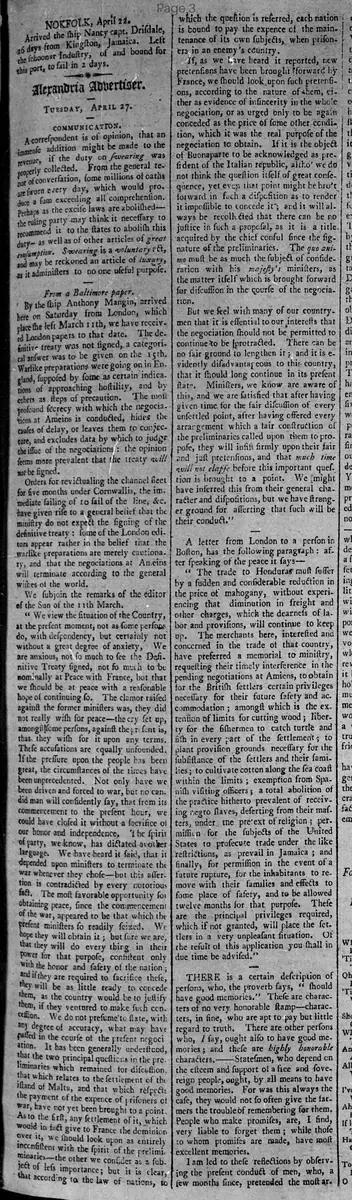
By the ship Anthony Mangin, arrived here on Saturday from London, which place she left March 4th, we have received London papers to that date. The definitive treaty was not signed, a categorical answer was to be given on the 18th. Warlike preparations were going on in England, supposed by some as certain indications of approaching hostility, and by others as steps of precaution. The most profound secrecy with which the negotiations at Amiens is conducted, hides the causes of delay, or leaves them to conjecture, and excludes data by which to judge the issue of the negotiations: the opinion seems more prevalent that the treaty will not be signed.
Orders for revictualling the channel fleet for five months under Cornwallis, the immediate sailing of two sail of the line, &c. have given rise to a general belief that the ministry do not expect the signing of the definitive treaty: some of the London editors appear rather in the belief that the warlike preparations are merely cautionary, and that the negotiations at Amiens will terminate according to the general wishes of the world.
We subjoin the remarks of the editor of the Sun of the 11th March.
"We view the situation of the Country, at the present moment, not as some persons do, with despondency, but certainly not without a great degree of anxiety. We are anxious, not so much to see the Definitive Treaty signed, not so much to be nominally at Peace with France, but that we should be at peace with a reasonable hope of continuing so. The clamor raised against the former ministers was, they did not really wish for peace—the cry set up, amongst some persons, against the present is, that they wish for it upon any terms. These accusations are equally unfounded. If the pressure upon the people has been great, the circumstances of the times have been unprecedented. Not only have we been driven and forced to war, but no candid man will consistently say, that from its commencement to the present hour, we could have closed it without a sacrifice of our honor and independence. The spirit of party, we know, has dictated another language. We have heard it said, that it depended upon ministers to terminate the war whenever they chose—but this assertion is contradicted by every notorious fact. The most favorable opportunity of obtaining peace, since the commencement of the war, appeared to be that which the present ministers so readily seized. We hope they will obtain it; but sure we are, that they will do every thing in their power for that purpose, consistent only with the honor and safety of the nation; and if they are required to sacrifice these, they will be as little ready to concede them, as the country would be to justify them, if they ventured to make such concession. We do not presume to state, with any degree of accuracy, what may have passed in the course of the present negotiation. It has been generally understood, that the two principal questions in the preliminaries which remained for discussion, that which relates to the settlement of the island of Malta, and that which respects the payment of the expense of prisoners of war, have not yet been brought to a point. As to the first, any settlement of it, which would in fact give to France the dominion over it, we should look upon as entirely inconsistent with the spirit of the preliminaries—the other we consider as a subject of less importance: but it is clear, that according to the law of nations, to which the question is referred, each nation is bound to pay the expense of the maintenance of its own subjects, when prisoners in an enemy's country.
If, as we have heard it reported, new pretensions have been brought forward by France, we should look upon such pretensions, according to the nature of them, either as evidence of insincerity in the whole negotiation, or as urged only to be again conceded as the price of some other condition, which it was the real purpose of the negotiation to obtain. If it is the object of Buonaparte to be acknowledged as president of the Italian republic, although we do not think the question itself of great consequence, yet even that point might be brought forward in such a disposition as to render it impossible to concede it; and it will always be recollected that there can be no justice in such a proposal, as it is a title acquired by the chief consul since the signature of the preliminaries. The quo animo must be as much the subject of consideration with his majesty's ministers, as the matter itself which is brought forward for discussion in the course of the negotiation.
But we feel with many of our countrymen that it is essential to our interests that the negotiation should not be permitted to continue to be protracted. There can be no fair ground to lengthen it; and it is evidently disadvantageous to this country that it should long continue in its present state. Ministers, we know are aware of this, and we are satisfied that after having given time for the fair discussion of every unsettled point, after having offered every arrangement which a fair construction of the preliminaries called upon them to propose, they will insist firmly upon their fair and just pretensions, and that much time will not elapse before this important question is brought to a point. We might have inferred this from their general character and dispositions, but we have stronger ground for asserting that such will be their conduct."
What sub-type of article is it?
What keywords are associated?
What entities or persons were involved?
Where did it happen?
Foreign News Details
Primary Location
Amiens
Event Date
March 4th
Key Persons
Outcome
uncertainty prevails on whether the definitive treaty will be signed; warlike preparations in england suggest possible hostility or precaution; key issues include malta settlement and prisoner expenses; new french pretensions reported.
Event Details
London papers to March 4th report that the definitive treaty with France at Amiens was not signed, with a categorical answer due on the 18th. Secrecy surrounds negotiations, leading to conjectures of delay. England revictuals channel fleet under Cornwallis for five months and prepares ships, interpreted by some as expecting no treaty and by others as cautionary. Editorial from Sun of March 11th expresses anxiety for sustainable peace, defends ministers, discusses unresolved issues on Malta and prisoners of war per law of nations, suspects French insincerity in new pretensions including Buonaparte's Italian title, and urges prompt resolution without sacrificing honor.