Thank you for visiting SNEWPapers!
Sign up free
Literary
June 22, 1803
The National Intelligencer And Washington Advertiser
Washington, District Of Columbia
What is this article about?
An essay proposing 'Fredon' as a geographical name for the U.S. territory, with poetic variant 'Fredonia', and derivatives like 'Fredonian' for citizens, 'Frede' colloquially, and 'Fredish' adjectivally. It critiques existing terms and provides examples in prose and verse.
Clipping
OCR Quality
95%
Excellent
Full Text
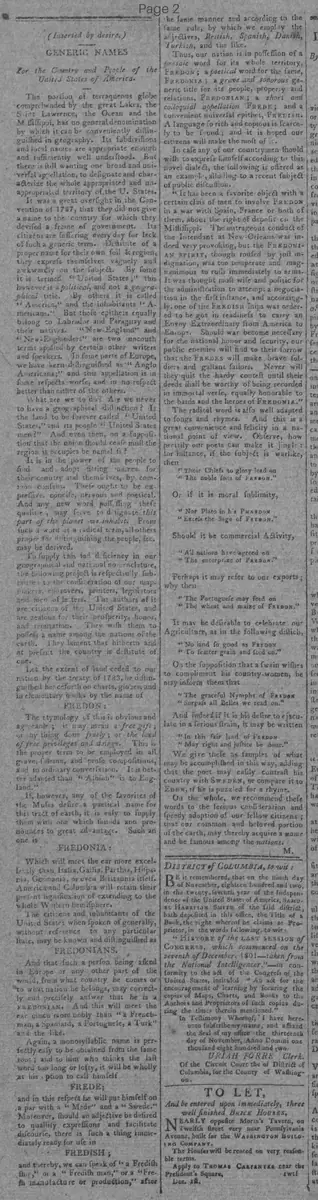
(Inserted by desire.)
GENERIC NAMES
For the Country and People of the United States of America.
The portion of terraqueous globe comprehended by the great Lakes, the St. Lawrence, the Ocean and the Mississippi, has no general denomination by which it can be conveniently distinguished in geography. Its subdivisions and local names are appropriate enough and sufficiently well understood. But there is still wanting one broad and universal appellation, to designate and characterize the whole appropriated and unappropriated territory of the U. States.
It was a great oversight in the Convention of 1787, that they did not give a name to the country for which they devised a frame of government. Its citizens are suffering every day for lack of such a generic term. Destitute of a proper name for their own soil & region, they express themselves vaguely and awkwardly on the subject. By some it is termed "the United States;" this however is a political, and not a geographical title. By others it is called "America," and the inhabitants "Americans." But those epithets equally belong to Labrador and Paraguay and their natives. "New-England" and "New-Englanders" are two uncouth terms applied by certain other writers and speakers. In some parts of Europe, we have been distinguished as "Anglo Americans;" and this appellation is in some respects worse, and in no respect better than either of the others.
What are we to do? Are we never to have a geographical distinction? Is the land to be forever called "United States," and its people "United States men?" And even then, on a supposition that the union should cease must the region it occupies be nameless?
It is in the power of the people to find and adopt fitting names for their country and themselves, by common consent. These ought to be expressive, concise, nervous and poetical. And any new word possessing these qualities, may serve to designate this part of the planet we inhabit. From such a word as a radical term, all others proper for distinguishing the people, &c. may be derived.
To supply this acknowledged deficiency in our geographical and national nomenclature, the following project is respectfully submitted to the consideration of our map-makers, engravers, printers, legislators and men of letters. The authors of it are citizens of the United States, and are zealous for their prosperity, honor, and reputation. They wish them to possess a name among the nations of the earth. They lament that hitherto and at present the country is destitute of one.
Let the extent of land ceded to our nation by the treaty of 1783, be distinguished hereafter on charts, globes, and in elementary books by the name of FREDON:
The etymology of this is obvious and agreeable; it may mean a free gift; or anything done freely; or the land of free privileges and blessings. This is the proper term to be employed in all grave, solemn, and prose compositions, and in ordinary conversation. It is better adapted than "Albion" is to England."
If, however, any of the favorites of the Muses desire a poetical name for this tract of earth, it is easy to supply them with one which sounds and pronounces to great advantage. Such an one is
FREDONIA:
Which will meet the ear more excellently than Italia, Gallia, Parthia, Hispania, Germania, or even Britannia itself. America and Columbia will retain their present signification of extending to the whole Western hemisphere.
The citizens and inhabitants of the United States when spoken of generally, without reference to any particular state, may be known and distinguished as FREDONIANS.
And that such a person being asked in Europe or any other part of the world, from what country he comes or to what nation he belongs, may correctly and precisely answer that he is a FREDONIAN. And this will meet the ear much more nobly than "a Frenchman, a Spaniard, a Portuguese, a Turk" and the like.
Again, a monosyllabic name is perfectly easy to be obtained from the same root; and to him who thinks the last word too long or lofty, it will be wholly at his option to call himself
FREDE;
and in this respect he will put himself on a par with a "Mede" and a "Swede."
Moreover, should an adjective be desired to qualify expressions and facilitate discourse, there is such a thing immediately ready for use in
FREDISH;
and thereby, we can speak of "a Fredish ship," or a "Fredish man," or a "Fredish manufacture or production," after the same manner and according to the same rule, by which we employ the adjectives, British, Spanish, Danish, Turkish, and the like.
Thus, our nation is in possession of a prosaic word for its whole territory, Fredon; a poetical word for the same, Fredonia; a grave and sonorous generic title for its people, properly and relations, Fredonian; a short and colloquial appellation Frede; and a convenient universal epithet, Fredish.
A language so rich and copious is scarcely to be found; and it is hoped our citizens will make the most of it.
In case any of our countrymen should wish to express himself according to this novel dialect, the following is offered as an example, alluding to a recent subject of public discussion.
"It has been a favorite object with a certain class of men to involve Fredon in a war with Spain, France or both of them, about the right of deposit on the Mississippi. The outrageous conduct of the Intendant at New-Orleans was indeed very provoking, but the Fredonian spirit, though roused by just indignation, was too temperate and magnanimous to rush immediately to arms. It was thought most wise and politic for the administration to attempt a negotiation in the first instance, and accordingly, one of these Fredish ships was ordered to be got in readiness to carry an Envoy Extraordinary from America to Europe. Should war become necessary for the national honor and security, our public enemies will find to their sorrow that the Fredes will make brave soldiers and gallant sailors. Never will they quit the hardy contest until their deeds shall be worthy of being recorded in immortal verse, equally honorable to the bards and the heroes of Fredonia."
The radical word is also well adapted to songs and rhymes. And this is a great convenience and felicity in a national point of view. Observe, how prettily our poets can make it jingle: for instance, if the subject is warlike, then
"Their Chiefs to glory lead on
The noble sons of Fredon."
Or if it is moral sublimity.
"Nor Plato in his Phaedon
Excels the Sage of Fredon."
Should it be commercial activity,
"All nations have agreed on
The enterprize of Fredon."
Perhaps it may refer to our exports; why then
"The Portuguese may feed on
The wheat and maize of Fredon."
It may be desirable to celebrate our agriculture, as in the following distich,
"No land so good as Fredon
To scatter grain and seed on."
On the supposition that a swain wishes to compliment his country-women, he may inform them that
"The graceful Nymphs of Fredon
Surpass all Belles we read on."
And indeed if it is his desire to ejaculate in a serious strain, it may be written
"In this fair land of Fredon
May right and justice be done."
We give these as samples of what may be accomplished in this way, adding that the poet may easily contract his country with Sweden, or compare it to Eden, if he is puzzled for a rhyme.
On the whole, we recommend these words to the serious consideration and speedy adoption of our fellow citizens; that our common and beloved portion of the earth, may thereby acquire a name and be famous among the nations.
M.
GENERIC NAMES
For the Country and People of the United States of America.
The portion of terraqueous globe comprehended by the great Lakes, the St. Lawrence, the Ocean and the Mississippi, has no general denomination by which it can be conveniently distinguished in geography. Its subdivisions and local names are appropriate enough and sufficiently well understood. But there is still wanting one broad and universal appellation, to designate and characterize the whole appropriated and unappropriated territory of the U. States.
It was a great oversight in the Convention of 1787, that they did not give a name to the country for which they devised a frame of government. Its citizens are suffering every day for lack of such a generic term. Destitute of a proper name for their own soil & region, they express themselves vaguely and awkwardly on the subject. By some it is termed "the United States;" this however is a political, and not a geographical title. By others it is called "America," and the inhabitants "Americans." But those epithets equally belong to Labrador and Paraguay and their natives. "New-England" and "New-Englanders" are two uncouth terms applied by certain other writers and speakers. In some parts of Europe, we have been distinguished as "Anglo Americans;" and this appellation is in some respects worse, and in no respect better than either of the others.
What are we to do? Are we never to have a geographical distinction? Is the land to be forever called "United States," and its people "United States men?" And even then, on a supposition that the union should cease must the region it occupies be nameless?
It is in the power of the people to find and adopt fitting names for their country and themselves, by common consent. These ought to be expressive, concise, nervous and poetical. And any new word possessing these qualities, may serve to designate this part of the planet we inhabit. From such a word as a radical term, all others proper for distinguishing the people, &c. may be derived.
To supply this acknowledged deficiency in our geographical and national nomenclature, the following project is respectfully submitted to the consideration of our map-makers, engravers, printers, legislators and men of letters. The authors of it are citizens of the United States, and are zealous for their prosperity, honor, and reputation. They wish them to possess a name among the nations of the earth. They lament that hitherto and at present the country is destitute of one.
Let the extent of land ceded to our nation by the treaty of 1783, be distinguished hereafter on charts, globes, and in elementary books by the name of FREDON:
The etymology of this is obvious and agreeable; it may mean a free gift; or anything done freely; or the land of free privileges and blessings. This is the proper term to be employed in all grave, solemn, and prose compositions, and in ordinary conversation. It is better adapted than "Albion" is to England."
If, however, any of the favorites of the Muses desire a poetical name for this tract of earth, it is easy to supply them with one which sounds and pronounces to great advantage. Such an one is
FREDONIA:
Which will meet the ear more excellently than Italia, Gallia, Parthia, Hispania, Germania, or even Britannia itself. America and Columbia will retain their present signification of extending to the whole Western hemisphere.
The citizens and inhabitants of the United States when spoken of generally, without reference to any particular state, may be known and distinguished as FREDONIANS.
And that such a person being asked in Europe or any other part of the world, from what country he comes or to what nation he belongs, may correctly and precisely answer that he is a FREDONIAN. And this will meet the ear much more nobly than "a Frenchman, a Spaniard, a Portuguese, a Turk" and the like.
Again, a monosyllabic name is perfectly easy to be obtained from the same root; and to him who thinks the last word too long or lofty, it will be wholly at his option to call himself
FREDE;
and in this respect he will put himself on a par with a "Mede" and a "Swede."
Moreover, should an adjective be desired to qualify expressions and facilitate discourse, there is such a thing immediately ready for use in
FREDISH;
and thereby, we can speak of "a Fredish ship," or a "Fredish man," or a "Fredish manufacture or production," after the same manner and according to the same rule, by which we employ the adjectives, British, Spanish, Danish, Turkish, and the like.
Thus, our nation is in possession of a prosaic word for its whole territory, Fredon; a poetical word for the same, Fredonia; a grave and sonorous generic title for its people, properly and relations, Fredonian; a short and colloquial appellation Frede; and a convenient universal epithet, Fredish.
A language so rich and copious is scarcely to be found; and it is hoped our citizens will make the most of it.
In case any of our countrymen should wish to express himself according to this novel dialect, the following is offered as an example, alluding to a recent subject of public discussion.
"It has been a favorite object with a certain class of men to involve Fredon in a war with Spain, France or both of them, about the right of deposit on the Mississippi. The outrageous conduct of the Intendant at New-Orleans was indeed very provoking, but the Fredonian spirit, though roused by just indignation, was too temperate and magnanimous to rush immediately to arms. It was thought most wise and politic for the administration to attempt a negotiation in the first instance, and accordingly, one of these Fredish ships was ordered to be got in readiness to carry an Envoy Extraordinary from America to Europe. Should war become necessary for the national honor and security, our public enemies will find to their sorrow that the Fredes will make brave soldiers and gallant sailors. Never will they quit the hardy contest until their deeds shall be worthy of being recorded in immortal verse, equally honorable to the bards and the heroes of Fredonia."
The radical word is also well adapted to songs and rhymes. And this is a great convenience and felicity in a national point of view. Observe, how prettily our poets can make it jingle: for instance, if the subject is warlike, then
"Their Chiefs to glory lead on
The noble sons of Fredon."
Or if it is moral sublimity.
"Nor Plato in his Phaedon
Excels the Sage of Fredon."
Should it be commercial activity,
"All nations have agreed on
The enterprize of Fredon."
Perhaps it may refer to our exports; why then
"The Portuguese may feed on
The wheat and maize of Fredon."
It may be desirable to celebrate our agriculture, as in the following distich,
"No land so good as Fredon
To scatter grain and seed on."
On the supposition that a swain wishes to compliment his country-women, he may inform them that
"The graceful Nymphs of Fredon
Surpass all Belles we read on."
And indeed if it is his desire to ejaculate in a serious strain, it may be written
"In this fair land of Fredon
May right and justice be done."
We give these as samples of what may be accomplished in this way, adding that the poet may easily contract his country with Sweden, or compare it to Eden, if he is puzzled for a rhyme.
On the whole, we recommend these words to the serious consideration and speedy adoption of our fellow citizens; that our common and beloved portion of the earth, may thereby acquire a name and be famous among the nations.
M.
What sub-type of article is it?
Essay
What themes does it cover?
Political
Patriotism
Liberty Freedom
What keywords are associated?
National Nomenclature
Fredon
Fredonia
United States
Geographical Name
Fredonian
Fredish
What entities or persons were involved?
M.
Literary Details
Title
Generic Names For The Country And People Of The United States Of America.
Author
M.
Subject
Proposal For Geographical And National Nomenclature For The United States
Form / Style
Prose Essay With Verse Examples
Key Lines
Let The Extent Of Land Ceded To Our Nation By The Treaty Of 1783, Be Distinguished Hereafter On Charts, Globes, And In Elementary Books By The Name Of Fredon:
"Their Chiefs To Glory Lead On
The Noble Sons Of Fredon."
"No Land So Good As Fredon
To Scatter Grain And Seed On."