Thank you for visiting SNEWPapers!
Sign up free
The Western Democrat
Charlotte, Mecklenburg County, North Carolina
What is this article about?
Detailed accounts of the Confederate victory at the Battle of Bethel Church on June 10, 1861, where 1,100 Southern troops, including the 1st North Carolina Regiment, repulsed 5,000 Union forces led by Gen. Pierce. Minimal Confederate losses; heavy Union casualties. Includes multiple eyewitness reports and a biography of Col. D.H. Hill.
Merged-components note: Table at reading_order 22 sequentially follows and directly relates to the story at 21, listing companies of the 1st N.C. Regiment mentioned in the battle account; merge to form complete article.
Clipping
OCR Quality
Full Text
FURTHER PARTICULARS.
INCIDENTS, &C.
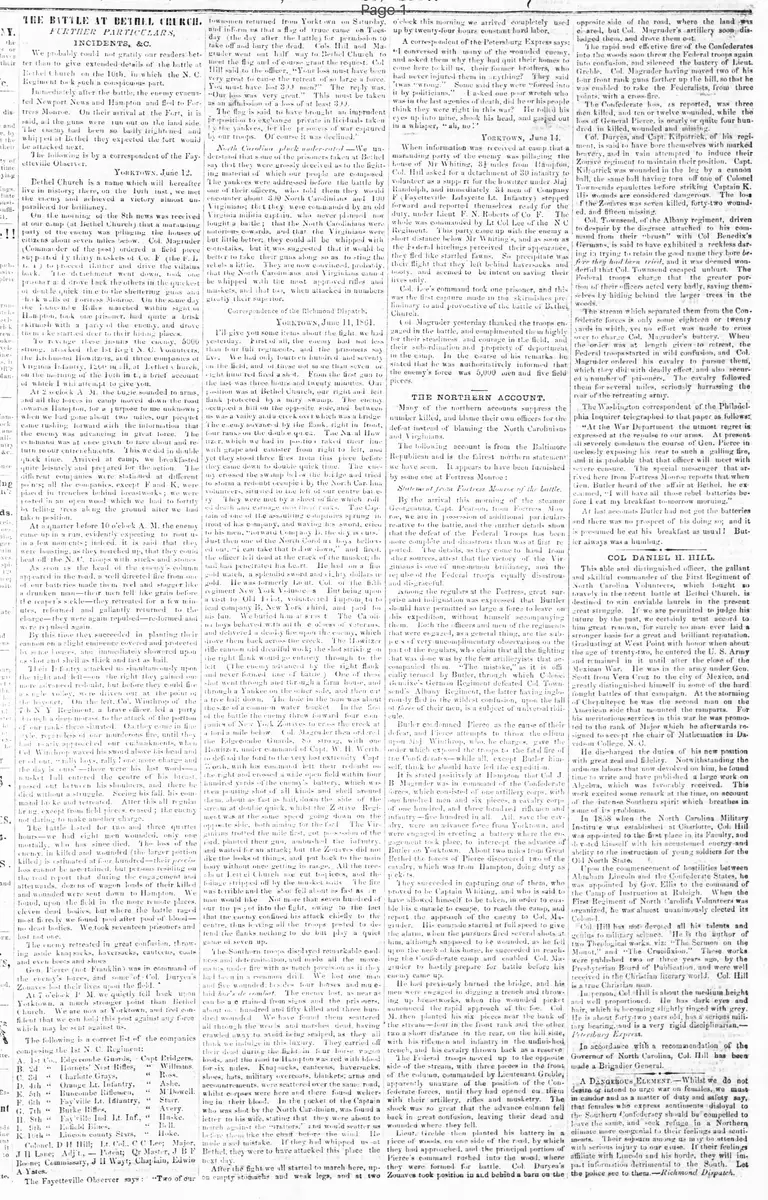
We probably could not gratify our readers better
than to give extended details of the battle at
Bethel Church on the 10th, in which the N. C.
Regiment took such a conspicuous part.
Immediately after the battle, the enemy evacuated
Newport News and Hampton and fled to Fortress
Monroe. On their arrival at the Fort, it is
said, as the guns were run out on the land side.
The enemy had been so badly frightened and
whipped at Bethel they expected the fort would
be attacked next.
The following is by a correspondent of the Fayetteville
Observer.
Yorktown, June 12.
Bethel Church is a name which will hereafter
live in history; there, on the 10th inst., we met
the enemy and achieved a victory almost un-
paralleled for brilliancy.
On the morning of the 9th news was received
at our Camp (at Bethel Church) that a marauding
party of the enemy was plundering the houses of
citizens about seven miles below. Col. Magruder
(Commander of the post) ordered a field piece
supplied by thirty muskets of Co. F (the F. L.
V. I.) to proceed thither and drive the villains
back. The detachment went down, took one
prisoner and drove back the others in the quickest
possible time to the sheltering guns and
thick walls of Fortress Monroe. On the Saturday
the Hampton Rifles marched within sight of
Hampton, took one prisoner, had quite a brisk
skirmish with a party of the enemy, and drove
them like startled deer to their hiding places.
To revenge these insults the enemy, 5000
strong, attacked the 1st Regt N. C. Volunteers,
the Richmond Howitzers, and three companies of
Virginia Infantry, about 1100 in all, at Bethel Church,
on the morning of the 10th inst., a brief account
of which I will attempt to give you.
At 2 o'clock A. M. the bugle sounded to arms,
and all the troops in camp moved down the road
towards Hampton, for a purpose to me unknown;
when we had gone about two miles, our picket
came rushing forward with the information that
the enemy was advancing in great force. The
command was at once given to face about and re-
turn to our entrenchments. This we did in double
quick time. Arrived at camp, we breakfasted
quite leisurely and prepared for the action. The
Fifth Regiment companies were stationed at different
points; all the companies, except F and K, were
placed in trenches behind breastworks; we were
posted in an open wood which we had to fortify
by felling trees along the ground after we had
taken position.
At a quarter before 10 o'clock A. M. the enemy
came up in a run, evidently expecting to rout us
in a few moments; indeed, it is said that they
were boasting, as they marched up, that they could
beat off the N. C. troops with sticks and stones.
As soon as the head of the enemy's column
appeared in the road, a well directed fire from one
of our batteries made them reel and stagger like
a drunken man--their men fell like grain before
the reaper's sickle--they retreated for a few minutes,
reformed and gallantly returned to the
charge--they were again repulsed--re-formed and
were repulsed again.
By this time they succeeded in planting their
cannon on a slight eminence covered and protected
by some houses, and immediately showered upon
us shot and shell as thick and fast as hail.
Their Infantry attacked us simultaneously upon
the right and left--on the right they gained one
of our advanced redoubts, but before they could fire
a single volley, were driven out at the point of
the bayonet. On the left, Col. Winthrop of the
7th N. Y. Regiment, a brave officer, led a party
to the attack of the portion
of our ranks--there resisted. On they came in fine
style, regardless of our murderous fire, until they
had nearly approached our embankments, when
Col. Winthrop waved his sword above his head and
cried out, "Rally boys, rally! One more charge and
the day is ours"--these were his last words--a
musket ball entered the centre of his breast,
passed out between his shoulders, and there he
died without a struggle. Seeing his fall, his com-
mand broke and retreated. After this all regular
firing, except from field pieces ceased; the enemy
not daring to make another charge.
The battle lasted for two and three quarters
hours--we had eight men wounded, only one
mortally, who has since died. The loss of the
enemy, in killed and wounded (the larger portion
killed) is estimated at over one hundred--their precise
loss cannot be ascertained, but persons residing on
the road report that during the engagement and
afterwards, dozens of wagon loads of their killed
and wounded were sent down to Hampton. We
found, upon the field in the more remote places,
eleven dead bodies, but where the battle raged
most fiercely we found pool after pool of blood--
no dead bodies. We took seventeen prisoners and
lost not one.
The enemy retreated in great confusion, throwing
aside knapsacks, haversacks, canteens, coats
and even boots and shoes.
Gen. Pierce (not Franklin) was in command of
the enemy's forces, and some of Col. Duryea's
Zouaves lost their lives upon the field.
At 7 o'clock P. M. we quietly fell back upon
Yorktown, a much stronger point than Bethel
Church. We are now at Yorktown, and feel confident
that we can hold this post against any force
which may be sent against us.
The following is a correct list of the companies
composing the 1st N. C. Regiment:
Colonel, D. H. Hill; Lt. Col., C. C. Lee; Major,
J. I. Lane; Adj't, C. Poteat; Qr Master, J. B. F.
Boone; Commissary, J. H. Wyatt; Chaplain, Edwin
A. Yates.
The Fayetteville Observer says: "Two of our
townsmen returned from Yorktown on Saturday
and inform us that a flag of truce came on Tues-
day (the day after the battle) for permission to
take off and bury the dead. Cols. Hill and Ma-
gruder went out half way to Bethel Church to
meet the flag and of course grant the request. Col.
Hill said to the officer, "Your loss must have been
very great to cause the retreat of so large a force.
You must have lost 300 men?" The reply was,
"Our loss was very great." This must be taken
as an admission of a loss of at least 300.
The flag is said to have brought an imprudent
proposition to exchange private individuals taken
by the Yankees, for the prisoners of war captured
by our troops. Of course it was declined.
North Carolina pluck under-rated--We under-
stand that some of the prisoners taken at Bethel
say that they were grossly deceived as to the fighting
material of which our people are composed.
The Yankees were addressed before the battle by
one of their officers, who told them they would
encounter about 300 North Carolinians and 100
Virginians; that they were commanded by an old
Virginia militia captain, who never planned nor
fought a battle; that the North Carolinians were
notorious cowards, and that the Virginians were
but little better; they could all be whipped with
constables, but it was suggested that it would be
better to take their guns along so as to sting the
rebels a little. They are now convinced, probably,
that the North Carolinians and Virginians cannot
be whipped with the most approved rifles and
muskets, and that too, when attacked in numbers
greatly their superior.
Correspondence of the Richmond Dispatch.
YORKTOWN, June 11, 1861.
I'll give you some items about the fight we had
yesterday. First of all, the enemy had not less
than four full regiments, and the prisoners say
five. We had only fourteen hundred and seventy
on the field, and of these not more than seven or
eight hundred fired a shot. From the first gun to
the last was three hours and twenty minutes. Our
position was at Bethel Church, our right and left
flank protected by a miry swamp. The enemy
occupied a hill on the opposite side, and between
us was a valley and a creek over which was a bridge.
The enemy advanced by the flank, right in front,
four ranks on the double quick. The Naval How-
itzer, which we had in position raked their line
with grape and canister from right to left, and
yet they stood three fires from this piece before
they came down to double quick time. The enemy
crossed the swamp below the bridge and tried
to storm a redoubt occupied by the North Carolina
volunteers, situated to the left of our centre battery.
They were met by a sheet of fire which rolled
death and carnage upon their ranks. The Captain
of one of the assailing companies sprang in
front of his company, and waving his sword, cried
to his men, "Forward Company B, the day is ours."
Just then one of the North Carolina boys bellowed
out, "I can take that fellow down," and fired.
the officer fell dead at the crack of the musket; the
ball had penetrated his heart. He had on a fine
gold watch, a splendid sword and eighty dollars in
gold. He was formerly Lt. Col. of the Fifth
regiment New York Volunteers. But being upon
a visit to Old Point, volunteered impromptu to
lead company B, New York 3rd, and paid for
his fun. We buried him at sun set. The Carolina
boys behaved with all the coolness of veterans,
and delivered a deadly fire upon the enemy, which
drove them back across the creek. The Howitzer
rifle cannon did dreadful work; the shot striking
the right flank would go entirely through to the
left (the enemy advanced by the right flank
and never formed line of battle.) One of these
shot went through and through a farm house, and
through a Yankee on the other side, and then entered
the earth down. The hole in the man was about
the size of a common water bucket. In the first
of the battle the enemy threw forward four companies
of New York Zouaves to cross the creek at
a ford a mile below. Col. Magruder then ordered
the Edgecombe Guards, 55 strong, with one
Howitzer, under command of Capt. W. H. Worth,
to defend that ford to the very last extremity. Capt.
Worth, with his command left their redoubt on
the right and crossed a wide open field within four
hundred yards of the enemy's battery, which was
then pouring shot of all kinds and shell around
them, about as fast as hail, down the side of the
stream at double quick, whilst the Zouave Regiment
was at the same speed going down on the
opposite side, both aiming for the ford. The Virginians
trotted the mile first, got possession of the
ford, planted their gun, ambushed the infantry,
and waited for an attack; but the Zouaves did not
like the looks of things, and put back to the main
body without once getting in range. All the trees
about Bethel Church are cut to pieces, and the
foliage stripped off by the musket balls; the fire
was terrible and the shot fell about as fast as
hail would fall. Not more than seven hundred of
our troops got into the fight, owing to the fact
that the enemy confined his attack chiefly to the
centre, thus leaving all the troops posted to defend
the flanks nothing to do but play a quiet
game of seven up.
The Southern troops displayed remarkable cool-
ness and determination, and made all the move-
ments under fire with as much precision as if they
had been in a common drill. We lost one man
and six wounded, besides four horses and one mule
laid hors du combat. The enemy lost, as near as
can be ascertained from signs and the prisoners,
about one hundred and fifty killed and three hundred
wounded. We have found them scattered
all through the woods and marshes dead, having
crawled away to avoid being scalped, as they all
think we indulge in this luxury. They carried off
their dead during the fight in four horse wagon
loads, and the road to Hampton was red with blood
for six miles. Knapsacks, canteens, haversacks,
shoes, hats, military overcoats, blankets; arms and
accoutrements, were scattered over the same road,
whilst corpses were here and there found weltering
in their blood. In the pocket of the Captain
who was shot by the North Carolinian, was found a
letter to his wife, stating that they were about to
march against the "traitors," and would scatter us
like the chaff before the wind. He
made a sad mistake. If they had whipped us at
Bethel, they were to have attacked this place the
next day.
After the fight we all started to march here, upon
empty stomachs and weak legs, and at two
o'clock this morning we arrived completely used
up by twenty-four hours constant hard labor.
A correspondent of the Petersburg Express says:
"I conversed with many of the wounded enemy,
and asked them why they had quit their homes to
come here to kill us, their former brothers who
had never injured them in anything? They said
"twas wrong." Some said they were "forced into
it by politicians." I asked one poor wretch who
was in the last agonies of death, did he or his people
think they were right in this war? He rolled his
eyes up into mine, shook his head, and gasped out
in a whisper, "ah, no!"
Yorktown, June 14.
When information was received at camp that a
marauding party of the enemy was pillaging the
house of Mr. Whiting, 3 miles from Hampton,
Col. Hill asked for a detachment of 30 infantry to
volunteer as a support for the howitzer under Maj.
Randolph, and immediately 34 men of Company
F (Fayetteville Light Infantry) stepped
forward and reported themselves ready for the
duty, under Lieut. F. N. Roberts of Co. F. The
whole was commanded by Lt. Col. Lee of the N. C.
Regiment. This party came up with the enemy a
short distance below Mr. Whiting's, and as soon as
the Federal hirelings perceived their appearance,
they fled like startled fawns. So precipitate was
their flight that they left behind haversacks and
booty, and seemed to be intent on saving their
lives only.
Col. Lee's command took one prisoner, and this
was the first capture made in the skirmishes preliminary
to and provocative of the battle of Bethel
Church.
Col. Magruder yesterday thanked the troops engaged
in the battle, and complimented them highly
for their steadiness and courage in the field, and
their subordination and propriety of deportment
in the camp. In the course of his remarks he
stated that he was authoritatively informed that
the enemy's force was 5,000 men and five field
pieces.
THE NORTHERN ACCOUNT.
Many of the northern accounts suppress the
number killed, and blame their own officers for the
defeat instead of blaming the North Carolinians
and Virginians.
The following account is from the Baltimore
Republican and is the fairest northern statement
we have seen. It appears to have been furnished
by some one at Fortress Monroe:
Statement from Fortress Monroe of the battle.
By the arrival this morning of the steamer
Georgeanna, Capt. Pearson, from Fortress Mon-
roe, we are in possession of additional particulars
relative to the battle, and the further details show
that the defeat of the Federal Troops has been
more complete and disastrous than was at first re-
ported. The details, as they come to hand from
other sources, attest that the victory of the Vir-
ginians is one of uncommon brilliancy, and the
repulse of the Federal troops equally disastrous
and disgraceful.
Among the regulars at the Fortress, great sur-
prise and indignation was expressed that Butler
should have permitted so large a force to leave on
this expedition, without himself accompanying
them. Both the officers and men of the regiments
that were engaged, as a general thing, are the sub-
ject of very uncomplimentary observations on the
part of the regulars, who claim that all the fighting
that was done was by the few artillerists that ac-
companied them. "The mistake," as it is officially
termed by Butler, through which Colonel
Benedix's German Regiment defeated Col. Townsend's
Albany Regiment, the latter having inglo-
riously fled in the wildest confusion, upon the fall
of three of their men, is a subject of universal ridi-
cule.
Butler condemns Pierce as the cause of their
defeat, and Pierce attempts to throw the odium
upon Maj. Winthrop, who, he charges, gave the
order which exposed the troops to the fatal fire of
the Confederates--while all, except Butler him-
self, think he should have led the expedition.
It is stated positively at Hampton that Col. J.
B. Magruder was in command of the Confederate
forces, which consisted of one artillery corps, with
one hundred men and six pieces, a cavalry corps
of one hundred, and three hundred riflemen and
infantry--five hundred in all. All, save the cavalry,
were an advance force from Yorktown, and
were engaged in erecting a battery where the engagement
took place, to intercept the advance of
Butler on Yorktown. About two miles from Great
Bethel the forces of Pierce discovered two of the
cavalry, which was from Hampton, doing duty as
pickets.
They succeeded in capturing one of them, who
proved to be Capt. Whiting, and who is said to
have allowed himself to be taken, in order to ena-
ble his comrade to escape, to reach the camp, and
report the approach of the enemy to Col. Ma-
gruder. His comrade started at full speed to give
the alarm, when the pursuers fired several shots at
him, although supposed to be wounded, as he fell
upon the neck of his horse, he succeeded in reaching
the Confederate camp and enabled Col. Ma-
gruder to hastily prepare for battle before his
enemy came up.
He had previously burned the bridge, and his
men were engaged in digging a trench and throwing
up breastworks, when the wounded picket
announced the rapid approach of the foe. Col.
M. then planted his six pieces near the bank of
the stream--four in the front rank and the other
two a short distance in the rear, on the hill side,
with his riflemen and infantry in the unfinished
trench, and his cavalry thrown back as a reserve.
The Federal troops moved up to the opposite
side of the stream, with three pieces in the front
of the column, commanded by Lieutenant Greble,
apparently unaware of the position of the Con-
federate forces, until they had opened on them
with their artillery, rifles and musketry. The
shock was so great that the advance column fell
back in great confusion, leaving their dead and
wounded where they fell.
Lieut. Greble then planted his battery in a
piece of woods, on one side of the road, by which
they had approached, and the principal portion of
Pierce's command rushed into the wood, where
they were formed for battle. Col. Duryea's
Zouaves took position in and behind a barn on the
opposite side of the road, where the land was
cleared, but Col. Magruder's artillery soon dis-
lodged them, and drove them out.
The rapid and effective fire of the Confederates
into the woods soon threw the Federal troops again
into confusion, and silenced the battery of Lieut.
Greble. Col. Magruder having moved two of his
four front rank guns farther up the hill, so that he
was enabled to rake the Federalists from three
points with a cross-fire.
The Confederate loss, as reported, was three
men killed, and ten or twelve wounded, while the
loss of General Pierce, is nearly or quite four hundred
in killed, wounded and missing.
Col. Duryea, and Capt. Kilpatrick, of his regi-
ment, is said to have bore themselves with marked
bravery, and in vain attempted to induce their
Zouave regiment to maintain their position. Capt.
Kilpatrick was wounded in the leg by a cannon
ball, the same ball having torn off one of Colonel
Townsend's epaulettes before striking Captain K.
His wounds are considered dangerous. The loss
of the Zouaves was seven killed, forty-two wounded
and fifteen missing.
Col. Townsend, of the Albany regiment, driven
to despair by the disgrace attached to his command
from their "brush" with Col. Benedix's
Germans, is said to have exhibited a reckless daring
in trying to retain the good name they bore before
they had been married, and it was deemed wonderful
that Col. Townsend escaped unhurt. The
Federal troops charge that the greater portion of
their officers acted very badly, saving themselves by
hiding behind the larger trees in the
woods.
The stream which separated them from the Con-
federate forces is only some eighteen or twenty
yards in width, yet no effort was made to cross
over to charge Col. Magruder's battery. When
the order was at length given to retreat, the
Federal troops started in wild confusion, and Col.
Magruder ordered his cavalry to pursue them
which they did with deadly effect, and also secured
a number of prisoners. The cavalry followed
them for several miles, seriously harassing the
rear of the retreating army.
The Washington correspondent of the Philadelphia
Inquirer telegraphed to that paper as follows:
"At the War Department the utmost regret is
expressed at the repulse to our arms. At present
all severely condemn the course of Gen. Pierce in
uselessly exposing his rear to such a galling fire,
and it is probable that that officer will meet with
severe censure. The special messenger that arrived
here from Fortress Monroe reports that when
Gen. Butler heard of the affair at Bethel, he exclaimed,
"I will have all those rebel batteries before
I eat my breakfast to-morrow morning."
At last accounts Butler had not got the batteries
and there was no prospect of his doing so; and it
is presumed he ate his breakfast as usual! Butler
always was a humbug.
COL. DANIEL H. HILL,
This able and distinguished officer, the gallant
and skillful commander of the First Regiment of
North Carolina Volunteers, which fought so
bravely in the recent battle at Bethel Church, is
destined to win enviable laurels in the present
great struggle. If we are permitted to judge his
future by the past, we certainly must accord to
him great renown, for surely no man ever laid a
stronger basis for a great and brilliant reputation.
Graduating at West Point with honor when about
the age of twenty-two, he entered the U. S. Army
and remained in it until after the close of the
Mexican War. He was in the army under Gen.
Scott from Vera Cruz to the city of Mexico, and
greatly distinguished himself in some of the hard
fought battles of that campaign. At the storming
of Chapultepec he was the second man on the
American side that mounted the ramparts. For
his meritorious services in this war he was promoted
to the rank of Major which he afterwards resigned
to accept the chair of Mathematics in Davidson
College, N. C.
He discharged the duties of his new position
with great zeal and fidelity. Notwithstanding the
arduous labors that now devolved on him, he found
time to write and have published a large work on
Algebra, which was favorably received. This
work excited some remark at the time, on account
of the intense Southern spirit which breathes in
some of its problems.
In 1858 when the North Carolina Military
Institute was established at Charlotte, Col. Hill
was appointed to the first place in its Faculty, and
devoted himself with his accustomed energy and
ability to the instruction of young soldiers for the
Old North State.
Upon the commencement of hostilities between
Abraham Lincoln and the Confederate States, he
was appointed by Gov. Ellis to the command of
the Camp of Instruction at Raleigh. When the
First Regiment of North Carolina Volunteers was
organized, he was almost unanimously elected its
Colonel.
Col. Hill has not devoted all his talents and
genius to military science. He is the author of
two Theological works, viz: "The Sermon on the
Mount," and "The Crucifixion." These works
were published two or three years ago, by the
Presbyterian Board of Publication, and were well
received in the Christian literary world. Col. Hill
is a true Christian man.
In person, Col. Hill is about the medium height
and well proportioned. He has dark eyes and
hair, which is becoming slightly tinged with grey.
He is about forty-two years old, has a serious military
bearing, and is a very rigid disciplinarian.
Petersburg Express.
In accordance with a recommendation of the
Governor of North Carolina, Col. Hill has been
made a Brigadier General.
A Dangerous Element.--Whilst we do not
desire or intend to urge war on females, we must
in candor and as a matter of duty and safety say,
that females who express sentiments disloyal to
the Southern Confederacy should be compelled to
leave the same, and seek refuge in a Northern
climate more congenial to their feelings and sentiments.
Their sojourn among us may be attended
with serious injury to our cause. If their feelings
affiliate with Lincoln and his horde, they will impart
information detrimental to the South. Let
the police see to them.--Richmond Dispatch.
| A. 1st Co., Edgecombe Guards, Capt. Bridgers. | ||
| B. 2d | “ Hornets’ Nest Rifles, | “ Williams. |
| C. 3d | “ Charlotte Grays, | “ Ross. |
| D. 4th | “ Orange Lt. Infantry, | “ Ashe. |
| E. 5th | “ Buncombe Riflemen, | “ M’Dowell. |
| F. 6th | “ Fay’ville Lt. Infantry, | “ Starr. |
| G. 7th | “ Burke Rifles, | “ Avery. |
| II. 8th | “ Fay’ville Ind. Lt. Inf., | “ Hanke. |
| I. 9th | “ Eifield Blues, | “ Ball. |
| K. 10th | “ Lincoln county Stars, | “ Hoke. |
What sub-type of article is it?
What themes does it cover?
What keywords are associated?
What entities or persons were involved?
Where did it happen?
Story Details
Key Persons
Location
Bethel Church, Yorktown, Hampton, Fortress Monroe
Event Date
June 10, 1861
Story Details
Confederate forces under Col. Magruder and Col. Hill, numbering about 1100 including 1st N.C. Regiment, repelled 5000 Union troops led by Gen. Pierce at Bethel Church. After skirmishes on June 9, battle began at 10 AM with artillery and infantry assaults. Union attacks repulsed; Col. Winthrop killed leading charge. Confederates lost 8 wounded (1 mortal); Union over 100 killed/wounded, 17 prisoners taken. Forces fell back to Yorktown.