Thank you for visiting SNEWPapers!
Sign up free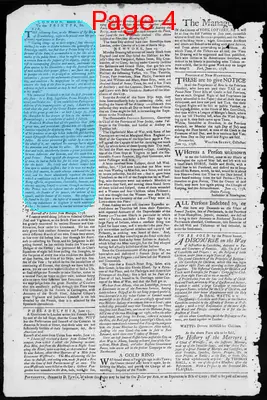
Letter to Editor
June 30, 1758
The New Hampshire Gazette
Portsmouth, Rockingham County, New Hampshire
What is this article about?
A letter to the printer quoting Frederick the Great's views on a sovereign's duties as the state's first servant, emphasizing wise use of funds for public benefit, and praising Frederick William's exemplary qualities in governance and virtue. (London, March 20)
Clipping
OCR Quality
98%
Excellent
Full Text
LONDON. March 20.
To the PRINTER, &c.
SIR,
The following lines, in the Memoirs of the House of Brandenburg, ought to be placed over the gate of every royal palace in Europe.
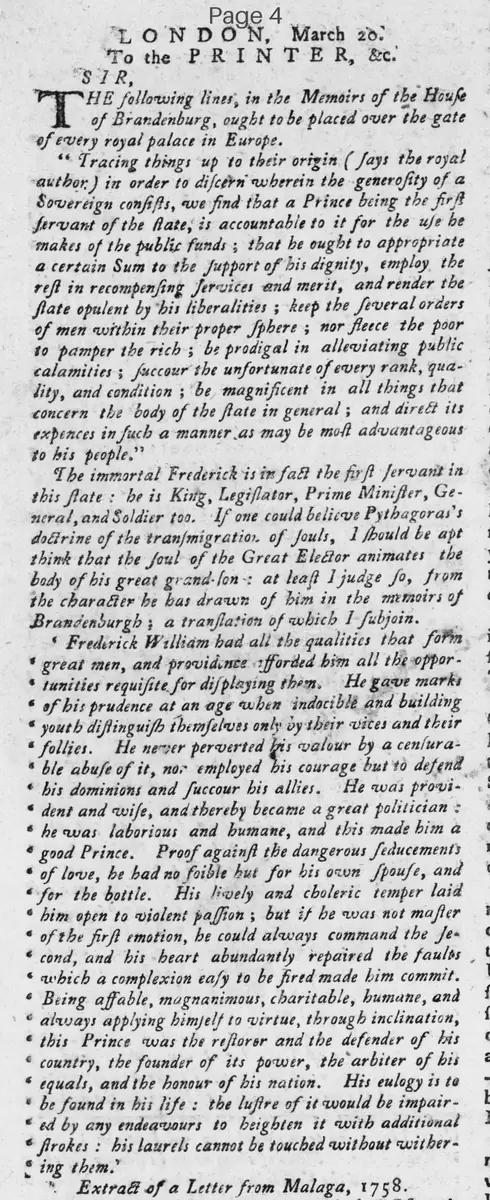
"Tracing things up to their origin (says the royal author) in order to discern wherein the generosity of a Sovereign consists, we find that a Prince being the first servant of the State, is accountable to it for the use he makes of the public funds; that he ought to appropriate a certain Sum to the support of his dignity, employ the rest in recompensing services and merit, and render the state opulent by his liberalities; keep the several orders of men within their proper Sphere; nor fleece the poor to pamper the rich; be prodigal in alleviating public calamities; succour the unfortunate of every rank, quality, and condition; be magnificent in all things that concern the body of the state in general; and direct its expences in such a manner as may be most advantageous to his people."
The immortal Frederick is in fact the first servant in this state: he is King, Legislator, Prime Minister, General, and Soldier too. If one could believe Pythagoras's doctrine of the transmigration of souls, I should be apt to think that the soul of the Great Elector animates the body of his great grand-son: at least I judge so, from the character he has drawn of him in the memoirs of Brandenburg: a translation of which I subjoin.
'Frederick William had all the qualities that form great men, and providence afforded him all the opportunities requisite for displaying them. He gave marks of his prudence at an age when indocile and building youth distinguish themselves only by their vices and their follies. He never perverted his valour by a censurable abuse of it, nor employed his courage but to defend his dominions and succour his allies. He was provident and wise, and thereby became a great politician: he was laborious and humane, and this made him a good Prince.' Proof against the dangerous seducements of love, he had no foible but for his own spouse, and for the bottle. 'His lively and choleric temper laid him open to violent passion; but if he was not master of the first emotion, he could always command the second, and his heart abundantly repaired the faults which a complexion easy to be fired made him commit. Being affable, magnanimous, charitable, humane, and always applying himself to virtue, through inclination: this Prince was the restorer and the defender of his country, the founder of its power, the arbiter of his equals, and the honour of his nation.' His eulogy is to be found in his life: the lustre of it would be impaired by any endeavours to heighten it with additional strokes: his laurels cannot be touched without withering them.
To the PRINTER, &c.
SIR,
The following lines, in the Memoirs of the House of Brandenburg, ought to be placed over the gate of every royal palace in Europe.
"Tracing things up to their origin (says the royal author) in order to discern wherein the generosity of a Sovereign consists, we find that a Prince being the first servant of the State, is accountable to it for the use he makes of the public funds; that he ought to appropriate a certain Sum to the support of his dignity, employ the rest in recompensing services and merit, and render the state opulent by his liberalities; keep the several orders of men within their proper Sphere; nor fleece the poor to pamper the rich; be prodigal in alleviating public calamities; succour the unfortunate of every rank, quality, and condition; be magnificent in all things that concern the body of the state in general; and direct its expences in such a manner as may be most advantageous to his people."
The immortal Frederick is in fact the first servant in this state: he is King, Legislator, Prime Minister, General, and Soldier too. If one could believe Pythagoras's doctrine of the transmigration of souls, I should be apt to think that the soul of the Great Elector animates the body of his great grand-son: at least I judge so, from the character he has drawn of him in the memoirs of Brandenburg: a translation of which I subjoin.
'Frederick William had all the qualities that form great men, and providence afforded him all the opportunities requisite for displaying them. He gave marks of his prudence at an age when indocile and building youth distinguish themselves only by their vices and their follies. He never perverted his valour by a censurable abuse of it, nor employed his courage but to defend his dominions and succour his allies. He was provident and wise, and thereby became a great politician: he was laborious and humane, and this made him a good Prince.' Proof against the dangerous seducements of love, he had no foible but for his own spouse, and for the bottle. 'His lively and choleric temper laid him open to violent passion; but if he was not master of the first emotion, he could always command the second, and his heart abundantly repaired the faults which a complexion easy to be fired made him commit. Being affable, magnanimous, charitable, humane, and always applying himself to virtue, through inclination: this Prince was the restorer and the defender of his country, the founder of its power, the arbiter of his equals, and the honour of his nation.' His eulogy is to be found in his life: the lustre of it would be impaired by any endeavours to heighten it with additional strokes: his laurels cannot be touched without withering them.
What sub-type of article is it?
Philosophical
Historical
Reflective
What themes does it cover?
Politics
Morality
What keywords are associated?
Frederick Great
Frederick William
Sovereign Duties
Kingship
Brandenburg Memoirs
Public Funds
Prussian History
What entities or persons were involved?
The Printer
Letter to Editor Details
Recipient
The Printer
Main Argument
sovereigns should act as the first servants of the state, using public funds to support dignity, reward merit, alleviate calamities, and benefit the people, as exemplified by frederick the great and his ancestor frederick william.
Notable Details
- quotes from memoirs of the house of brandenburg on sovereign generosity
- references pythagoras's transmigration of souls
- eulogy of frederick william's qualities: prudence, valor, providence, humanity