Thank you for visiting SNEWPapers!
Sign up free
The New Hampshire Gazette And Historical Chronicle
Portsmouth, Greenland, Rockingham County, New Hampshire
What is this article about?
A satirical essay critiquing how wealth and social position create the illusion of wisdom and learning in conversation, rather than true knowledge. It discusses the rich dominating discourse at their tables, the advantages of half-learned individuals, and proposes superficial rules for appearing learned without deep study.
Merged-components note: These two components are sequential in reading order with adjacent bounding boxes and contain text that flows as a single cohesive literary essay on the themes of learning, conversation, and social practices.
Clipping
OCR Quality
Full Text
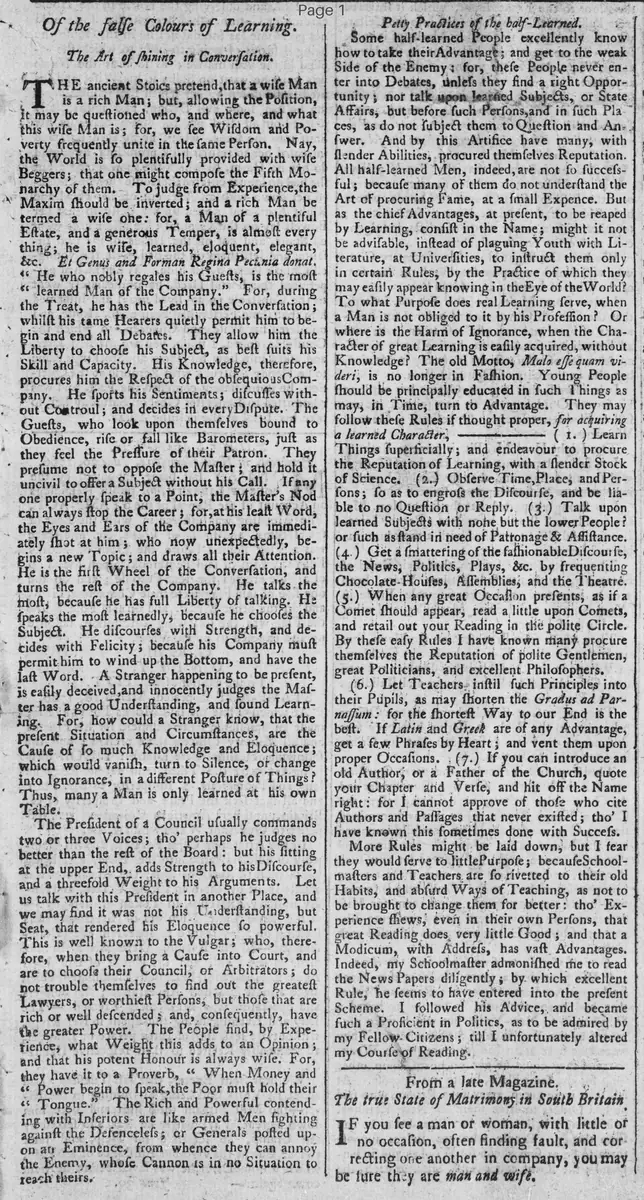
The Art of Shining in Conversation.
THE ancient Stoics pretend, that a wise Man is a rich Man; but, allowing the Position, it may be questioned who, and where, and what this wise Man is: for we see Wisdom and Poverty frequently unite in the same Person. Nay, the World is so plentifully provided with wise Beggars; that one might compose the Fifth Monarchy of them. - To judge from Experience, the Maxim should be inverted: and a rich Man be termed a wise one: for a Man of a plentiful Estate, and a generous Temper, is almost every thing; he is wise, learned, eloquent, elegant, &c. Et Genus and Formam Regina Pecunia donat.
"He who nobly regales his Guests, is the most learned Man of the Company." For, during the Treat, he has the Lead in the Conversation; whilst his tame Hearers quietly permit him to begin and end all Debates. They allow him the Liberty to choose his Subject, as best suits his Skill and Capacity. His Knowledge, therefore, procures him the Respect of the obsequious Company. He ports his Sentiments; discusses without Controul; and decides in every Dispute. The Guests, who look upon themselves bound to Obedience, rise or fall like Barometers, just as they feel the Pressure of their Patron. They presume not to oppose the Master; and hold it uncivil to offer a Subject without his Call. If any one properly speaks to a Point, the Master's Nod can always stop the Career; for, at his least Word, the Eyes and Ears of the Company are immediately shot at him; who now unexpectedly, begins a new Topic; and draws all their Attention. He is the first Wheel of the Conversation; and turns the rest of the Company. He talks the most, because he has full Liberty of talking. He speaks the most learnedly, because he chooses the Subject. He discourses with Strength, and decides with Felicity; because his Company must permit him to wind up the Bottom, and have the last Word. - A Stranger happening to be present, is easily deceived, and innocently judges the Master has a good Understanding, and sound Learning. For, how could a Stranger know, that the present Situation and Circumstances, are the Cause of so much Knowledge and Eloquence; which would vanish, turn to Silence, or change into Ignorance, in a different Posture of Things? Thus, many a Man is only learned at his own Table.
The President of a Council usually commands two or three Voices; tho' perhaps he judges no better than the rest of the Board: but his sitting at the upper End, adds Strength to his Discourse, and a threefold Weight to his Arguments. Let us talk with this President in another Place, and we may find it was not his Understanding, but Seat, that rendered his Eloquence so powerful. This is well known to the Vulgar; who, therefore, when they bring a Cause into Court, and are to choose their Council; or Arbitrators; do not trouble themselves to find out the greatest Lawyers, or worthiest Persons; but those that are rich or well descended; and, consequently, have the greater Power. The People find, by Experience, what Weight this adds to an Opinion; and that his potent Honour is always wise. For, they have it to a Proverb, "When Money and Power begin to speak, the Poor must hold their Tongue." The Rich and Powerful contending with Inferiors- are like armed Men fighting against the Defenceless; or Generals posted upon an Eminence, from whence they can annoy the Enemy, whose Cannon is in no Situation to reach theirs.
Petty Practices of the half-Learned.
Some half-learned People excellently know how to take their Advantage: and get to the weak Side of the Enemy: for, these People never enter into Debates, unless they find a right Opportunity: nor talk upon Learned Subjects, or State Affairs, but before such Persons, and in such Places, as do not subject them to Question and Answer. And by this Artifice have many, with slender Abilities, procured themselves Reputation. All half-learned Men, indeed, are not so successful: because many of them do not understand the Art of procuring Fame, at a small Expence. But as the chief Advantages, at present, to be reaped by Learning, consist in the Name; might it not be advisable, instead of plaguing Youth with Literature, at Universities, to instruct them only in certain Rules, by the Practice of which they may easily appear knowing in the Eye of the World? To what Purpose does real Learning serve, when a Man is not obliged to it by his Profession? Or where is the Harm of Ignorance, when the Character of great Learning is easily acquired, without Knowledge? The old Motto, Malo esse quam videri, is no longer in Fashion. Young People should be principally educated in such Things as may, in Time, turn to Advantage. They may follow these Rules if thought proper, for acquiring a learned Character:
(1.) Learn Things superficially; and endeavour to procure the Reputation of Learning, with a slender Stock of Science. (2.) Observe Time, Place, and Persons; so as to engross the Discourse, and be liable to no Question or Reply. (3.) Talk upon learned Subjects with none but the lower People; or such as stand in need of Patronage & Assistance. (4.) Get a smattering of the fashionable Discourse, the News, Politics, Plays, &c. by frequenting Chocolate-Houses, Assemblies; and the Theatre. (5.) When any great Occasion presents, as if a Comet should appear, read a little upon Comets, and retail out your Reading in the polite Circle. By these easy Rules I have known many procure themselves the Reputation of polite Gentlemen, great Politicians, and excellent Philosophers. (6.) Let Teachers- instil such Principles into their Pupils, as may shorten this Gradus ad Parnassum: for the shortest Way to our End is the best. If Latin and Greek are of any Advantage, get a few Phrases by Heart; and vent them upon proper Occasions. (7.) If you can introduce an old Author, or a Father of the Church, quote your Chapter and Verse, and hit off the Name right: for I cannot approve of those who cite Authors and Passages that never existed: tho' I have known this sometimes done with Success. More Rules might be laid down, but I fear they would serve to little Purpose: because School-masters and Teachers are so rivetted to their old Habits, and absurd Ways of Teaching, as not to be brought to change them for better: tho' Experience shews, even in their own Persons, that great Reading does very little Good; and that a Modicum, with Address, has vast Advantages. Indeed, my Schoolmaster admonished me to read the News Papers diligently: by which excellent Rule, he seems to have entered into the present Scheme. I followed his Advice, and became such a Proficient in Politics, as to be admired by my Fellow-Citizens; till I unfortunately altered my Course of Reading.
What sub-type of article is it?
What themes does it cover?
What keywords are associated?
Literary Details
Title
Of The False Colours Of Learning
Subject
The Art Of Shining In Conversation
Form / Style
Satirical Prose Essay
Key Lines