Thank you for visiting SNEWPapers!
Sign up free
The Key West Citizen
Key West, Monroe County, Florida
What is this article about?
Fingerprint expert Roy Hamlin debunks myths that skin grafting can endanger fingerprint identification, citing past failed theories and expert consensus that such alterations are detectable and impractical for criminals like Jack Klutas.
Merged-components note: These three components form a single article on fingerprint identification and skin grafting myths.
Clipping
OCR Quality
Full Text
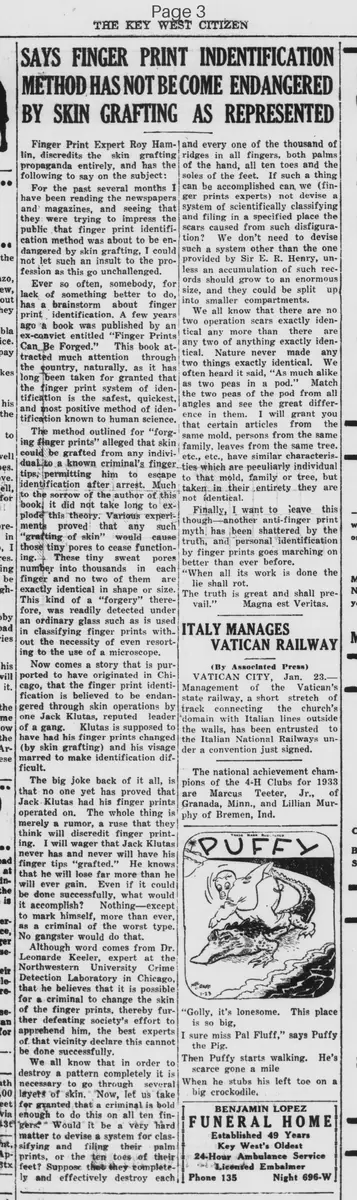
SAYS FINGER PRINT IDENTIFICATION
METHOD HAS NOT BECOME ENDANGERED
BY SKIN GRAFTING
AS REPRESENTED
Finger Print Expert Roy Hamlin, discredits the skin grafting
propaganda entirely, and has the following to say on the subject:
For the past several months I
have been reading the newspapers
and magazines, and seeing that
they were trying to impress the
public that finger print identifi-
cation method was about to be en-
dangered by skin grafting. I could
not let such an insult to the pro-
fession as this go unchallenged.
Ever so often, somebody, for
lack of something better to do,
has a brainstorm about finger
print identification. A few years
ago a book was published by an
ex-convict entitled "Finger Prints
Can Be Forged."
This book at-
tracted much attention through
the country, naturally, as it has
long been taken for granted that
the finger print system of iden-
tification is the safest, quickest,
and most positive method of iden-
tification known to human science.
The method outlined for "forg-
ing finger prints" alleged that skin
could be grafted from any indivi-
dual to a known criminal's finger.
tips, permitting him to escape
identification after arrest. Much
to the sorrow of the author of this
book, it did not take long to ex-
plode this theory. Various experi-
ments proved that any such
"grafting of skin" would cause
those tiny pores to cease function-
ing. These tiny sweat pores
number into thousands in
each
finger and no two of them
are
exactly identical in shape or size.
This kind of a "forgery" there-
fore, was readily detected under
an ordinary glass such as is used
in classifying finger prints with.
out the necessity of even resort-
ing to the use of a microscope.
Now comes a story that is pur-
ported to have originated in Chi-
cago, that the finger print identi-
fication is believed to be endan-
gered through skin operations by
one Jack Klutas, reputed leader
of a gang.
Klutas is supposed to
have had his finger prints changed
(by skin grafting) and his visage
marred to make identification dif-
ficult.
The big joke back of it all, is
that no one yet has proved that
Jack Klutas had his finger prints
operated on. The whole thing is
merely a rumor, a ruse that they
think will discredit finger print-
ing. I will wager that Jack Klutas
never has and never will have his
finger tips "grafted." He knows
that he will lose far more than he
will ever gain. Even if it could
be done successfully, what would
it accomplish?
Nothing—except
to mark himself, more than ever,
as a criminal of the worst type.
No gangster would do that.
Although word comes from Dr.
Leonarde Keeler, expert at the
Northwestern University Crime
Detection Laboratory in Chicago,
that he believes that it is possible
for a criminal to change the skin
of the finger prints, thereby fur-
ther defeating society's effort to
apprehend him, the best experts
of that vicinity declare this cannot
be done successfully.
We all know that in order to
destroy a pattern completely it is
necessary to go through several
layers of skin. Now, let us take
for granted that a criminal is bold
enough to do this on all ten fin-
gers. Would it be a very hard
matter to devise a system for clas-
sifying and filing their palm
prints, or the ten toes of their
feet? Suppose that they complete-
ly and effectively destroy each
and every one of the thousands of
ridges in all fingers, both palms
of the hand, all ten toes and the
soles of the feet. If such a thing
can be accomplished can we (fin-
ger prints experts) not devise a
system of scientifically classifying
and filing in a specified place the
scars caused from such disfigura-
tion? We don't need to devise
such a system other than the one
provided by Sir E. R. Henry, un-
less an accumulation of such rec-
ords should grow to an enormous
size, and they could be split up
into smaller compartments.
We all know that there are no
two operation scars exactly iden-
tical any more than there
are
any two of anything exactly iden-
tical. Nature never made any
two things exactly identical. We
often heard it said, "As much alike
as two peas in a pod." Match
the two peas of the pod from all
angles and see the great differ-
ence in them. I will grant you
that certain articles from the
same mold, persons from the same
family, leaves from the same tree,
etc., etc., have similar characteris.
tics which are peculiarly individual
to that mold, family or tree, but
taken in their entirety they are
not identical.
Finally, I want to leave
this
thought—another anti-finger print
myth has been shattered by the
truth, and personal identification
by finger prints goes marching on
better than ever before.
"When all its work is done the
lie shall rot.
The truth is great and shall pre-
vail."
Magna est Veritas.
What sub-type of article is it?
What themes does it cover?
What keywords are associated?
What entities or persons were involved?
Where did it happen?
Story Details
Key Persons
Location
Chicago
Story Details
Fingerprint expert Roy Hamlin refutes claims that skin grafting can undermine fingerprint identification, explaining that grafts disrupt pore patterns detectable under magnification, past forgery theories were debunked, and even if attempted, alternatives like palm or toe prints and scar classification ensure identification remains reliable.