Thank you for visiting SNEWPapers!
Sign up free
The Topeka State Journal
Topeka, Shawnee County, Kansas
What is this article about?
An article observes the cultural Anglicization of Ireland, with English, Scottish, and other non-Irish names dominating businesses, newspapers, directories, and industries in Dublin, Belfast, and beyond. English has largely replaced Irish as the spoken language, even among Catholics, marking a rapid shift within 50 years.
Clipping
OCR Quality
Full Text
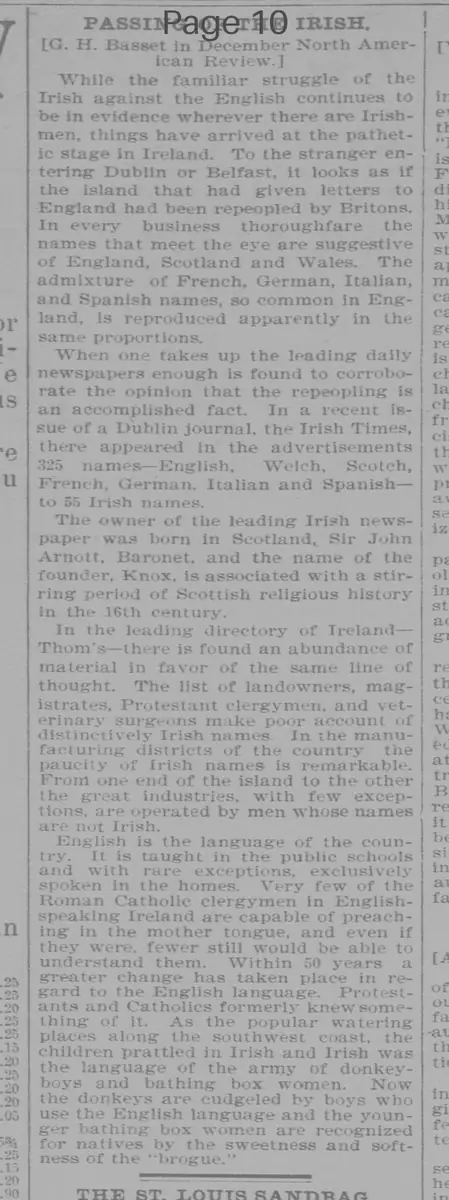
While the familiar struggle of the Irish against the English continues to be in evidence wherever there are Irishmen, things have arrived at the pathetic stage in Ireland. To the stranger entering Dublin or Belfast, it looks as if the island that had given letters to England had been repeopled by Britons. In every business thoroughfare the names that meet the eye are suggestive of England, Scotland and Wales. The admixture of French, German, Italian, and Spanish names, so common in England, is reproduced apparently in the same proportions.
When one takes up the leading daily newspapers enough is found to corroborate the opinion that the repeopling is an accomplished fact. In a recent issue of a Dublin journal, the Irish Times, there appeared in the advertisements 325 names-English, Welsh, Scotch, French, German, Italian and Spanish-to 55 Irish names.
The owner of the leading Irish newspaper was born in Scotland, Sir John Arnott, Baronet, and the name of the founder, Knox, is associated with a stirring period of Scottish religious history in the 16th century.
In the leading directory of Ireland-Thom's-there is found an abundance of material in favor of the same line of thought. The list of landowners, magistrates, Protestant clergymen, and veterinary surgeons make poor account of distinctively Irish names. In the manufacturing districts of the country the paucity of Irish names is remarkable. From one end of the island to the other the great industries, with few exceptions, are operated by men whose names are not Irish.
English is the language of the country. It is taught in the public schools and with rare exceptions, exclusively spoken in the homes. Very few of the Roman Catholic clergymen in English-speaking Ireland are capable of preaching in the mother tongue, and even if they were, fewer still would be able to understand them. Within 50 years a greater change has taken place in regard to the English language. Protestants and Catholics formerly knew something of it. As the popular watering places along the Southwest coast, the children prattled in Irish and Irish was the language of the army of donkey-boys and bathing box women. Now the donkeys are cudgeled by boys who use the English language and the younger bathing box women are recognized for natives by the sweetness and softness of the "brogue."
What sub-type of article is it?
What themes does it cover?
What keywords are associated?
What entities or persons were involved?
Where did it happen?
Story Details
Key Persons
Location
Ireland (Dublin, Belfast, Manufacturing Districts, Southwest Coast)
Event Date
Within 50 Years (Recent As Of December North American Review)
Story Details
Observation of Ireland's cultural shift towards English dominance, with non-Irish names prevalent in businesses, newspapers, directories, and industries; English language replacing Irish in schools, homes, and public life, even among Roman Catholics.