Thank you for visiting SNEWPapers!
Sign up free
The National Intelligencer And Washington Advertiser
Washington, District Of Columbia
What is this article about?
On May 3, in the House of Commons, Mr. Windham criticizes the definitive Treaty of Peace with France, Batavian Republic, and Spain, highlighting unknown circumstances like cessions of Elbe, French Guiana, and Louisiana; interval events like Italian Republic formation; deviations such as on prisoners and Malta; and new omissions like non-revival of prior treaties, urging further consideration.
Clipping
OCR Quality
Full Text
MAY 3.
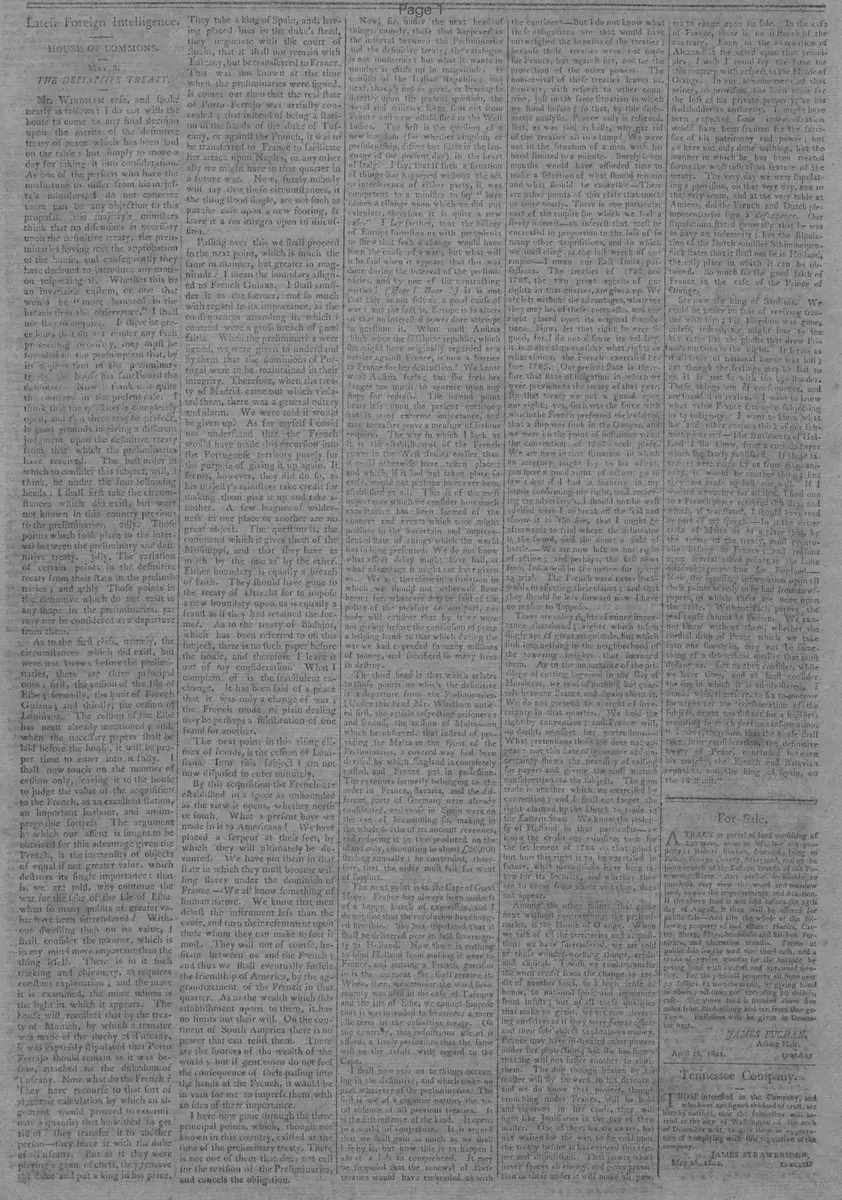
THE DEFINITIVE TREATY
Mr. Windham rose, and spoke nearly as follows: I do not wish the house to come to any final decision upon the merits of the definitive treaty of peace which has been laid on the table: but simply to move a day for taking it into consideration. As one of the persons who have the misfortune to differ from his majesty's ministers, I do not conceive there can be any objection to this proposal. His majesty's ministers think that no discussion is necessary upon the definitive treaty, the preliminaries having met the approbation of the house, and consequently they have declined to introduce any motion respecting it. Whether this be an invariable custom, or one that would be "more honored in the breach than the observance," I shall not stay to enquire. If there be precedents that do not render any such proceeding necessary, they must be founded on the presumption that, by its approbation of the preliminary treaty, the house has sanctioned the definitive. Now I think it is quite the contrary in the present case. I think that the question is completely open, and that there may be perfectly good grounds in giving a different judgment upon the definitive treaty from that which the preliminaries have received. The best order in which to consider this subject, will, I think, be under the four following heads: I shall first take the circumstances which did exist, but were not known in this country previous to the preliminaries, 2dly. Those points which took place in the interval between the preliminary and definitive treaty. 3dly. The variation of certain points in the definitive treaty from their state in the preliminaries; and 4thly Those points in the definitive which do not exist in any shape in the preliminaries, yet may not be considered as a departure from them.
As to the first class, namely, the circumstances which did exist, but were not known before the preliminaries, there are three principal ones: first, the cession of the Isle of Elbe; secondly, the limit of French Guiana; and thirdly, the cession of Louisiana. The cession of the Elbe has been already mentioned; and, when the necessary papers shall be laid before the house, it will be proper time to enter into it fully. I shall now touch on the manner of cession only, leaving it to the house to judge the value of the acquisition to the French, as an excellent station, an important harbour, and an impregnable fortress. The argument by which our assent is ought to be obtained for this advantage given the French, is the immensity of objects of equal if not greater value, which destroys its single importance: that is, we are told, why continue the war for the sake of the Isle of Elbe when so many points of greater value have been surrendered? Without dwelling then on its value, I shall consider the manner, which is in my mind more important than the thing itself. There is in it such tricking and chicanery, as requires constant explanation; and the more it is examined, the more odious is the light in which it appears. The house will recollect that by the treaty of Munich, by which a transfer was made of the duchy of Tuscany, it was expressly stipulated that Porto Ferrajo should remain as it was before, attached to the dukedom of Tuscany. Now what do the French? They have recourse to that sort of algebraic calculation by which an algebraist would proceed to exterminate a quantity that he wished to get rid of they transfer it to another person-they leave it with the duke of Tuscany. But as if they were playing a game of chess, they remove the duke and put a king in his place. They take a king of Spain, and, having placed him in the duke's stead, they negotiate with the court of Spain, that it shall not remain with Tuscany, but be transferred to France. This was not known at the time when the preliminaries were signed. It comes out then that the real state of Porto Ferrajo was artfully concealed; that instead of being a station in the hands of the duke of Tuscany, or against the French, it was to be transferred to France to facilitate her attack upon Naples, or any other ally we might have in that quarter in a future war. Now, surely nobody will say that these circumstances, if the thing stood single, are not such as put the case upon a new footing, and leave it a res integra open to discussion.
Passing over this we shall proceed to the next point, which is much the same in manner, but greater in magnitude: I mean the boundary assigned to French Guiana. I shall consider it as the former, not so much with regard to its importance, as the consequences attending it, which I contend were a gross breach of good faith. When the preliminaries were signed, we were given to understand by them that the dominions of Portugal were to be maintained in their integrity. Therefore, when the treaty of Madrid came out which violated them, there was a general outcry and alarm. We were told it would be given up. As for myself I could not understand that the French would have made this excursion into the Portuguese territory purely for the purpose of giving it up again. It seems, however, they did do so, as his majesty's ministers take credit for making them give it up and take another. A few leagues of wilderness in one place or another are no great object. The question is, the command which it gives them of the Mississippi, and that they have as much by the one as by the other. Either boundary is equally a breach of faith. They should have gone to the treaty of Utrecht for to impose a new boundary upon us is equally a fraud as if they had retained the former. As to the treaty of Badajos, which has been referred to on this subject, there is no such paper before the house, and therefore I leave it out of my consideration. What I complain of is the fraudulent exchange. It has been said of a peace that it was only a change of war; the French mode of plain dealing may be perhaps a substitution of one fraud for another.
The next point in this rising climax of frauds, is the cession of Louisiana. Into this subject I am not now disposed to enter minutely. By this acquisition the French are established in a space as unbounded as the view it opens, whether north or south. What a present have we made to Americans! We have placed a serpent at their feet, by which they will ultimately be devoured. We have put them in that state in which they must become willing slaves under the dominion of France. We all know something of human nature. We know that men detest the instrument less than the cause, and turn their resentment upon those whom they can make to feel it most. They will not of course, hesitate between us and the French; and thus we shall eventually forfeit the friendship of America, by the aggrandizement of the French in that quarter. As to the wealth which this establishment opens to them, it has no limits but their will. On the continent of South America there is no power that can resist them. There are the sources of the wealth of the world; but if gentlemen do not feel the consequence of their passing into the hands of the French, it would be in vain for me to impress them with an idea of their importance.
I have now gone through the three principal points, which, though not known in this country, existed at the time of the preliminary treaty. There is not one of them that does not call for the revision of the Preliminaries, and cancels the obligation.
Now, sir, under the next head of things, namely, those that happened in the interval between the Preliminaries and the definitive treaty, the catalogue is not numerous: but what it wants in number is made up in magnitude. It consists of the Italian Republic; and next, though not so great, or bearing so directly upon the present question, the naval and military force sent out from France and now established in the West Indies. The first is the question of a new kingdom (for whether kingdom or presidency, differs but little in the language of the present day) in the heart of Italy. I say, that if such a situation of things had happened without the act or interference of either party, it was competent to a minister to say "here comes a change upon which we did not calculate, therefore it is quite a new case." I say farther, that the history of Europe furnishes us with precedents to show that such a change would have been the cause of a war; but what will it be said when it appears that this was done during the interval of the preliminaries, and by one of the contracting parties! (Hear, hear!) It is not that this is not felt as a good cause of war: but the fact is, Europe is so altered that no independent power dare attempt to question it. What must Austria think when the Cisalpine republic, which she might have originally regarded as a barrier against France, is now a barrier to France for her destruction? We know what Austria feels; but she feels her danger too much to venture upon any steps for redress. The second point bears less upon the present question; but it is of extreme importance, and may hereafter prove a measure of serious enquiry. The way in which I look at it is the establishment of the French power in the West Indies earlier than it could otherwise have taken place; and which, if it had not taken place so early, would not perhaps have ever been established at all. This is of the most importance which we consider how much expectation has been formed of the charters and events which time might produce in the uncertain and unprecedented state of things which the world has so long presented. We do not know what effect delay might have had, or what advantage it might not have given us. We are therefore in a situation in which we should not otherwise have been; for, whatever may be said of the policy of the measure on our part, nobody will deny that by it we were not giving before the conclusion of peace a helping hand to that which during the war we had expended so many millions of money, and sacrificed so many lives to destroy.
The third head is that which relates to those points on which the definitive is a departure from the Preliminaries. [Under this head Mr. Windham noticed first, the article respecting prisoners; and second, the cession of Malta--on which he observed, that instead of providing for Malta in the spirit of the Preliminaries, a covered way had been devised by which England is completely ousted, and France put in possession. The revenues formerly belonging to the order in France, Bavaria, and the different parts of Germany were already confiscated, and those in Spain were on the eve of becoming so, making in the whole 4-5ths of its ancient revenues, and reducing it to that produced on the island only, amounting to about £50,000 sterling annually; he contended, therefore, that the order must fall for want of support.]
The next point is in the Cape of Good Hope. France has always been mistress of a happy knack of expression, and I do not find that the revolution has changed her style. She has stipulated that it shall be delivered over in full sovereignty to Holland. Now there is nothing to bind Holland from making it over to France, and putting a French garrison in it the moment she shall receive it. When, then, we consider the word sovereignty was used in the case of Tuscany and the Isle of Elbe, we cannot suppose that it was intended to be otiosus a mere idle term in the definitive treaty. On the contrary, this industrious use of it affords a lively persuasion that the same will be the result with regard to the Cape.
I shall now pass on to things occurring in the definitive, and which make no part whatever of the preliminaries. The first is one of a gigantic nature; the total absence of all previous treaties. It is the first instance of the kind. It opens to a world of conjecture. It is argued that we shall gain as much as we shall lose by it, but how this is to happen I am at a loss to comprehend. It may be supposed that the renewal of these treaties would have embroiled us with the continent--But I do not know what these obligations are that would have outweighed the benefits of the treaties; because these treaties were not made for France, but against her, and for the protection of the other powers. The non-revival of these treaties leaves us, however, with respect to other countries, just in the same situation in which we stood before; so that, by this diplomatic analysis, France only is relieved. But, as was said at Lisle, why get rid of the treaties all in a lump? We were not in the situation of a man with his hand limited to a minute. Surely seven months would have afforded time to make a selection of what should remain and what should be cancelled--There are other points of this class that touch us more nearly. There is one particular part of the empire for which we feel a lively interest--an interest that must be increased in proportion to the loss of so many other acquisitions, and to which we must cling as the last wreck of our empire--I mean our East India possessions. The treaties of 1783 and 1787, the two great epochs of our rights in that quarter, are given up. We are left without the advantages, whatever they may be, of these compacts, and our right placed upon its original foundation. Now, let that right be ever so good, or I do not dispute its validity, it is material to consider what rights or what claims, the French exercised before 1783. Our present state is therefore that state of litigation in which we were previous to the treaty of that year. By that treaty we put a guard upon our right; yet, such was the force with which the French preferred their claims, that a ship was sunk in the Ganges, and we were on the point of hostilities when the convention of 1787 took place. We are now in that situation in which an attorney might say to his client, you have a good right of action, go to law: but if I had a security in my hands confirming my right, and removing my adversary's, I should not be well advised were I to break off the seal and throw it in the fire, that I might go afterwards to trial where the arbitrator is the sword, and the court a field of battle. We are now left to our right of action; and perhaps, the first news from India will be the notice for going to trial. The French were never backward in asserting their claims; and that they should be less forward now I have no reason to suppose.
There are other rights of minor importance abandoned; rights which taken singly are of great magnitude, but which sink into nothing in the neighborhood of the towering heights that surround them. As to the importance of the privilege of cutting logwood in the Bay of Honduras, we read of nothing but quarrels between France and Spain about it. We do not pretend to a right of sovereignty in that quarter. We hold the right by convention; and France will, no doubt, re-assert her pretensions. What pretensions she has does not appear: but this state of ignorance and uncertainty shows the necessity of calling for papers and giving the most mature consideration to the subject. The gum trade is another which we exercised by Convention; and I shall not forget the right claimed by the Dutch to trade in the Eastern Seas. We know the jealousy of Holland in that particular--we know the credit our ministers took for the settlement of 1784 on that point; but how this right is to be exercised in future, what precautions have been taken for its security, and whether they are to come from above or below, does not appear.
Among the other points that come next without contravening the preliminaries, is the House of Orange. When we talk of all the territories and acquisitions we have surrendered, we are told of those wonder-working things, credit and capital. I wish we could transfer the word credit from the chance to credit of another kind, to a high sense of honor, to national spirit and immunity from insult; but of all these qualities that make us great, we are now diverting ourselves as if they were functus officio and their sole object to obtain us money. France may have ill-treated other powers under her protection; but she has shown that she will not suffer another to abuse them. The dog though beaten by his master will fly forward in his defence; and we do know that powers, though crouching under France, will be bold and vigorous in her cause, they will fight like Janissaries in the pay of their master. One of them we are aware, has not waited for the wax to be cold upon the treaty before it has evinced this temper and disposition. That power which never spares an enemy, and gives protection to those under it will make all powers to range upon its side. In the case of France, there is no instance of the contrary. Even in the evacuation of Alexandria they acted upon that principle. I wish I could say the same for this country with respect to the House of Orange. In our abandonment of that prince, no provision has been made for the loss of his private property, or his stadtholderian authority. It might have been expected. Some indemnification would have been secured for the sacrifice of his patrimony and power; but we have not only done nothing, but the manner in which he has been treated forms the most ridiculous feature of the treaty. The very day we were stipulating a provision, on that very day, and in that very room, and at the very table at Amiens, did the French and Dutch plenipotentiaries sign a defeasance. Our stipulations stood generally that he was to have an indemnity: but the stipulation of the Dutch minister Schimmelpenninck states that it shall not be in Holland, the only place in which it can be obtained. So much for the good faith of France in the case of the Prince of Orange.
See now the king of Sardinia. We could be under no fear of reviving treaties with him; his kingdom was gone, unless, indeed, we might fear to see him come like the ghost that drew Priam's curtains in the night. It seems as if all sense of national honor was lost; but though the feelings may be lost to us, it is not so with the by-stander. These things are of consequence, and are founded in reason. I want to know what value France sets upon subjecting us to indignity. I want to know what she and other nations think of our submitting to it?--The sentiments of Holland I do know, from a curious paper which he lately published. If the sacrifices were made by us from magnanimity, it would be another thing; but they are made against our will. If I wanted a voucher for all this, I find one in a French paper received this day, and which, if translated, I should have read as part of my speech.--In it the writer talks of Malta as of a place that, by the terms of the treaty, must eventually belong to France; and reasons upon several other points in the same disadvantageous line for England.--Now, the necessary information upon all these points is only to be had from newspapers, of which there are none upon the table. Without such papers the real case cannot be known. We cannot know without them, whether the cordial drop of Peace which we take into our stomachs, may not be something of a deleterious quality that must destroy us. Let us then consider, while we have time, and at least consider the cup in which it is administered. I should wish, therefore, to fix to-morrow fortnight for the consideration of the subject, as not too distant for a business requiring so much previous information. I move, therefore, that the house shall take into consideration, the definitive treaty of Peace, concluded between his majesty, the French and Batavian republics, and the king of Spain, on the 25th inst.
What sub-type of article is it?
What keywords are associated?
What entities or persons were involved?
Where did it happen?
Foreign News Details
Primary Location
France
Event Date
May 3
Key Persons
Outcome
motion to consider the definitive treaty on a future date; criticisms of concessions including cessions of isle of elbe, louisiana, malta, cape of good hope, and non-revival of prior treaties.
Event Details
Mr. Windham addresses the House of Commons, arguing for reconsideration of the definitive Treaty of Peace due to concealed circumstances like cessions of Isle of Elbe, French Guiana boundary, and Louisiana; events in interval such as Italian Republic and French forces in West Indies; deviations on prisoners and Malta; and new elements like absence of previous treaties and treatment of House of Orange.