Thank you for visiting SNEWPapers!
Sign up free
The Massachusetts Spy, And Worcester County Advertiser
Worcester, Worcester County, Massachusetts
What is this article about?
In Peru, General Santa Cruz decreed a constitutional congress for May 1 on January 26, overthrowing the Bolivian constitution in a bloodless revolution led by Colombian officers. This triumph of constitutionalists in Peru and Colombia discourages anti-republican ambitions, sparking joy in Bogota.
Clipping
OCR Quality
Full Text
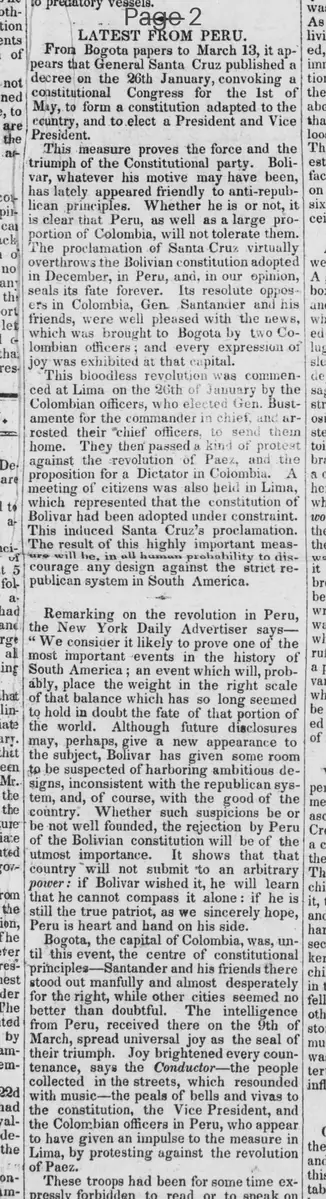
From Bogota papers to March 13, it appears that General Santa Cruz published a decree on the 26th January, convoking a constitutional Congress for the 1st of May, to form a constitution adapted to the country, and to elect a President and Vice President. This measure proves the force and the triumph of the Constitutional party. Bolivar, whatever his motive may have been, has lately appeared friendly to anti-republican principles. Whether he is or not, it is clear that Peru, as well as a large proportion of Colombia, will not tolerate them. The proclamation of Santa Cruz virtually overthrows the Bolivian constitution adopted in December, in Peru, and, in our opinion, seals its fate forever. Its resolute opposers in Colombia, Gen Santander and his friends, were well pleased with the news, which was brought to Bogota by two Colombian officers; and every expression of joy was exhibited at that capital. This bloodless revolution was commenced at Lima on the 26th of January by the Colombian officers, who elected Gen. Bustamente for the commander in chief, and arrested their chief officers, to send them home. They then passed a kind of protest against the revolution of Paez, and the proposition for a Dictator in Colombia. A meeting of citizens was also held in Lima, which represented that the constitution of Bolivar had been adopted under constraint. This induced Santa Cruz's proclamation. The result of this highly important measure will be, in all human probability to discourage any design against the strict republican system in South America. Remarking on the revolution in Peru, the New York Daily Advertiser says—'We consider it likely to prove one of the most important events in the history of South America; an event which will, probably, place the weight in the right scale of that balance which has so long seemed to hold in doubt the fate of that portion of the world. Although future disclosures may, perhaps, give a new appearance to the subject, Bolivar has given some room to be suspected of harboring ambitious designs, inconsistent with the republican system, and, of course, with the good of the country.' Whether such suspicions be or be not well founded, the rejection by Peru of the Bolivian constitution will be of the utmost importance. It shows that that country will not submit to an arbitrary power: if Bolivar wished it, he will learn that he cannot compass it alone: if he is still the true patriot, as we sincerely hope, Peru is heart and hand on his side. Bogota, the capital of Colombia, was, until this event, the centre of constitutional principles—Santander and his friends there stood out manfully and almost desperately for the right, while other cities seemed no better than doubtful. The intelligence from Peru, received there on the 9th of March, spread universal joy as the seal of their triumph. Joy brightened every countenance, says the Conductor—the people collected in the streets, which resounded with music—the peals of bells and vivas to the constitution, the Vice President, and the Colombian officers in Peru, who appear to have given an impulse to the measure in Lima, by protesting against the revolution of Paez. 'These troops had been for some time expressly forbidden to read or to speak on political subjects, or to hold any correspondence with Colombia. They obtained, however, a few newspapers, through which they learnt that Gen. Sucre had protested against Paez's movements; and then displaced Lara, and put Gen. Bustemente at their head.
What sub-type of article is it?
What keywords are associated?
What entities or persons were involved?
Where did it happen?
Foreign News Details
Primary Location
Peru
Event Date
26th January
Key Persons
Outcome
bloodless revolution overthrowing the bolivian constitution in peru, triumph of the constitutional party, convocation of a congress for may 1, discouragement of anti-republican designs in south america, universal joy in bogota
Event Details
General Santa Cruz published a decree on January 26 convoking a constitutional Congress for May 1 to form a new constitution and elect leaders. This followed a bloodless revolution in Lima started by Colombian officers who elected Gen. Bustamente as commander, arrested superiors, and protested against Paez's revolution and a proposed Dictator in Colombia. A citizens' meeting claimed Bolivar's constitution was adopted under constraint, leading to the proclamation. The news reached Bogota by March 9, eliciting celebrations supporting constitutional principles.