Thank you for visiting SNEWPapers!
Sign up free
Literary
August 28, 1894
Event 1 of 2
The Topeka State Journal
Topeka, Shawnee County, Kansas
What is this article about?
A romantic short story about Charlotte inheriting Edgemoor, marrying Eaton Wolcott, discovering a misinterpreted love letter leading to her abandonment, and reuniting six years later after Eaton explains the mix-up involving his uncle's correspondence.
Clipping
OCR Quality
95%
Excellent
Full Text
This is Event 1 of 2. The full text below covers all events in this component.
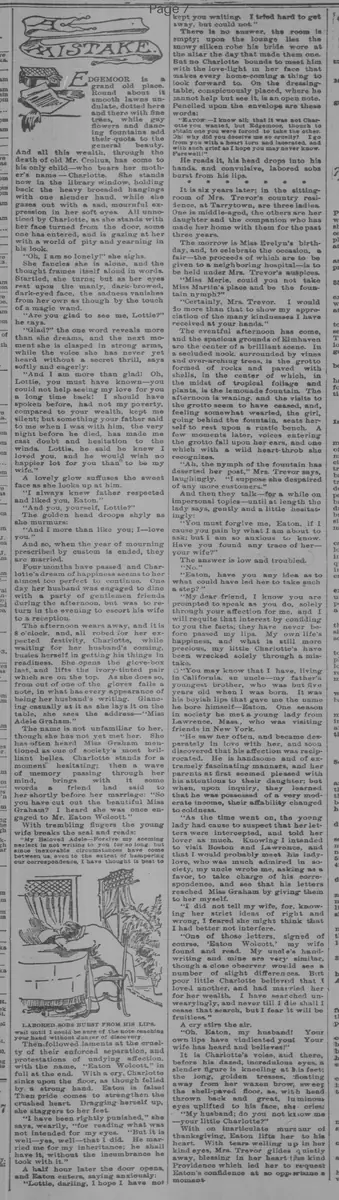
Edgemoor is a grand old place.
Round about it smooth lawns undulate, dotted here and there with fine trees, while gay flowers and dancing fountains add their quota to the general beauty.
And all this wealth, through the death of old Mr. Crolus, has come to his only child—who bears her mother's name—Charlotte. She stands now in the library window, holding back the heavy brocaded hangings with one slender hand, while she gazes out with a sad, mournful expression in her soft eyes. All unnoticed by Charlotte, as she stands with her face turned from the door, some one has entered, and is gazing at her with a world of pity and yearning in his look.
"Oh, I am so lonely!" she sighs.
She fancies she is alone, and the thought frames itself aloud in words.
Startled, she turns; but as her eyes rest upon the manly, dark-browed, dark-eyed face, the sadness vanishes from her own as though by the touch of a magic wand.
"Are you glad to see me, Lottie?" he says.
"Glad?" the one word reveals more than she dreams, and the next moment she is clasped in strong arms, while the voice she has never yet heard without a secret thrill, says softly and eagerly:
"And I am more than glad! Oh, Lottie, you must have known—you could not help seeing my love for you a long time back! I should have spoken before, had not my poverty, compared to your wealth, kept me silent; but something your father said to me when I was with him, the very night before he died, has made me cast doubt and hesitation to the winds. Lottie, he said he knew I loved you, and he would wish no happier lot for you than to be my wife."
A lovely glow suffuses the sweet face as she looks up at him.
"I always knew father respected and liked you, Eaton."
"And you, yourself, Lottie?"
The golden head droops shyly as she murmurs:
"And I more than like you; I—love you."
And so, when the year of mourning prescribed by custom is ended, they are married.
Four months have passed and Charlotte's dream of happiness seems to her almost too perfect to continue. One day her husband was engaged to dine with a party of gentlemen friends during the afternoon, but was to return in the evening to escort his wife to a reception.
The afternoon wears away, and it is 8 o'clock, and, all robed for her expected festivity, Charlotte, while waiting for her husband's coming, busies herself in getting his things in readiness. She opens the glove-box last, and lifts the ivory-tinted pair which are on the top. As she does so, from out of one of the gloves falls a note, in what has every appearance of being her husband's writing. Glancing casually at it as she lays it on the table, she sees the address—'Miss Adele Graham.'
The name is not unfamiliar to her, though she has not yet met her. She has often heard Miss Graham mentioned as one of society's most brilliant belles. Charlotte stands for a moment hesitating; then a wave of memory passing through her mind, brings with it some words a friend had said to her shortly before her marriage:
"So you have cut out the beautiful Miss Graham? I heard she was once engaged to Mr. Eaton Wolcott."
With trembling fingers the young wife breaks the seal and reads:
My Beloved Adele—Forgive my seeming neglect in not writing to you for so long, but since inexorable circumstances have come between us, even to the extent of hampering our correspondence, I have thought it best to wait until I could be sure of the note reaching your hand without danger of discovery.
Then followed laments at the cruelty of their enforced separation, and protestations of undying affection, with the name, "Eaton Wolcott," in full at the end. With a cry, Charlotte sinks upon the floor, as though felled by a strong hand. Eaton is false!
Then pride comes to strengthen the crushed heart. Dragging herself up, she staggers to her feet.
"I have been rightly punished," she says, wearily, "for reading what was not intended for my eyes.
"But it is well—yes, well that I did. He married me for my inheritance; he shall have it, without the incumbrance he took with it."
A half hour later the door opens, and Eaton enters, saying anxiously:
"Lottie, darling, I hope I have not kept you waiting. I tried hard to get away, but could not."
There is no answer. The room is empty; upon the lounge lies the snowy silken robe his bride wore at the altar the day that made them one.
But no Charlotte bounds to meet him with the love-light in her face that makes every home-coming a thing to look forward to. On the dressing-table, conspicuously placed, where he cannot help but see it, is an open note.
Penciled upon the envelope are these words:
Eaton:—I know all; that it was not Charlotte you wanted, but Edgemoor, though to obtain one you were forced to take the other. Oh! why did you deceive me so cruelly? I go from you with a heart torn and lacerated, and with such grief as I hope you may never know. Farewell!
He reads it. His head drops into his hands, and convulsive, labored sobs burst from his lips.
It is six years later; in the sitting-room of Mrs. Trevor's country residence, at Tarrytown, are three ladies. One is middle-aged, the others are her daughter and the companion who has made her home with them for the past three years.
The morrow is Miss Evelyn's birthday, and, to celebrate the occasion, a fair—the proceeds of which are to be given to a neighboring hospital—is to be held under Mrs. Trevor's auspices.
"Miss Merle, could you not take Miss Martin's place and be the fountain nymph?"
"Certainly, Mrs. Trevor. I would do more than that to show my appreciation of the many kindnesses I have received at your hands."
The eventful afternoon has come, and the spacious grounds of Elmhaven are the center of a brilliant scene. In a secluded nook, surrounded by vines and over-arching trees, is the grotto formed of rocks and paved with shells, in the center of which, in the midst of tropical foliage and plants, is the lemonade fountain. The afternoon is waning, and the visits to the grotto seem to have ceased, and, feeling somewhat wearied, the girl, going behind the fountain, seats herself to rest upon a rustic bench. A few moments later, voices entering the grotto fall upon her ears, and one which with a wild heart-throb she recognizes.
"Ah, the nymph of the fountain has deserted her post," Mrs. Trevor says, laughingly. "I suppose she despaired of any more customers."
And then they talk—for a while on impersonal topics—until at length the lady says, gently and a little hesitatingly:
"You must forgive me, Eaton, if I cause you pain by what I am about to ask; but I am so anxious to know. Have you found any trace of her—your wife?"
The answer is low and troubled.
"No."
"Eaton, have you any idea as to what could have led her to take such a step?"
"My dear friend, I know you are prompted to speak as you do, solely through your affection for me, and I will requite that interest by confiding to you the facts; they have never before passed my lips. My own life's happiness, and what is still more precious, my little Charlotte's have been wrecked solely through a mistake.
You may know that I have, living in California, an uncle—my father's youngest brother, who was but five years old when I was born. It was his boyish lips that gave me the name he bore himself—Eaton. One season in society he met a young lady from Lawrence, Mass., who was visiting friends in New York.
"He saw her often, and became desperately in love with her, and soon discovered that his affection was reciprocated. He is handsome and of extremely fascinating manners, and her parents at first seemed pleased with his attentions to their daughter; but when, upon inquiry, they learned that he was possessed of a very moderate income, their affability changed to coldness.
"As the time went on, the young lady had cause to suspect that her letters were intercepted, and told her lover as much. Knowing I intended to visit Boston and Lawrence, and that I would probably meet his lady-love, who was much admired in society, my uncle wrote me, asking as a favor, to take charge of his correspondence, and see that his letters reached Miss Graham by giving them to her myself.
"I did not tell my wife, for, knowing her strict ideas of right and wrong, I feared she might think that I had better not interfere.
One of those letters, signed of course, 'Eaton Wolcott,' my wife found and read. My uncle's handwriting and mine are very similar, though a close observer would see a number of slight differences. But poor little Charlotte believed that I loved another, and had married her for her wealth. I have searched unwearyingly, and never till I die shall I cease that search, but I fear it will be fruitless."
A cry stirs the air.
"Oh, Eaton, my husband! Your own lips have vindicated you!
Your wife has heard and believes!"
It is Charlotte's voice, and there, before his dazed, incredulous eyes, a slender figure is kneeling at his feet; the long, golden tresses, floating away from her waxen brow, sweep the shell-paved floor, as, with head thrown back and great, luminous eyes uplifted to his face, she cries:
"My husband; do you not know me—your little Charlotte?"
With an inarticulate murmur of thanksgiving, Eaton lifts her to his heart. With tears welling up in her kind eyes, Mrs. Trevor glides quietly away, blessing in her heart the kind Providence which led her to request Eaton's confidence at so opportune a moment.
Round about it smooth lawns undulate, dotted here and there with fine trees, while gay flowers and dancing fountains add their quota to the general beauty.
And all this wealth, through the death of old Mr. Crolus, has come to his only child—who bears her mother's name—Charlotte. She stands now in the library window, holding back the heavy brocaded hangings with one slender hand, while she gazes out with a sad, mournful expression in her soft eyes. All unnoticed by Charlotte, as she stands with her face turned from the door, some one has entered, and is gazing at her with a world of pity and yearning in his look.
"Oh, I am so lonely!" she sighs.
She fancies she is alone, and the thought frames itself aloud in words.
Startled, she turns; but as her eyes rest upon the manly, dark-browed, dark-eyed face, the sadness vanishes from her own as though by the touch of a magic wand.
"Are you glad to see me, Lottie?" he says.
"Glad?" the one word reveals more than she dreams, and the next moment she is clasped in strong arms, while the voice she has never yet heard without a secret thrill, says softly and eagerly:
"And I am more than glad! Oh, Lottie, you must have known—you could not help seeing my love for you a long time back! I should have spoken before, had not my poverty, compared to your wealth, kept me silent; but something your father said to me when I was with him, the very night before he died, has made me cast doubt and hesitation to the winds. Lottie, he said he knew I loved you, and he would wish no happier lot for you than to be my wife."
A lovely glow suffuses the sweet face as she looks up at him.
"I always knew father respected and liked you, Eaton."
"And you, yourself, Lottie?"
The golden head droops shyly as she murmurs:
"And I more than like you; I—love you."
And so, when the year of mourning prescribed by custom is ended, they are married.
Four months have passed and Charlotte's dream of happiness seems to her almost too perfect to continue. One day her husband was engaged to dine with a party of gentlemen friends during the afternoon, but was to return in the evening to escort his wife to a reception.
The afternoon wears away, and it is 8 o'clock, and, all robed for her expected festivity, Charlotte, while waiting for her husband's coming, busies herself in getting his things in readiness. She opens the glove-box last, and lifts the ivory-tinted pair which are on the top. As she does so, from out of one of the gloves falls a note, in what has every appearance of being her husband's writing. Glancing casually at it as she lays it on the table, she sees the address—'Miss Adele Graham.'
The name is not unfamiliar to her, though she has not yet met her. She has often heard Miss Graham mentioned as one of society's most brilliant belles. Charlotte stands for a moment hesitating; then a wave of memory passing through her mind, brings with it some words a friend had said to her shortly before her marriage:
"So you have cut out the beautiful Miss Graham? I heard she was once engaged to Mr. Eaton Wolcott."
With trembling fingers the young wife breaks the seal and reads:
My Beloved Adele—Forgive my seeming neglect in not writing to you for so long, but since inexorable circumstances have come between us, even to the extent of hampering our correspondence, I have thought it best to wait until I could be sure of the note reaching your hand without danger of discovery.
Then followed laments at the cruelty of their enforced separation, and protestations of undying affection, with the name, "Eaton Wolcott," in full at the end. With a cry, Charlotte sinks upon the floor, as though felled by a strong hand. Eaton is false!
Then pride comes to strengthen the crushed heart. Dragging herself up, she staggers to her feet.
"I have been rightly punished," she says, wearily, "for reading what was not intended for my eyes.
"But it is well—yes, well that I did. He married me for my inheritance; he shall have it, without the incumbrance he took with it."
A half hour later the door opens, and Eaton enters, saying anxiously:
"Lottie, darling, I hope I have not kept you waiting. I tried hard to get away, but could not."
There is no answer. The room is empty; upon the lounge lies the snowy silken robe his bride wore at the altar the day that made them one.
But no Charlotte bounds to meet him with the love-light in her face that makes every home-coming a thing to look forward to. On the dressing-table, conspicuously placed, where he cannot help but see it, is an open note.
Penciled upon the envelope are these words:
Eaton:—I know all; that it was not Charlotte you wanted, but Edgemoor, though to obtain one you were forced to take the other. Oh! why did you deceive me so cruelly? I go from you with a heart torn and lacerated, and with such grief as I hope you may never know. Farewell!
He reads it. His head drops into his hands, and convulsive, labored sobs burst from his lips.
It is six years later; in the sitting-room of Mrs. Trevor's country residence, at Tarrytown, are three ladies. One is middle-aged, the others are her daughter and the companion who has made her home with them for the past three years.
The morrow is Miss Evelyn's birthday, and, to celebrate the occasion, a fair—the proceeds of which are to be given to a neighboring hospital—is to be held under Mrs. Trevor's auspices.
"Miss Merle, could you not take Miss Martin's place and be the fountain nymph?"
"Certainly, Mrs. Trevor. I would do more than that to show my appreciation of the many kindnesses I have received at your hands."
The eventful afternoon has come, and the spacious grounds of Elmhaven are the center of a brilliant scene. In a secluded nook, surrounded by vines and over-arching trees, is the grotto formed of rocks and paved with shells, in the center of which, in the midst of tropical foliage and plants, is the lemonade fountain. The afternoon is waning, and the visits to the grotto seem to have ceased, and, feeling somewhat wearied, the girl, going behind the fountain, seats herself to rest upon a rustic bench. A few moments later, voices entering the grotto fall upon her ears, and one which with a wild heart-throb she recognizes.
"Ah, the nymph of the fountain has deserted her post," Mrs. Trevor says, laughingly. "I suppose she despaired of any more customers."
And then they talk—for a while on impersonal topics—until at length the lady says, gently and a little hesitatingly:
"You must forgive me, Eaton, if I cause you pain by what I am about to ask; but I am so anxious to know. Have you found any trace of her—your wife?"
The answer is low and troubled.
"No."
"Eaton, have you any idea as to what could have led her to take such a step?"
"My dear friend, I know you are prompted to speak as you do, solely through your affection for me, and I will requite that interest by confiding to you the facts; they have never before passed my lips. My own life's happiness, and what is still more precious, my little Charlotte's have been wrecked solely through a mistake.
You may know that I have, living in California, an uncle—my father's youngest brother, who was but five years old when I was born. It was his boyish lips that gave me the name he bore himself—Eaton. One season in society he met a young lady from Lawrence, Mass., who was visiting friends in New York.
"He saw her often, and became desperately in love with her, and soon discovered that his affection was reciprocated. He is handsome and of extremely fascinating manners, and her parents at first seemed pleased with his attentions to their daughter; but when, upon inquiry, they learned that he was possessed of a very moderate income, their affability changed to coldness.
"As the time went on, the young lady had cause to suspect that her letters were intercepted, and told her lover as much. Knowing I intended to visit Boston and Lawrence, and that I would probably meet his lady-love, who was much admired in society, my uncle wrote me, asking as a favor, to take charge of his correspondence, and see that his letters reached Miss Graham by giving them to her myself.
"I did not tell my wife, for, knowing her strict ideas of right and wrong, I feared she might think that I had better not interfere.
One of those letters, signed of course, 'Eaton Wolcott,' my wife found and read. My uncle's handwriting and mine are very similar, though a close observer would see a number of slight differences. But poor little Charlotte believed that I loved another, and had married her for her wealth. I have searched unwearyingly, and never till I die shall I cease that search, but I fear it will be fruitless."
A cry stirs the air.
"Oh, Eaton, my husband! Your own lips have vindicated you!
Your wife has heard and believes!"
It is Charlotte's voice, and there, before his dazed, incredulous eyes, a slender figure is kneeling at his feet; the long, golden tresses, floating away from her waxen brow, sweep the shell-paved floor, as, with head thrown back and great, luminous eyes uplifted to his face, she cries:
"My husband; do you not know me—your little Charlotte?"
With an inarticulate murmur of thanksgiving, Eaton lifts her to his heart. With tears welling up in her kind eyes, Mrs. Trevor glides quietly away, blessing in her heart the kind Providence which led her to request Eaton's confidence at so opportune a moment.
What sub-type of article is it?
Prose Fiction
What themes does it cover?
Love Romance
What keywords are associated?
Romantic Fiction
Misunderstanding
Inheritance Marriage
False Love Letter
Reunion
Literary Details
Key Lines
"And I Am More Than Glad! Oh, Lottie, You Must Have Known—You Could Not Help Seeing My Love For You A Long Time Back!"
My Beloved Adele—Forgive My Seeming Neglect In Not Writing To You For So Long, But Since Inexorable Circumstances Have Come Between Us...
Eaton:—I Know All; That It Was Not Charlotte You Wanted, But Edgemoor... Farewell!
"My Own Life's Happiness, And What Is Still More Precious, My Little Charlotte's Have Been Wrecked Solely Through A Mistake."
"Oh, Eaton, My Husband! Your Own Lips Have Vindicated You! Your Wife Has Heard And Believes!"