Thank you for visiting SNEWPapers!
Sign up free
Alexandria Gazette & Daily Advertiser
Alexandria, Virginia
What is this article about?
A private correspondence from Paris dated October 23 details the strict French censorship of journals, including suppressed passages on English support for Greek independence and Lord Byron's poetry. It also covers theater censorship and the appointment of actor Talma as elocution examiner, opposed by ultras.
Clipping
OCR Quality
Full Text
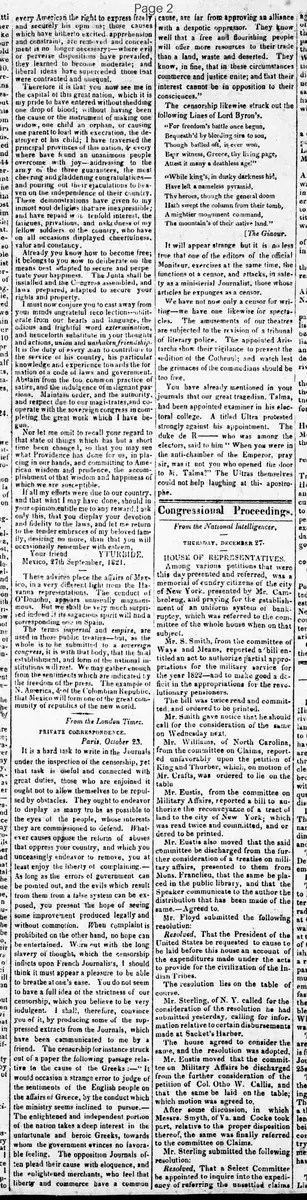
PRIVATE CORRESPONDENCE.
Paris. October 23.
It is a hard task to write in the Journals under the inspection of the censorship, yet that task is useful and connected with great duties, those who are enjoined it ought not to allow themselves to be repulsed by obstacles. They ought to endeavor to display as many truths as possible to the eyes of the people, whose interests they are commissioned to defend. Whatever causes oppose the reform of abuses that oppress your country, and which you unceasingly endeavor to remove, you at least enjoy the liberty of complaining.-- As long as the errors of government can be pointed out, and the evils which result from them from a false system can be exposed, you present the hope of seeing some improvement produced legally and without commotion. When Complaint is prohibited on the other hand, no hope can be entertained. Worn out with the long slavery of thought, which the censorship inflicts upon French Journalists, I should think it must appear a pleasure to be able to breathe at one's ease. You do not seem to have a full idea of the strictness of our censorship, which you believe to be very indulgent. I shall, therefore, convince you of it, by producing some of the suppressed extracts from the Journals, which have been communicated to me by a friend. The censorship for instance struck out of a paper the following passage relative to the cause of the Greeks:--"It would occasion a strange error to judge of the sentiments of the English people on the affairs of Greece, by the conduct which the ministry seems inclined to pursue.-- The enlightened and independent portion of the nation takes a deep interest in the unfortunate and heroic Greeks, towards whom the government evinces no favorable feeling. The opposition Journals often plead their cause with eloquence, and the enlightened merchants, who feel that liberty and commerce have a common cause, are far from approving an alliance with a despotic oppressor. They know well that a free and flourishing people will offer more resources to their trade than a land, waste and deserted. They know, in fine, that in these circumstances commerce and justice unite; and that their interest cannot be in opposition to their consciences."
The censorship likewise struck out the following Lines of Lord Byron's.
"For freedom's battle once begun,
Bequeath'd by bleeding sire to son,
Though baffled oft, is ever won,
Bear witness, Greece, thy living page,
Attest it many a deathless age!"
"While kings, in dusky darkness hid,
Have left a nameless pyramid.
Thy heroes, though the general doom
Hath swept the column from their tomb,
A mightier monument command.
The mountains of their native land."
[The Giaour.
It will appear strange but it is no less true that one of the editors of the official Moniteur. exercises at the same time, the functions of a censor, and attacks, in safety as a ministerial Journalist, those whose articles he expunges as a censor.
We have not now only a censor for writing--we have one likewise for spectacles. The amusements of our theatres are subjected to the revision of a tribunal of literary police. The appointed Aristarchs show their vigilance to prevent the sedition of the Chorus: and watch lest the grimaces of the comedians should be too free.
You have already mentioned in your journals that our great tragedian. Talma, had been appointed examiner in his elocution college. A titled Ultra protested strongly against his appointment. The duke de R** who was among the electors, said to him" When you were in the anti-chamber of the Emperor, pray sir, was it not you who opened the door to M.. Talma?" The Ultras themselves could not help laughing at this apostrophe.
What sub-type of article is it?
What keywords are associated?
What entities or persons were involved?
Where did it happen?
Foreign News Details
Primary Location
Paris
Event Date
October 23
Key Persons
Event Details
A correspondent describes the challenges of writing under French censorship, provides examples of suppressed passages supporting Greek independence and Lord Byron's poetry on Greece, notes an editor of the Moniteur acting as censor, discusses theater censorship, and recounts an anecdote about Talma's appointment opposed by an ultra, rebuked by the duke de R**.