Thank you for visiting SNEWPapers!
Sign up free
Editorial
April 11, 1842
Daily Cincinnati Republican
Cincinnati, Hamilton County, Ohio
What is this article about?
An editorial from the N.Y. Sun criticizes journals, especially the American, for misrepresenting the Creole case to portray the U.S. as wrong. It defends Secretary Webster's position that British authorities unjustly freed mutinous slaves on the ship, arguing for indemnity rather than war, and highlights true U.S.-British tensions over naval freedom.
Clipping
OCR Quality
98%
Excellent
Full Text
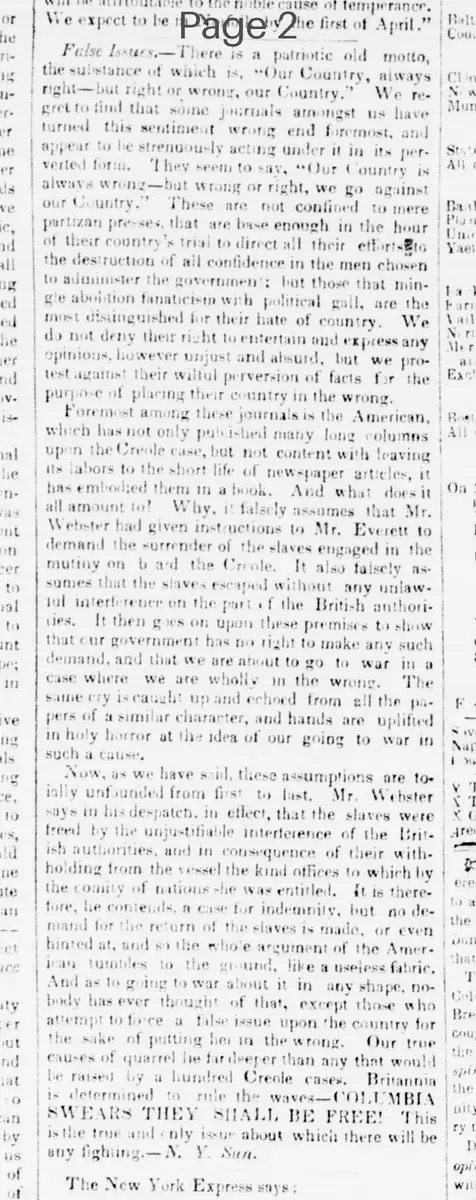
False Issues.—There is a patriotic old motto, the substance of which is, "Our Country, always right—but right or wrong, our Country." We regret to find that some journals amongst us have turned this sentiment wrong end foremost, and appear to be strenuously acting under it in its perverted form. They seem to say, "Our Country is always wrong—but wrong or right, we go against our Country." These are not confined to mere partizan presses, that are base enough in the hour of their country's trial to direct all their efforts to the destruction of all confidence in the men chosen to administer the government: but those that mingle abolition fanaticism with political gain, are the most distinguished for their hate of country. We do not deny their right to entertain and express any opinions, however unjust and absurd, but we protest against their wilful perversion of facts for the purpose of placing their country in the wrong.
Foremost among these journals is the American, which has not only published many long columns upon the Creole case, but not content with leaving its calumnies to the short life of newspaper articles, it has embodied them in a book. And what does it all amount to? Why, it falsely assumes that Mr. Webster had given instructions to Mr. Everett to demand the surrender of the slaves engaged in the mutiny on board the Creole. It also falsely assumes that the slaves escaped without any unlawful interference on the part of the British authorities. It then goes on upon these premises to show that our government has no right to make any such demand, and that we are about to go to war in a case where we are wholly in the wrong. The same cry is caught up and echoed from all the papers of a similar character, and hands are uplifted in holy horror at the idea of our going to war in such a cause.
Now, as we have said, these assumptions are totally unfounded from first to last. Mr. Webster says in his despatch, in effect, that the slaves were freed by the unjustifiable interference of the British authorities, and in consequence of their withholding from the vessel the kind offices to which by the comity of nations she was entitled. It is therefore, he contends, a case for indemnity, but no demand for the return of the slaves is made, or even hinted at, and so the whole argument of the American tumbles to the ground, like a useless fabric.
And as to going to war about it in any shape, nobody has ever thought of that, except those who attempt to force a false issue upon the country for the sake of putting it in the wrong. Our true causes of quarrel lie farther over than any that would be raised by a hundred Creole cases. Britannia is determined to rule the waves—'COLUMBIA SWEARS THEY SHALL BE FREE!' This is the true and only gist about which there will be any fighting.—N. Y. Sun.
Foremost among these journals is the American, which has not only published many long columns upon the Creole case, but not content with leaving its calumnies to the short life of newspaper articles, it has embodied them in a book. And what does it all amount to? Why, it falsely assumes that Mr. Webster had given instructions to Mr. Everett to demand the surrender of the slaves engaged in the mutiny on board the Creole. It also falsely assumes that the slaves escaped without any unlawful interference on the part of the British authorities. It then goes on upon these premises to show that our government has no right to make any such demand, and that we are about to go to war in a case where we are wholly in the wrong. The same cry is caught up and echoed from all the papers of a similar character, and hands are uplifted in holy horror at the idea of our going to war in such a cause.
Now, as we have said, these assumptions are totally unfounded from first to last. Mr. Webster says in his despatch, in effect, that the slaves were freed by the unjustifiable interference of the British authorities, and in consequence of their withholding from the vessel the kind offices to which by the comity of nations she was entitled. It is therefore, he contends, a case for indemnity, but no demand for the return of the slaves is made, or even hinted at, and so the whole argument of the American tumbles to the ground, like a useless fabric.
And as to going to war about it in any shape, nobody has ever thought of that, except those who attempt to force a false issue upon the country for the sake of putting it in the wrong. Our true causes of quarrel lie farther over than any that would be raised by a hundred Creole cases. Britannia is determined to rule the waves—'COLUMBIA SWEARS THEY SHALL BE FREE!' This is the true and only gist about which there will be any fighting.—N. Y. Sun.
What sub-type of article is it?
Foreign Affairs
Slavery Abolition
Partisan Politics
What keywords are associated?
Creole Case
Webster Dispatch
British Interference
Abolitionist Journals
Freedom Of Seas
Slave Mutiny
Indemnity Demand
What entities or persons were involved?
American (Journal)
Mr. Webster
Mr. Everett
British Authorities
Creole (Ship)
N. Y. Sun
Editorial Details
Primary Topic
Defense Against Misrepresentations Of The Creole Case
Stance / Tone
Patriotic Defense Of U.S. Position Against Abolitionist Journals
Key Figures
American (Journal)
Mr. Webster
Mr. Everett
British Authorities
Creole (Ship)
N. Y. Sun
Key Arguments
Journals Pervert Facts To Portray U.S. As Wrong In Creole Case
Webster Did Not Demand Slaves' Return, Only Indemnity For British Interference
Slaves Freed Unjustly By British Withholding Aid To The Vessel
No Intent To Go To War Over Creole; True Quarrel Is Over Freedom Of The Seas
Criticizes Abolitionist Presses For Mixing Fanaticism With Politics