Thank you for visiting SNEWPapers!
Sign up free
Richmond Enquirer
Richmond, Richmond County, Virginia
What is this article about?
Legal case in Richmond's Chancery Court where merchants sued Bank of Virginia for payment on lost half-sent bank notes, offering indemnity. Court reversed decree due to insufficient proof of note identity, dismissing the bill.
Clipping
OCR Quality
Full Text
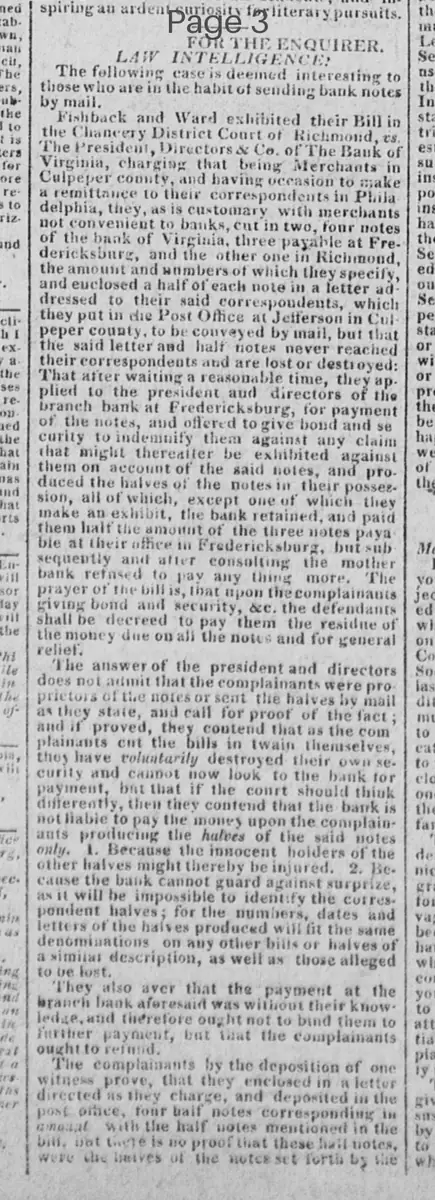
LAW INTELLIGENCE:
The following case is deemed interesting to those who are in the habit of sending bank notes by mail.
Fishback and Ward exhibited their Bill in the Chancery District Court of Richmond, vs. The President, Directors & Co. of The Bank of Virginia, charging that being Merchants in Culpeper county, and having occasion to make a remittance to their correspondents in Philadelphia, they, as is customary with merchants not convenient to banks, cut in two, four notes of the bank of Virginia, three payable at Fredericksburg, and the other one in Richmond. the amount and numbers of which they specify, and enclosed a half of each note in a letter addressed to their said correspondents, which they put in the Post Office at Jefferson in Culpeper county, to be conveyed by mail, but that the said letter and half notes never reached their correspondents and are lost or destroyed: That after waiting a reasonable time, they applied to the president and directors of the branch bank at Fredericksburg, for payment of the notes, and offered to give bond and security to indemnify them against any claim that might thereafter be exhibited against them on account of the said notes, and produced the halves of the notes in their possession, all of which, except one of which they make an exhibit, the bank retained, and paid them half the amount of the three notes payable at their office in Fredericksburg. but subsequently and after consulting the mother bank refused to pay any thing more. The prayer of the bill is, that upon the complainants giving bond and security, &c. the defendants shall be decreed to pay them the residue of the money due on all the notes and for general relief.
The answer of the president and directors does not admit that the complainants were proprietors of the notes or sent the halves by mail as they state, and call for proof of the fact; and if proved, they contend that as the complainants cut the bills in twain themselves, they have voluntarily destroyed their own security and cannot now look to the bank for payment, but that if the court should think differently, then they contend that the bank is not liable to pay the money upon the complainants producing the halves of the said notes only. 1. Because the innocent holders of the other halves might thereby be injured. 2. Be- cause the bank cannot guard against surprise, as it will be impossible to identify the corresponding halves; for the numbers, dates and letters of the halves produced will fit the same denominations on any other bills or halves of a similar description, as well as those alleged to be lost.
They also aver that the payment at the branch bank aforesaid was without their knowledge, and therefore ought not to bind them to further payment, but that the complainants ought to refund.
The complainants by the deposition of one witness prove, that they enclosed in a letter directed as they charge, and deposited in the post office, four half notes corresponding in amount with the half notes mentioned in the bill. But there is no proof that these half notes, were the halves of the notes set forth by the complainants, or that they agreed in any other particulars save in amount. They also prove that the half notes retained by the bank, correspond in amount with those described in the bill. The bank proved by the affidavit of Mr. Nekervis, agreed to be received as testimony, that if the bank notes of the kind in question, be cut exactly alike, the half of one note will fit the halves of any other notes, besides its real corresponding half, and that the bank cannot discriminate. The Chancellor decreed in conformity with the prayer of the bill, from which decree the bank appealed.
Judge Roane delivered the Opinion of the Court as follows :
The court is of opinion, that the bona fide owner of a bank note having transmitted one half thereof by the mail, which has been stolen therefrom, or is lost, cannot demand payment from the bank of any part of its amount, in consequence of holding the remaining half, merely; but that he is entitled to demand the whole amount of the said note, on satisfying the bank of the verity of the above facts, or establishing them by the judgment of a court of equity--and giving, in either case, a satisfactory indemnity, to secure the bank against future loss, from the appearance and setting up the other half of such note. But the requisite proof does not exist in the case before us ; the half notes on which the bill is founded, not being specifically and satisfactorily identified, as the counterparts of the halves transmitted--for want of which proof the decree is to be reversed and the bill dismissed.
What sub-type of article is it?
What themes does it cover?
What keywords are associated?
What entities or persons were involved?
Where did it happen?
Story Details
Key Persons
Location
Chancery District Court Of Richmond, Culpeper County, Fredericksburg
Story Details
Merchants Fishback and Ward cut four Bank of Virginia notes in half to send halves by mail to Philadelphia correspondents; halves lost in transit. They sought payment from bank on remaining halves with indemnity offer. Bank refused full payment, citing identification issues. Court ruled proof of specific note identity insufficient, dismissing bill.