Thank you for visiting SNEWPapers!
Sign up free
Richmond Enquirer
Richmond, Richmond County, Virginia
What is this article about?
In New York General Sessions, Hannah Conner was convicted of possessing counterfeit bank notes after attempting to entrap Bridget Murphy by leaving forged notes with her, leading to a police search and discovery. Trial occurred on a Wednesday following the June 16, 1821 incident.
Clipping
OCR Quality
Full Text
Hannah Conner, alias Curran,
Indictment for having in possession several forged notes.
The People.
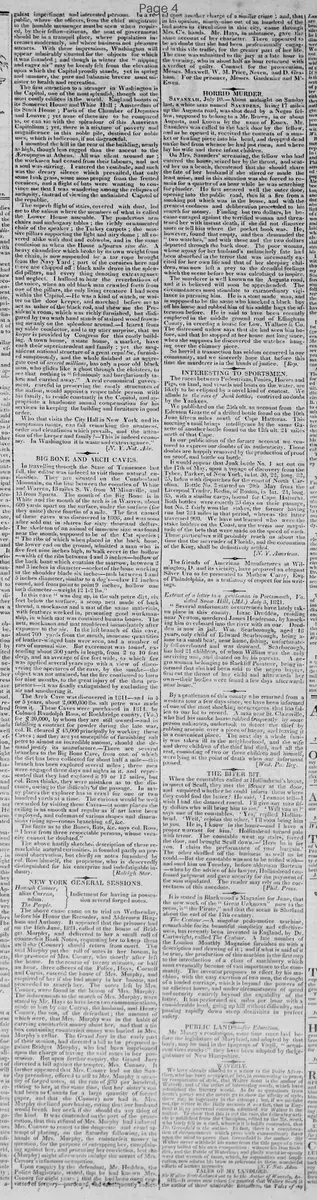
The above cause came on to trial on Wednesday, before his Honor the Recorder, and Aldermen Bingham and Anthony. It appeared that the prisoner had on the 16th June, 1821, called at the house of Bridget Murphy, and delivered to her a small roll of counterfeit Bank Notes, requesting her to keep them until she (Conner) should return from court. The said Murphy put the roll of notes in her bosom, in the presence of Mrs. Conner, who shortly after left the house. In the course of twenty minutes, or half an hour, three officers of the Police, Hays, Cornell and Curtis, entered the house of Mrs. Murphy, and enquired of her if she had money in her bosom, and proceeded to search her. The notes left by Mrs. Conner, were found in the bosom of Mrs. Murphy.
The inducements to the search of Mrs. Murphy, were stated by Mr. Hays to have been two communications, made to him by one Curran, the husband, and Henry Conner, the son, of the defendant; the amount of which were, that Mrs. Murphy was in the habit of carrying counterfeit money about her, and that a tin box containing counterfeit money was buried in Mrs. Murphy's cellar. The Grand Jury in the early part of their session, had directed a bill to be prepared against Bridget Murphy, who had been imprisoned upon the charge of having the said notes in her possession. But upon further enquiry, the Grand Jury directed a bill against the tempter, Mrs. Conner. It further appeared that Mrs. Conner had on the Sunday preceding, offered to sell to Mrs. Murphy a quantity of forged notes, at the rate of $30 per hundred, stating to her, at the same time, that her sister's son had been to Canada for a large quantity of forged paper, and that she (Conner) now had it. Mrs. Murphy declined purchasing, saying that her husband would break her neck if she should do any thing of the kind. It was contended on the part of the prosecution, that this refusal of Mrs. Murphy had induced Mrs. Conner to resort to the desperate and cruel attempt of placing, on the Saturday following, in the hands of Mrs. Murphy, the counterfeit money in question, for the purpose of entrapping her, complaining against her, and procuring her conviction, lest she (Murphy) might afterwards indulge the secret of Mrs. Conner's infamous occupation.
Upon enquiry by the defendant, Mr. Hedden, the Police Magistrate, stated, that he had known Mrs. Conner for eight years; that she had been once convicted of forgery—pardoned, and subsequently indicted upon another charge of a similar crime; and, that in his opinion, ninety-nine out of a hundred of the bad notes in circulation in this city, came through Mrs. C's. hands. Mr. Hays, in substance, gave the same account of her character. There appeared to be no doubt that she had been professionally engaged in this vile traffic, for the greater part of her life.
The case was submitted to the jury at a late hour in the evening, who in about half an hour returned with a verdict of guilty. Counsel for the prosecution, Messrs. Maxwell, W. M. Price, Neven, and D. Graham. For the prisoner, Messrs. Gardenier and M. Ewen.
What sub-type of article is it?
What keywords are associated?
What entities or persons were involved?
Where did it happen?
Domestic News Details
Primary Location
New York
Event Date
Wednesday, Following 16th June 1821
Key Persons
Outcome
verdict of guilty
Event Details
Hannah Conner was tried for possessing forged notes. She left counterfeit notes with Bridget Murphy on 16th June 1821, leading to Murphy's search and discovery of the notes by police officers. Evidence showed Conner's prior attempts to sell forged notes and her history in counterfeit trade. The jury returned a guilty verdict after deliberation.