Thank you for visiting SNEWPapers!
Sign up free
Story
August 8, 1862
Oxford Democrat
Paris, South Paris, Oxford County, Maine
What is this article about?
John M. Willard disputes prior advice on removing corn suckers, arguing they provide late pollen to fill ear tips via their tassels, based on corn silk impregnation process. Written from Wilton in July 1862 for Maine Farmer.
Clipping
OCR Quality
95%
Excellent
Full Text
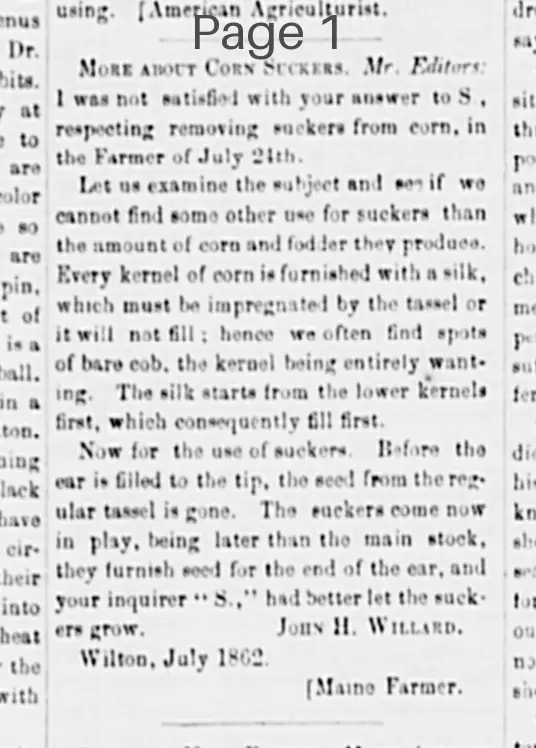
More About Corn Suckers.
Mr. Editors—I was not satisfied with your answer to S. respecting removing suckers from corn, in the Farmer of July 24th.
Let us examine the subject and see if we cannot find some other use for suckers than the amount of corn and fodder they produce. Every kernel of corn is furnished with a silk, which must be impregnated by the tassel or it will not fill: hence we often find spots of bare cob, the kernel being entirely wanting. The silk starts from the lower kernels first, which consequently fill first.
Now for the use of suckers. Before the ear is filled to the tip, the seed from the regular tassel is gone. The suckers come now in play, being later than the main stock, they furnish seed for the end of the ear, and your inquirer "S." had better let the suckers grow.
JOHN M. WILLARD.
Wilton, July 1862
[Maine Farmer.
Mr. Editors—I was not satisfied with your answer to S. respecting removing suckers from corn, in the Farmer of July 24th.
Let us examine the subject and see if we cannot find some other use for suckers than the amount of corn and fodder they produce. Every kernel of corn is furnished with a silk, which must be impregnated by the tassel or it will not fill: hence we often find spots of bare cob, the kernel being entirely wanting. The silk starts from the lower kernels first, which consequently fill first.
Now for the use of suckers. Before the ear is filled to the tip, the seed from the regular tassel is gone. The suckers come now in play, being later than the main stock, they furnish seed for the end of the ear, and your inquirer "S." had better let the suckers grow.
JOHN M. WILLARD.
Wilton, July 1862
[Maine Farmer.
What sub-type of article is it?
Agricultural Advice
What themes does it cover?
Nature
What keywords are associated?
Corn Suckers
Tassel Pollen
Corn Silk
Farming Practice
Ear Filling
What entities or persons were involved?
John M. Willard
S.
Where did it happen?
Wilton
Story Details
Key Persons
John M. Willard
S.
Location
Wilton
Event Date
July 1862
Story Details
Willard argues against removing corn suckers, explaining they provide pollen for upper ear kernels after main tassel sheds, preventing bare cobs.