Thank you for visiting SNEWPapers!
Sign up free
The Daily Union
Washington, District Of Columbia
What is this article about?
A Tennessee letter to the editor analyzes the Democratic defeat in recent elections, attributing it to Southern Whigs' concessions on territorial slavery issues, the Taylor administration's abolitionist leanings, the Nashville Convention's disruption, and misrepresentations of gubernatorial candidate General Trousdale's qualified support for the Compromise of 1850. The writer argues Trousdale's criticisms fueled suspicions of disunionism, costing him the election. Signed Davidson, Oct. 24, 1851.
Clipping
OCR Quality
Full Text
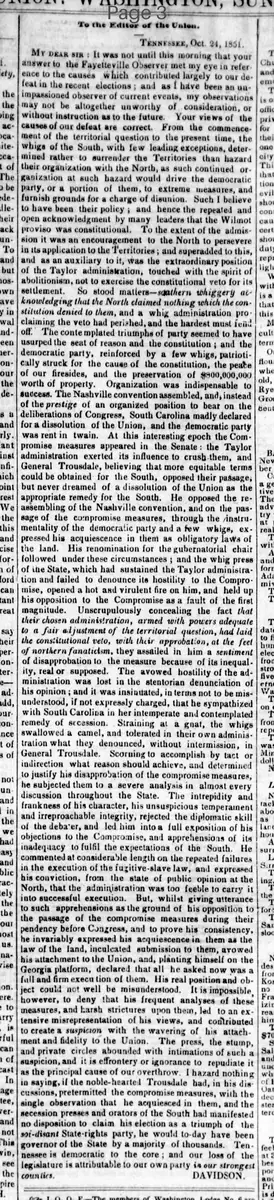
Tennessee, Oct. 24, 1851.
My Dear Sir: It was not until this morning that your answer to the Fayetteville Observer met my eye in reference to the causes which contributed largely to our defeat in the recent elections; and as I have been an impassioned observer of current events, my observations may not be altogether unworthy of consideration, or without instruction as to the future. Your views of the causes of our defeat are correct. From the commencement of the territorial question to the present time, the whigs of the South, with few leading exceptions, determined rather to surrender the Territories than hazard their organization with the North, as such continued organization at such hazard would drive the democratic party, or a portion of them, to extreme measures, and furnish grounds for a charge of disunion. Such I believe to have been their policy; and hence the repeated and open acknowledgment by many leaders that the Wilmot proviso was constitutional. To the extent of the admission it was an encouragement to the North to persevere in its application to the Territories; and superadded to this, and as an auxiliary to it, was the extraordinary position of the Taylor administration, touched with the spirit of abolitionism, not to exercise the constitutional veto for its settlement. So stood matters—South ern whiggery acknowledging that the North claimed nothing which the constitution denied to them, and a whig administration proclaiming the veto had perished, and the hardest must fend off. The contemplated triumphs of party seemed to have usurped the seat of reason and the constitution; and the democratic party, reinforced by a few whigs, patriotically struck for the cause of the constitution, the peace of our firesides, and the preservation of $500,000,000 worth of property. Organization was indispensable to success. The Nashville convention assembled, and, instead of the prestige of an organized position to bear on the deliberations of Congress, South Carolina madly declared for a dissolution of the Union, and the democratic party was rent in twain. At this interesting epoch the Compromise measures appeared in the Senate: the Taylor administration exerted its influence to crush them, and General Trousdale, believing that more equitable terms could be obtained for the South, opposed their passage; but never dreamed of a dissolution of the Union as the appropriate remedy for the South. He opposed the re-assembling of the Nashville convention, and on the passage of the compromise measures, through the instrumentality of the democratic party and a few whigs, expressed his acquiescence in them as obligatory laws of the land. His renomination for the gubernatorial chair followed under these circumstances; and the whig press of the State, which had sustained the Taylor administration and failed to denounce its hostility to the Compromise, opened a hot and virulent fire on him, and held up his opposition to the Compromise as a fault of the first magnitude. Unscrupulously concealing the fact that their chosen administration, armed with powers adequate to a fair adjustment of the territorial question, had laid the constitutional veto, with their approbation, at the feet of northern fanaticism, they assailed in him a sentiment of disapprobation to the measure because of its inequality, real or supposed. The avowed hostility of the administration was lost in the stentorian denunciation of his opinion; and it was insinuated, in terms not to be misunderstood, if not expressly charged, that he sympathized with South Carolina in her intemperate and contemplated remedy of secession. Straining at a gnat, the whigs swallowed a camel, and tolerated in their own administration what they denounced, without intermission, in General Trousdale. Scouring to accomplish by tact or indirection what reason should achieve, and determined to justify his disapprobation of the compromise measures, he subjected them to a severe analysis in almost every discussion throughout the State. The intrepidity and frankness of his character, his unsuspicious temperament and irreproachable integrity, rejected the diplomatic skill of the debater, and led him into a full exposition of his objections to the Compromise, and apprehensions of its inadequacy to fulfil the expectations of the South. He commented at considerable length on the repeated failures in the execution of the fugitive-slave law, and expressed his conviction, from the state of public opinion at the North, that the administration was too feeble to carry it into successful execution. But, whilst giving utterance to such apprehensions as the ground of his opposition to the passage of the compromise measures during their pendency before Congress, and to prove his consistency, he invariably expressed his acquiescence in them as the law of the land, inculcated submission to them, avowed his attachment to the Union, and, planting himself on the Georgia platform, declared that all he asked now was a full and firm execution of them. His real position and object could not well be misunderstood. It is impossible, however, to deny that his frequent analyses of these measures, and harsh strictures upon them, led to an extensive misrepresentation of his views, and contributed to create a suspicion with the wavering of his attachment and fidelity to the Union. The press, the stump, and private circles abounded with intimations of such a suspicion, and it is effrontery or ignorance to repudiate it as the principal cause of our overthrow. I hazard nothing in saying, if the noble-hearted Trousdale had, in his discussions, pretermitted the compromise measures, with the single observation that he acquiesced in them, and the secession presses and orators of the South had manifested no disposition to claim his election as a triumph of the soi-disant State-rights party, he would to-day have been governor of the State by a majority of thousands. Tennessee is democratic to the core; and our loss of the legislature is attributable to our own party in our strongest counties.
DAVIDSON.
What sub-type of article is it?
What themes does it cover?
What keywords are associated?
What entities or persons were involved?
Letter to Editor Details
Author
Davidson
Recipient
To The Editor Of The Union
Main Argument
the democratic defeat in tennessee's recent elections stemmed from whig concessions on territorial slavery, the taylor administration's failure to veto the wilmot proviso, the disruptive nashville convention, and misrepresentations of general trousdale's criticisms of the compromise of 1850, which fueled disunion suspicions; had trousdale avoided such critiques, he would have won the governorship.
Notable Details