Thank you for visiting SNEWPapers!
Sign up free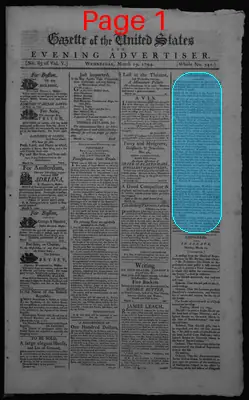
Gazette Of The United States & Evening Advertiser
Philadelphia, Philadelphia County, Pennsylvania
What is this article about?
Details from the American Star on the French fleet division under Rear-Admiral Vanstabel that sailed from Brest in late November 1793, captured 17 English prizes, evaded chase by Lord Howe's 26-ship English fleet off Ouessant, and safely returned to Brest before heading to America.
Clipping
OCR Quality
Full Text
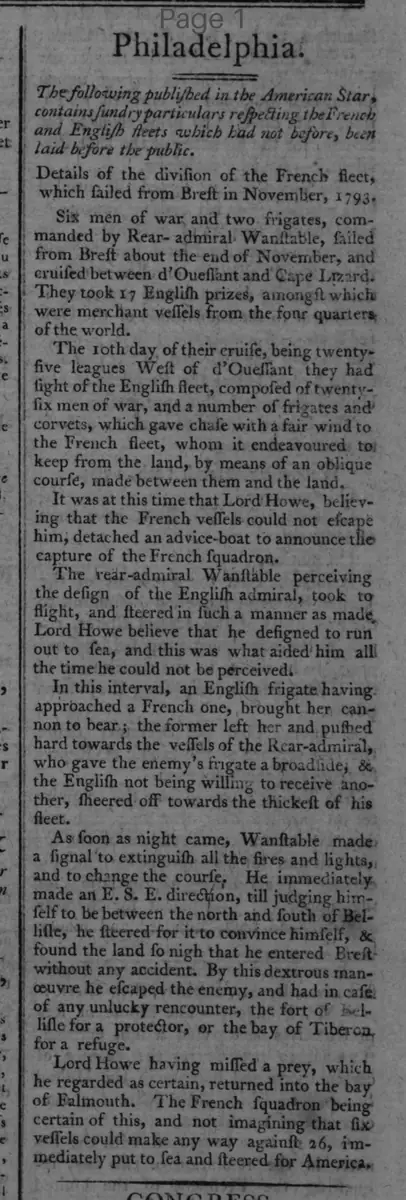
The following published in the American Star contains sundry particulars respecting the French and English fleets which had not before, been laid before the public.
Details of the division of the French fleet, which sailed from Brest in November, 1793.
Six men of war and two frigates, commanded by Rear-admiral Vanstabel, sailed from Brest about the end of November, and cruised between Ouessant and Cape Razard.
They took 17 English prizes, amongst which were merchant vessels from the four quarters of the world.
The 10th day of their cruise, being twenty five leagues West of Ouessant they had sight of the English fleet, composed of twenty-six men of war, and a number of frigates and corvettes, which gave chase with a fair wind to the French fleet, whom it endeavoured to keep from the land, by means of an oblique course, made between them and the land.
It was at this time that Lord Howe, believing that the French vessels could not escape him, detached an advice-boat to announce this capture of the French squadron.
The rear-admiral Vanstabel perceiving the design of the English admiral, took to flight, and steered in such a manner as made Lord Howe believe that he designed to run out to sea, and this was what aided him all the time he could not be perceived.
In this interval, an English frigate having approached a French one, brought her cannon to bear; the former fled her and pursued hard towards the vessels of the Rear-admiral, who gave the enemy's frigate a broadside; & the English not being willing to receive another, sheered off towards the thickest of his fleet.
As soon as night came, Vanstabel made a signal to extinguish all the fires and lights, and to change the course. He immediately made an E. S. E. direction, till judging himself to be between the north and south of Belleisle, he steered for it to convince himself, & found the land so nigh that he entered Brest without any accident. By this dextrous manoeuvre he escaped the enemy, and had in case of any unlucky rencounter, the fort of Belleisle for a protector, or the bay of Audierne for a refuge.
Lord Howe having missed a prey, which he regarded as certain, returned into the bay of Falmouth. The French squadron being certain of this, and not imagining that six vessels could make any way against 26, immediately put to sea and steered for America.
What sub-type of article is it?
What keywords are associated?
What entities or persons were involved?
Where did it happen?
Foreign News Details
Primary Location
Brest
Event Date
November, 1793
Key Persons
Outcome
french squadron escaped capture, took 17 english prizes; no casualties reported; later steered for america.
Event Details
Six French men-of-war and two frigates under Rear-Admiral Vanstabel sailed from Brest end of November 1793, cruised between Ouessant and Cape Razard, captured 17 English prizes. On 10th day of cruise, 25 leagues west of Ouessant, sighted English fleet of 26 men-of-war and frigates under Lord Howe which chased them. Vanstabel evaded by feinting to sea, then at night changed course E.S.E. to Belleisle and returned safely to Brest. Lord Howe returned to Falmouth; French squadron then sailed for America.