Thank you for visiting SNEWPapers!
Sign up free
Literary
September 7, 1764
The New Hampshire Gazette And Historical Chronicle
Portsmouth, Greenland, Rockingham County, New Hampshire
What is this article about?
A foreigner's observations extracted from travel letters praise the merciful spirit of English laws, which avoid severe punishments unlike tyrannical systems. Critiques numerous penal laws for enabling injustice, extortion by corrupt magistrates, and diminishing security. Includes metaphors like the human hyena and the merciful Emperor Nangu's story, advocating rare but terrifying punishments.
Clipping
OCR Quality
95%
Excellent
Full Text
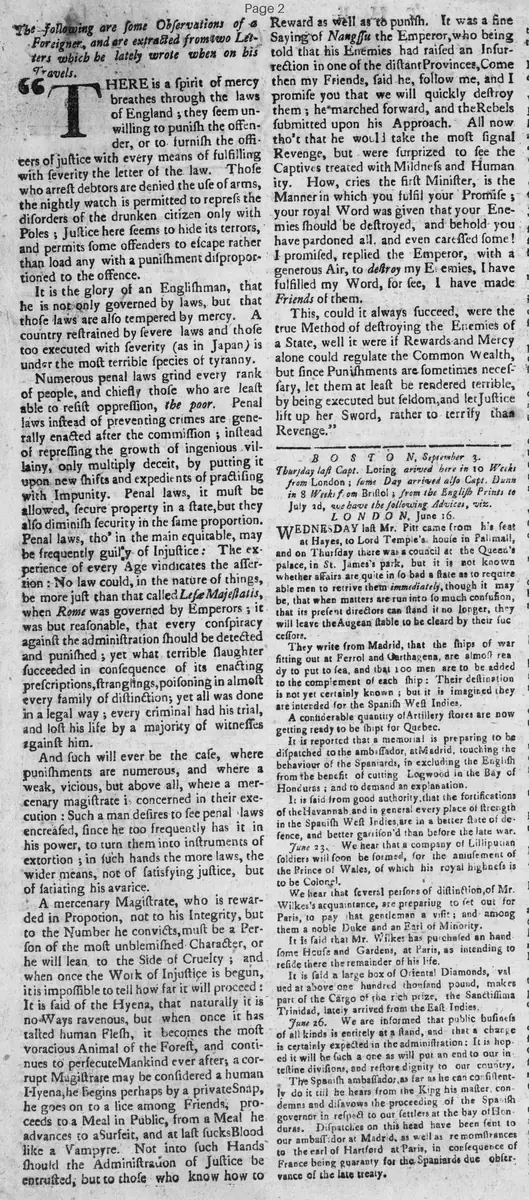
The following are some Observations of a Foreigner, and are extracted from two Letters which he lately wrote when on his Travels.
HERE is a spirit of mercy that breathes through the laws of England; they seem unwilling to punish the offender, or to furnish the officers of justice with every means of fulfilling with severity the letter of the law. Those who arrest debtors are denied the use of arms, the nightly watch is permitted to repress the disorders of the drunken citizen only with Poles; Justice here seems to hide its terrors, and permits some offenders to escape rather than load any with a punishment disproportionated to the offence.
It is the glory of an Englishman, that he is not only governed by laws, but that those laws are also tempered by mercy. A country restrained by severe laws and those too executed with severity (as in Japan) is under the most terrible species of tyranny.
Numerous penal laws grind every rank of people, and chiefly those who are least able to resist oppression, the poor. Penal laws instead of preventing crimes are generally enacted after the commission: instead of repressing the growth of ingenious villainy, only multiply deceit, by putting it upon new shifts and expedients of practicing with Impunity. Penal laws, it must be allowed, secure property in a state, but they also diminish security in the same proportion.
Penal laws, tho' in the main equitable, may be frequently guilty of Injustice: The experience of every Age vindicates the assertion: No law could, in the nature of things, be more just than that called Lèse Majestas, when Rome was governed by Emperors; it was but reasonable, that every conspiracy against the administration should be detected and punished; yet what terrible slaughter succeeded in consequence of its enacting proscriptions, stranglings, poisoning in almost every family of distinction; yet all was done in a legal way; every criminal had his trial, and lost his life by a majority of witnesses against him.
And such will ever be the case, where punishments are numerous, and where a weak, vicious, but above all, where a mercenary magistrate is concerned in their execution: Such a man desires to see penal laws increased, since he too frequently has it in his power, to turn them into instruments of extortion; in such hands the more laws, the wider means, not of satisfying justice, but of satiating his avarice.
A mercenary Magistrate, who is rewarded in Proportion, not to his Integrity, but to the Number he convicts, must be a Person of the most unblemished Character, or he will lean to the Side of Cruelty; and when once the Work of Injustice is begun, it is impossible to tell how far it will proceed: It is said of the Hyena, that naturally it is no Ways ravenous, but when once it has tasted human Flesh, it becomes the most voracious Animal of the Forest, and continues to persecute Mankind ever after; a corrupt Magistrate may be considered a human Hyena, he Begins perhaps by a private Snap, he goes on to a slice among Friends; proceeds to a Meal in Public, from a Meal he advances to a Surfeit, and at last sucks Blood like a Vampyre. Not into such Hands should the Administration of Justice be entrusted; but to those who know how to Reward as well as to punish.
It was a fine Saying of Nangu the Emperor, who being told that his Enemies had raised an Insurrection in one of the distant Provinces, Come then my Friends, said he, follow me, and I promise you that we will quickly destroy them: he marched forward, and the Rebels submitted upon his Approach. All now tho't that he would take the most signal Revenge, but were surprized to see the Captives treated with Mildness and Humanity. How, cries the first Minister, is this the Manner in which you fulfil your Promise; your royal Word was given that your Enemies should be destroyed, and behold you have pardoned all, and even caressed some! I promised, replied the Emperor, with a generous Air, to destroy my Enemies, I have fulfilled my Word, for see, I have made Friends of them.
This, could it always succeed, were the true Method of destroying the Enemies of a State, well it were if Rewards and Mercy alone could regulate the Common Wealth, but since Punishments are sometimes necessary, let them at least be rendered terrible, by being executed but seldom, and let Justice lift up her Sword, rather to terrify than Revenge.
HERE is a spirit of mercy that breathes through the laws of England; they seem unwilling to punish the offender, or to furnish the officers of justice with every means of fulfilling with severity the letter of the law. Those who arrest debtors are denied the use of arms, the nightly watch is permitted to repress the disorders of the drunken citizen only with Poles; Justice here seems to hide its terrors, and permits some offenders to escape rather than load any with a punishment disproportionated to the offence.
It is the glory of an Englishman, that he is not only governed by laws, but that those laws are also tempered by mercy. A country restrained by severe laws and those too executed with severity (as in Japan) is under the most terrible species of tyranny.
Numerous penal laws grind every rank of people, and chiefly those who are least able to resist oppression, the poor. Penal laws instead of preventing crimes are generally enacted after the commission: instead of repressing the growth of ingenious villainy, only multiply deceit, by putting it upon new shifts and expedients of practicing with Impunity. Penal laws, it must be allowed, secure property in a state, but they also diminish security in the same proportion.
Penal laws, tho' in the main equitable, may be frequently guilty of Injustice: The experience of every Age vindicates the assertion: No law could, in the nature of things, be more just than that called Lèse Majestas, when Rome was governed by Emperors; it was but reasonable, that every conspiracy against the administration should be detected and punished; yet what terrible slaughter succeeded in consequence of its enacting proscriptions, stranglings, poisoning in almost every family of distinction; yet all was done in a legal way; every criminal had his trial, and lost his life by a majority of witnesses against him.
And such will ever be the case, where punishments are numerous, and where a weak, vicious, but above all, where a mercenary magistrate is concerned in their execution: Such a man desires to see penal laws increased, since he too frequently has it in his power, to turn them into instruments of extortion; in such hands the more laws, the wider means, not of satisfying justice, but of satiating his avarice.
A mercenary Magistrate, who is rewarded in Proportion, not to his Integrity, but to the Number he convicts, must be a Person of the most unblemished Character, or he will lean to the Side of Cruelty; and when once the Work of Injustice is begun, it is impossible to tell how far it will proceed: It is said of the Hyena, that naturally it is no Ways ravenous, but when once it has tasted human Flesh, it becomes the most voracious Animal of the Forest, and continues to persecute Mankind ever after; a corrupt Magistrate may be considered a human Hyena, he Begins perhaps by a private Snap, he goes on to a slice among Friends; proceeds to a Meal in Public, from a Meal he advances to a Surfeit, and at last sucks Blood like a Vampyre. Not into such Hands should the Administration of Justice be entrusted; but to those who know how to Reward as well as to punish.
It was a fine Saying of Nangu the Emperor, who being told that his Enemies had raised an Insurrection in one of the distant Provinces, Come then my Friends, said he, follow me, and I promise you that we will quickly destroy them: he marched forward, and the Rebels submitted upon his Approach. All now tho't that he would take the most signal Revenge, but were surprized to see the Captives treated with Mildness and Humanity. How, cries the first Minister, is this the Manner in which you fulfil your Promise; your royal Word was given that your Enemies should be destroyed, and behold you have pardoned all, and even caressed some! I promised, replied the Emperor, with a generous Air, to destroy my Enemies, I have fulfilled my Word, for see, I have made Friends of them.
This, could it always succeed, were the true Method of destroying the Enemies of a State, well it were if Rewards and Mercy alone could regulate the Common Wealth, but since Punishments are sometimes necessary, let them at least be rendered terrible, by being executed but seldom, and let Justice lift up her Sword, rather to terrify than Revenge.
What sub-type of article is it?
Essay
What themes does it cover?
Political
Moral Virtue
Liberty Freedom
What keywords are associated?
Penal Laws
Mercy
Justice
England
Magistrate
Punishment
Tyranny
Corruption
Literary Details
Title
Observations Of A Foreigner
Subject
On The Mercy In English Laws And Penal Systems
Key Lines
It Is The Glory Of An Englishman, That He Is Not Only Governed By Laws, But That Those Laws Are Also Tempered By Mercy.
A Mercenary Magistrate, Who Is Rewarded In Proportion, Not To His Integrity, But To The Number He Convicts, Must Be A Person Of The Most Unblemished Character, Or He Will Lean To The Side Of Cruelty;
A Corrupt Magistrate May Be Considered A Human Hyena, He Begins Perhaps By A Private Snap, He Goes On To A Slice Among Friends; Proceeds To A Meal In Public, From A Meal He Advances To A Surfeit, And At Last Sucks Blood Like A Vampyre.
I Promised, Replied The Emperor, With A Generous Air, To Destroy My Enemies, I Have Fulfilled My Word, For See, I Have Made Friends Of Them.
Let Justice Lift Up Her Sword, Rather To Terrify Than Revenge.