Thank you for visiting SNEWPapers!
Sign up free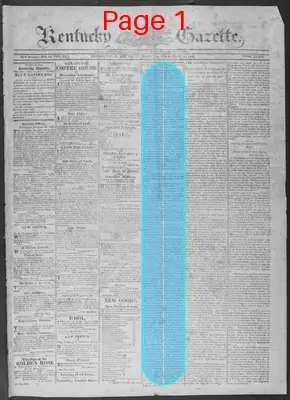
Kentucky Gazette
Lexington, Fayette County, Kentucky
What is this article about?
Captain J.R. Bell recounts Major Long's pacific exploring expedition from Council Bluffs to the Rockies, aiming for topographical and scientific knowledge. The party split, pursued Arkansas and Canadian rivers to Belle Point, encountered unknown Indian tribes ignorant of the U.S., and gathered valuable data on geography, botany, and geology.
Clipping

OCR Quality
Full Text
We were yesterday gratified with a few minutes conversation with capt. J. R. Bell, who arrived in this city on Tuesday, from Cape Girardeau, in Missouri; which place he left on the 18th October last. The information derived from him was so interesting to us, that we believe our reader will be pleased with some account of it.
Capt. Bell was second in rank of a Exploring Expedition, under the command of major Long, the objects of which were topographical and scientific information respecting the vast wilderness of country, which stretches from the Council Bluffs, on the Missouri, to the foot of the Rocky mountains, of which so little is yet known. The expedition being wholly pacific in its objects, consisted of some twenty soldiers only, and the following officers and artists, besides the two officers already mentioned:-
Lieutenant Graham, Lieut. Swift, Dr. James, Messrs. Seymour and Peale, designers and painters.
The expedition started out from the Council Bluffs, on the 6th of June, directing their course first to the Pawnee villages, on a fork of the La Platte, distant about one hundred and twenty miles from the Pawnee villages. The interval is a rolling prairie country, of course destitute of hills and wood, so that the mountains are visible at the distance of one hundred and twenty miles. Time has not yet allowed a calculation of the observations, which were made as accurately as circumstances would allow, but it is supposed the greatest height of the ridge does not exceed the elevation of four thousand feet above the base of the mountain.
The Expedition separated into two parties, near the point on the Arkansas designated on the maps as Pike's Block-house.
The one party, under the command of Major Long, proceeded thence with a view to strike the head-waters of Red river. But, it appears the maps which we have are very defective, the courses of the rivers being almost wholly conjectural, and often entirely fabulous.-- The expedition did not attain the object sought, because it was not to be found where it is laid down in the maps. and fell upon the waters of the Canadian for the Arkansas, which it pursued, and terminated its tour at Belle Point on the Arkansas, the place mentioned, in the late Message of the President to Congress as being the advanced post of our cordon in that direction
The other party, under the command of Capt. Bell, proceeded down the Arkansas to Belle Point, which place they reached on the 5th September, after an absence of three months from the haunts of civilization
Below the First Fort of the Arkansas. as it was named by Pike they met several parties of strange Indians, whose names even have rarely, if ever been heard of before -'u jong to the tribes of the Arrapahoes, the Kaskoyas, the Kiawas, and the Cawennes. They are frequently, and perhaps at present, engaged in war with the Pawnee, Osages and other tribes. of whom we have some knowledge. Of the Indians met by our party, none have ever been into our settlements. They appeared to be wholly ignorant of the existence of such a people as those of the United States, or indeed of the existence of a fairer complexion than those of Mexico, or the adjacent Spanish provinces, of whom it appeared they had some knowledge
Being made to understand the existence. of such a government, its power and its humane policy, as exemplified in its treatment of other Indian tribes, they expressed a great desire to be taken by the hand of the United States, and to place themselves under our protection.
The topographers medical gentlemen, and painters, attached to this expedition, have collected abundant materials for correcting some of the grosser errors in the received geography of this part of our country, for making important additions to the medical botany, and to the stock of our geological knowledge of our own territory; and the painters have many interesting and valuable. sketches of the prominent features of the country Besides possessing the government of such information as was indispensable to judicious arrangements. for the support and protection of the American population penetrating into that country, this expedition ought, and we hope will, form the subject of one of the most attractive works ever published in this country.
What struck us most impressively in this brief narrative was, that, some two thousand miles on this side of our utmost west, run boundary,or in other words about half way between the Mississippi River and the Pacific Ocean, an exploring party has met with several tribes of men, the aborigines and proprietors of the soil of the country, who were ignorant, not only of the existence of the People of the United States, but of the existence of a race of White People!
It gives us an awful idea of the magnificent extent of the domain of the
What sub-type of article is it?
What themes does it cover?
What keywords are associated?
What entities or persons were involved?
Where did it happen?
Story Details
Key Persons
Location
From The Council Bluffs On The Missouri To The Foot Of The Rocky Mountains, Along The Arkansas And Canadian Rivers To Belle Point
Event Date
Started On The 6th Of June; Reached Belle Point On The 5th September
Story Details
Major Long's expedition explored the wilderness for topographical and scientific information, starting from Council Bluffs to Pawnee villages and beyond. Parties split near Pike's Block-house; one sought Red River but followed Canadian to Arkansas ending at Belle Point. Met Arrapahoes, Kaskoyas, Kiawas, Cawennes ignorant of U.S. Collected data on geography, botany, geology; painters made sketches.