Thank you for visiting SNEWPapers!
Sign up free
Editorial
November 9, 1801
Jenks's Portland Gazette
Portland, Cumberland County, Maine
What is this article about?
An anonymous observer in the New York Gazette critiques Thomas Jefferson's authorship of the Declaration of Independence, claiming it largely copies John Locke's essay, and questions Jefferson's writing skills based on his other works, contrasting with Washington's era.
Clipping
OCR Quality
95%
Excellent
Full Text
From the Newyork Gazette.
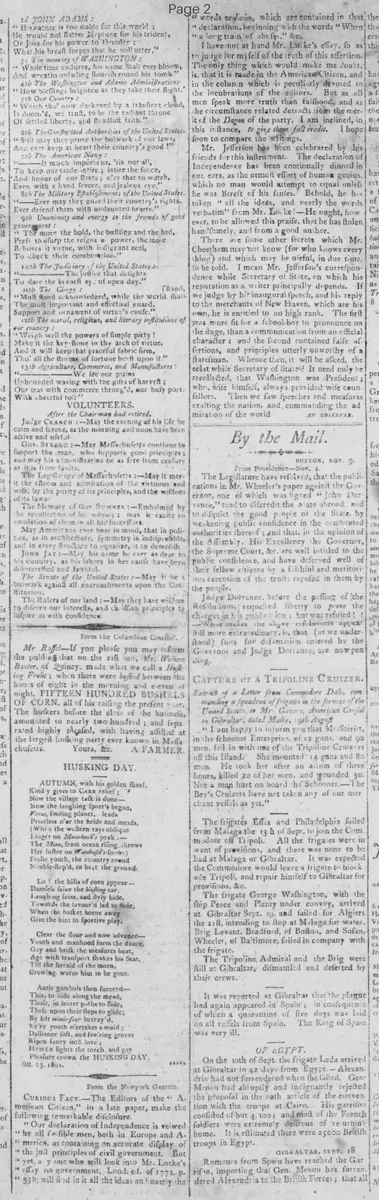
Curious Fact. The Editors of the "American Citizen," in a late paper, make the following remarkable disclosure.
"Our declaration of Independence is viewed by all sensible men, both in Europe and America, as containing an accurate display of the just principles of civil government. But yet, any one who will look into Mr. Locke's essay on government, Lond. ed. of 1772. p. 358. will find in it all the ideas and nearly the words verbatim, which are contained in that declaration, beginning with the words "When a long train of abuses," &c."
I have not at hand Mr. Locke's essay, so as to judge for myself of the truth of this assertion. The only thing which would make me doubt, is, that it is made in the American Citizen, and in the column which is peculiarly devoted to the lucubrations of the editors. But as all men speak more truth than falsehood, and as the circumstance related detracts from the merit of the Dagon of the party, I am inclined, in this instance, to give them full credit. I hope soon to compare the writings.
Mr. Jefferson has been celebrated by his friends for this instrument. The declaration of Independence has been continually dinned in our ears, as the utmost effort of human genius, which no man would attempt to equal unless he was bereft of his senses. Behold, he has taken "all the ideas, and nearly the words verbatim" from Mr. Locke!—He ought, however, to be allowed this praise, that he has stolen handsomely, and from a good author.
There are some other secrets which Mr. Cheetham may not know (for who knows everything) and which may be useful, in due time, to be told. I mean Mr. Jefferson's correspondence while Secretary of State, on which his reputation as a writer principally depends. If we judge by his inaugural speech, and his reply to the merchants of New Haven, which are his own, he is entitled to no high rank. The first was more fit for a school-boy to pronounce on the stage, than a communication from an official character: and the second contained false assertions, and principles utterly unworthy of a statesman. Whence then, it will be asked, the eclat while Secretary of State? It need only be recollected, that Washington was President; who, wise himself, always provided wise counsellors. Then we saw speeches and measures exalting the nation, and commanding the admiration of the world.
AN OBSERVER.
Curious Fact. The Editors of the "American Citizen," in a late paper, make the following remarkable disclosure.
"Our declaration of Independence is viewed by all sensible men, both in Europe and America, as containing an accurate display of the just principles of civil government. But yet, any one who will look into Mr. Locke's essay on government, Lond. ed. of 1772. p. 358. will find in it all the ideas and nearly the words verbatim, which are contained in that declaration, beginning with the words "When a long train of abuses," &c."
I have not at hand Mr. Locke's essay, so as to judge for myself of the truth of this assertion. The only thing which would make me doubt, is, that it is made in the American Citizen, and in the column which is peculiarly devoted to the lucubrations of the editors. But as all men speak more truth than falsehood, and as the circumstance related detracts from the merit of the Dagon of the party, I am inclined, in this instance, to give them full credit. I hope soon to compare the writings.
Mr. Jefferson has been celebrated by his friends for this instrument. The declaration of Independence has been continually dinned in our ears, as the utmost effort of human genius, which no man would attempt to equal unless he was bereft of his senses. Behold, he has taken "all the ideas, and nearly the words verbatim" from Mr. Locke!—He ought, however, to be allowed this praise, that he has stolen handsomely, and from a good author.
There are some other secrets which Mr. Cheetham may not know (for who knows everything) and which may be useful, in due time, to be told. I mean Mr. Jefferson's correspondence while Secretary of State, on which his reputation as a writer principally depends. If we judge by his inaugural speech, and his reply to the merchants of New Haven, which are his own, he is entitled to no high rank. The first was more fit for a school-boy to pronounce on the stage, than a communication from an official character: and the second contained false assertions, and principles utterly unworthy of a statesman. Whence then, it will be asked, the eclat while Secretary of State? It need only be recollected, that Washington was President; who, wise himself, always provided wise counsellors. Then we saw speeches and measures exalting the nation, and commanding the admiration of the world.
AN OBSERVER.
What sub-type of article is it?
Partisan Politics
What keywords are associated?
Declaration Of Independence
Thomas Jefferson
John Locke
Political Critique
Writing Originality
What entities or persons were involved?
Thomas Jefferson
Mr. Locke
Mr. Cheetham
Washington
Editorial Details
Primary Topic
Critique Of Thomas Jefferson's Originality In The Declaration Of Independence
Stance / Tone
Sarcastically Critical Of Jefferson's Merits As A Writer
Key Figures
Thomas Jefferson
Mr. Locke
Mr. Cheetham
Washington
Key Arguments
The Declaration Of Independence Contains Ideas And Nearly Verbatim Words From Locke's Essay On Government
Jefferson's Reputation As A Writer Is Overstated And Based On Borrowed Content
Jefferson's Own Speeches, Like His Inaugural And Reply To New Haven Merchants, Are Unworthy Of A Statesman
Washington's Wise Counsel Elevated Official Communications During His Presidency