Thank you for visiting SNEWPapers!
Sign up free
Portland Gazette, And Maine Advertiser
Portland, Cumberland County, Maine
What is this article about?
This essay proposes a military system where all young men undergo rotational training in instruction camps to become citizen-soldiers, ensuring national defense without the risks of standing armies. It argues this fosters equality, prevents tyranny, and enables rapid mobilization while preserving peace and civilian life.
Merged-components note: Continuation of the essay on military constitutions across pages 1 and 2, based on sequential reading order and text flow.
Clippings
1 of 2
OCR Quality
Full Text
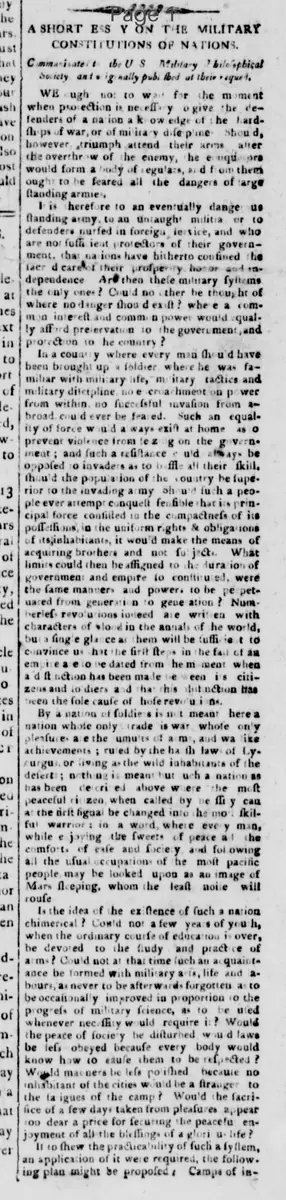
Communicated to the U. S. Military Philosophical Society and originally published at their request.
We ought not to wait for the moment when protection is necessary to give the defenders of a nation a knowledge of the hardships of war, or of military discipline. Should, however triumph attend their arms after the overthrow of the enemy, the conquerors would form a body of regulars, and from them ought to be feared all the dangers of large standing armies.
It is therefore to an eventually dangerous standing army, to an untaught militia or to defenders nursed in foreign service, and who are not sufficient protectors of their government, that nations have hitherto confined the sacred care of their prosperity, honor and independence. Are then these military systems the only ones? Could no other be thought of where no danger should exist? where a common interest and common power would equally afford preservation to the government, and protection to the country?
In a country where every man should have been brought up a soldier where he was familiar with military life, military tactics and military discipline no encroachment on power from within, no successful invasion from abroad could ever be feared. Such an equality of force would always exist at home as to prevent violence from the government; and such a resistance could always be opposed to invaders as to baffle all their skill, though the population of the country be superior to the invading army. Should such a people ever attempt conquest sensible that its principal force consisted in the compactness of its possessions, in the uniform rights & obligations of its inhabitants, it would make the means of acquiring brothers and not subjects. What limits could then be assigned to the duration of government and empire so constituted, were the same manners and power to be perpetuated from generation to generation? Nevertheless revolutions indeed are written with characters of blood in the annals of the world, but a single glance at them will be sufficient to convince us that the first steps in the fall of an empire are alone dated from the moment where a distinction has been made between its citizens and its soldiers and that this distinction has been the sole cause of those revolutions.
By a nation of soldiers is not meant here a nation whose only trade is war whose only pleasures are the tumults of arms and warlike achievements; ruled by the harsh law of Lycurgus, or living as the wild inhabitants of the desert; nothing is meant but such a nation as has been described above where the most peaceful citizen, when called by necessity can at the first signal be changed into the most skilful warrior: in a word, where every man, while enjoying the sweets of peace at the comfort of ease and society, and following all the usual occupations of the most pacific people, may be looked upon as an image of Mars sleeping, whom the least noise will rouse.
Is the idea of the existence of such a nation chimerical? Could not a few years of youth when the ordinary course of education is over, be devoted to the study and practice of arms? Could not at that time such an acquaintance be formed with military art, life and habits, as never to be afterwards forgotten as to be occasionally improved in proportion to the progress of military science, as to be used whenever necessity would require it? Would the peace of society be disturbed would laws be less obeyed because every body would know how to cause them to be respected? Would manners be less relished because no inhabitant of the cities would be a stranger to the fatigues of the camp? Would the sacrifice of a few days taken from pleasures appear too dear a price for securing the peaceable enjoyment of all the blessings of a glorious life?
It to shew the practicability of such a system, an application of it were required, the following plan might be proposed; Camps of instruction...
A junction should be formed in five or six convenient positions, according to the extent, or number of inhabitants of the country. All the young men from eighteen to twenty five years of age, with a few peculiar exceptions, should be divided into four classes, each of which would by turns spend three months dispersed in the different camps of instruction. Each class during its stay in the camps would form the standing army of the country, and as such receive the stated pay of the line. So that the permanent standing army would never amount to more than 1/4 of the youth between 18 and 25 years of age, and every young man during the three fourths of the year, would be enabled to follow his own particular avocations. Camps of instruction are absolutely necessary: it is not enough to drill men to carry or present arms, they must be made complete soldiers trained to the different orders of march and battle, to all the secrets of great tactics, to the details of camp ration and arms, to the hardships and discipline of war. In such camps excellent general officers would be brought up, and military science be studied with success. Here everything relating to war would be taught and practiced, and with the exception of its concomitant horrors war actually be carried on. And let not so great an importance be attached to this exception, as to occasion a fear that it would be sufficient to frustrate the design of the intention. It is not so much fear as it resolution that makes bad troops. Where danger is ever denied courage and foresight are always the result of knowledge. Timidity and indecision be the privilege of ignorance. Soldiers led on by powerful motives, directed by skill and valor will soon know how to face death in battle, how to find their safety in the destruction of their enemy. In the several camps the youth of the country should be carefully mixed; the inhabitants of one part thus would receive instruction in the other; they would thus forget the peculiar prejudice, habits and distinction of their native places in camps where they would see nothing but the general interests of the great family where they would form intimate connections with the inhabitants of the most remote parts of their country. After the age of twenty five, every young man would be discharged, but he would then be embodied in the militia and preserve through his whole life the knowledge acquired during seven years of service. At certain epochs, more or less distant general reviews of the militia should take place; reviews like those of the Prussian army in the time of Frederick, where great manoeuvres would be executed, and the improvements of the military science diligently cultivated. Meanwhile the seaports of the country should be strongly fortified—rather to prevent devastation than invasion, and the same system followed for the navy as for land service. If ever the peace of the country was threatened if ever occasion so called for it, with what facility could an army be raised of two or three hundred thousand warriors, who, to be excellent soldiers, would have only to remember what they would have been practicing for seven years, and studying all their life; who under their well known colors would immediately resume their martial habits, and numerous fleets manned at a moment's notice by bold and experienced seamen be found, waiting only for a signal to sail triumphantly from their harbors. In this fortunate country equally impenetrable to foreign and domestic enemies, peace, plenty and independence would fill their abodes. Courted by all nations, influenced by none, proudly conscious of its superiority, its people would stand for ever defying the world and ages. Its example would probably in time be followed by its less happy neighbors; and ambition and war would be banished from the earth when every nation unconquerable at home, would find it impossible to subdue another.
What sub-type of article is it?
What themes does it cover?
What keywords are associated?
What entities or persons were involved?
Literary Details
Title
A Short Essay On The Military Constitutions Of Nations.
Author
Communicated To The U. S. Military Philosophical Society
Subject
On The Military Constitutions Of Nations
Key Lines