Thank you for visiting SNEWPapers!
Sign up free
Editorial
November 4, 1841
Staunton Spectator, And General Advertiser
Staunton, Virginia
What is this article about?
An editorial quotes an extract from Secretary of the Navy Abel P. Upshur's 1840 book critiquing the U.S. Constitution's veto power as an excessive executive check on legislation that undermines self-government, proposing instead a simple return for reconsideration without absolute veto.
Clipping
OCR Quality
98%
Excellent
Full Text
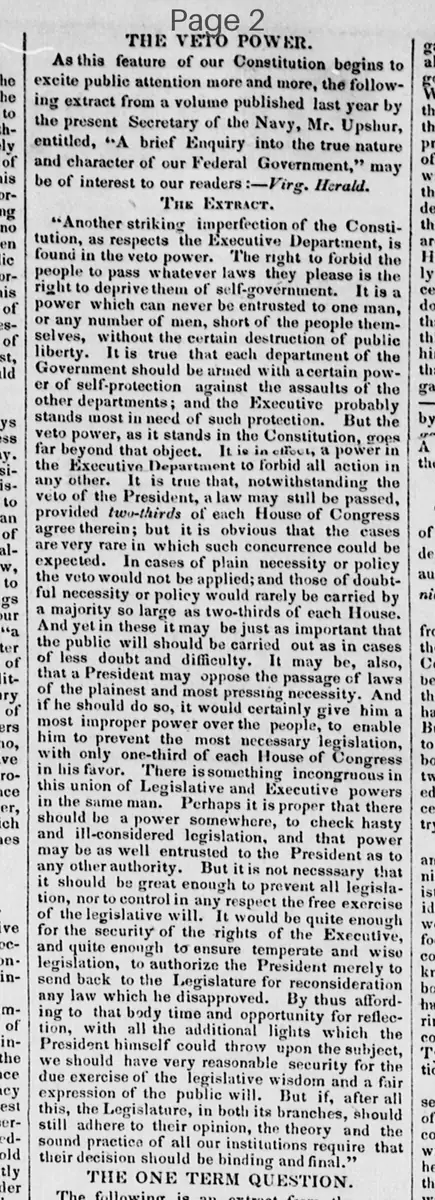
THE VETO POWER.
As this feature of our Constitution begins to excite public attention more and more, the following extract from a volume published last year by the present Secretary of the Navy, Mr. Upshur, entitled, "A brief Enquiry into the true nature and character of our Federal Government," may be of interest to our readers: Virg. Herald.
THE EXTRACT.
"Another striking imperfection of the Constitution, as respects the Executive Department, is found in the veto power. The right to forbid the people to pass whatever laws they please is the right to deprive them of self-government. It is a power which can never be entrusted to one man, or any number of men, short of the people themselves, without the certain destruction of public liberty. It is true that each department of the Government should be armed with a certain power of self-protection against the assaults of the other departments; and the Executive probably stands most in need of such protection. But the veto power, as it stands in the Constitution, goes far beyond that object. It is in effect, a power in the Executive Department to forbid all action in any other. It is true that, notwithstanding the veto of the President, a law may still be passed, provided two-thirds of each House of Congress agree therein; but it is obvious that the cases are very rare in which such concurrence could be expected. In cases of plain necessity or policy the veto would not be applied; and those of doubtful necessity or policy would rarely be carried by a majority so large as two-thirds of each House. And yet in these it may be just as important that the public will should be carried out as in cases of less doubt and difficulty. It may be, also, that a President may oppose the passage of laws of the plainest and most pressing necessity. And if he should do so, it would certainly give him a most improper power over the people, to enable him to prevent the most necessary legislation, with only one-third of each House of Congress in his favor. There is something incongruous in this union of Legislative and Executive powers in the same man. Perhaps it is proper that there should be a power somewhere, to check hasty and ill-considered legislation, and that power may be as well entrusted to the President as to any other authority. But it is not necessary that it should be great enough to prevent all legislation, nor to control in any respect the free exercise of the legislative will. It would be quite enough for the security of the rights of the Executive, and quite enough to ensure temperate and wise legislation, to authorize the President merely to send back to the Legislature for reconsideration any law which he disapproved. By thus affording to that body time and opportunity for reflection, with all the additional lights which the President himself could throw upon the subject, we should have very reasonable security for the due exercise of the legislative wisdom and a fair expression of the public will. But if, after all this, the Legislature, in both its branches, should still adhere to their opinion, the theory and the sound practice of all our institutions require that their decision should be binding and final."
As this feature of our Constitution begins to excite public attention more and more, the following extract from a volume published last year by the present Secretary of the Navy, Mr. Upshur, entitled, "A brief Enquiry into the true nature and character of our Federal Government," may be of interest to our readers: Virg. Herald.
THE EXTRACT.
"Another striking imperfection of the Constitution, as respects the Executive Department, is found in the veto power. The right to forbid the people to pass whatever laws they please is the right to deprive them of self-government. It is a power which can never be entrusted to one man, or any number of men, short of the people themselves, without the certain destruction of public liberty. It is true that each department of the Government should be armed with a certain power of self-protection against the assaults of the other departments; and the Executive probably stands most in need of such protection. But the veto power, as it stands in the Constitution, goes far beyond that object. It is in effect, a power in the Executive Department to forbid all action in any other. It is true that, notwithstanding the veto of the President, a law may still be passed, provided two-thirds of each House of Congress agree therein; but it is obvious that the cases are very rare in which such concurrence could be expected. In cases of plain necessity or policy the veto would not be applied; and those of doubtful necessity or policy would rarely be carried by a majority so large as two-thirds of each House. And yet in these it may be just as important that the public will should be carried out as in cases of less doubt and difficulty. It may be, also, that a President may oppose the passage of laws of the plainest and most pressing necessity. And if he should do so, it would certainly give him a most improper power over the people, to enable him to prevent the most necessary legislation, with only one-third of each House of Congress in his favor. There is something incongruous in this union of Legislative and Executive powers in the same man. Perhaps it is proper that there should be a power somewhere, to check hasty and ill-considered legislation, and that power may be as well entrusted to the President as to any other authority. But it is not necessary that it should be great enough to prevent all legislation, nor to control in any respect the free exercise of the legislative will. It would be quite enough for the security of the rights of the Executive, and quite enough to ensure temperate and wise legislation, to authorize the President merely to send back to the Legislature for reconsideration any law which he disapproved. By thus affording to that body time and opportunity for reflection, with all the additional lights which the President himself could throw upon the subject, we should have very reasonable security for the due exercise of the legislative wisdom and a fair expression of the public will. But if, after all this, the Legislature, in both its branches, should still adhere to their opinion, the theory and the sound practice of all our institutions require that their decision should be binding and final."
What sub-type of article is it?
Constitutional
What keywords are associated?
Veto Power
Constitution
Executive Department
Self Government
Legislative Will
Presidential Veto
What entities or persons were involved?
Mr. Upshur
Secretary Of The Navy
President
Congress
Editorial Details
Primary Topic
Critique Of The Presidential Veto Power
Stance / Tone
Critical Of The Veto Power's Scope
Key Figures
Mr. Upshur
Secretary Of The Navy
President
Congress
Key Arguments
Veto Power Deprives People Of Self Government
Exceeds Necessary Self Protection For Executive
Two Thirds Override Is Rarely Achievable
Allows President To Block Necessary Laws With Minority Support
Incongruous Union Of Legislative And Executive Powers
Suggests Mere Return For Reconsideration Instead Of Absolute Veto