Thank you for visiting SNEWPapers!
Sign up free
The Virginia Gazette
Richmond, Williamsburg, Richmond County, Virginia
What is this article about?
In Berlin, December 1779, King Frederick the Great of Prussia punishes three Court of Appeals counselors (Friedle, Graun, Ranftleben) and Chancellor Baron Furst with imprisonment for upholding an unjust sentence against miller Arnold of Pommerszig, whose mill was ruined by a lord's fish pond. The king emphasizes impartial justice for all ranks.
Clipping
OCR Quality
Full Text
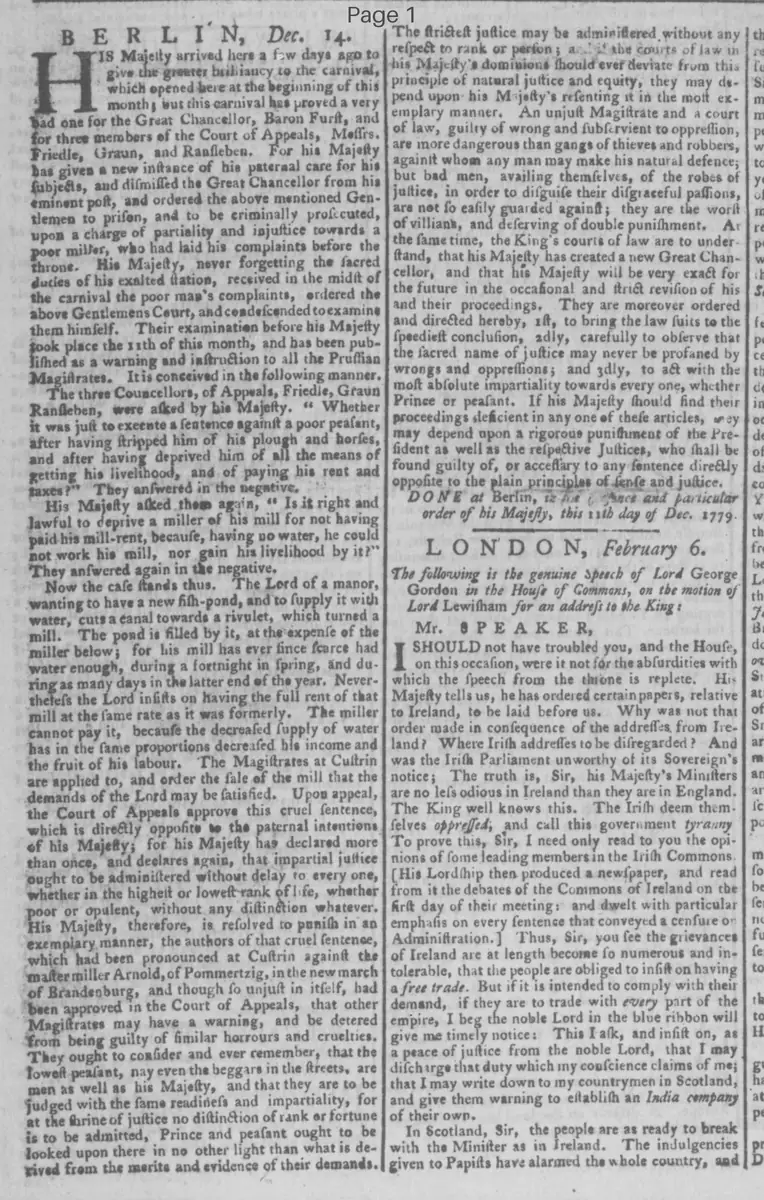
His Majesty arrived here a few days ago to give the greater brilliancy to the carnival, which opened here at the beginning of this month; but this carnival had proved a very sad one for the Great Chancellor, Baron Furst, and for three members of the Court of Appeals, Messrs. Friedle, Graun, and Ranftleben. For his Majesty has given a new instance of his paternal care for his eminent subjects, and ordered the above mentioned gentlemen to prison, and to be criminally prosecuted, upon a charge of partiality and injustice towards a poor miller, who had laid his complaints before the throne. His Majesty, never forgetting the sacred duties of his exalted station, received in the midst of the carnival the poor man's complaints, ordered the above gentlemen's court, and condescended to examine them himself. Their examination before his Majesty took place the 11th of this month, and has been published as a warning and instruction to all the Prussian Magistrates. It is conceived in the following manner.
The three Counsellors of Appeals, Friedle, Graun, Ranftleben, were asked by his Majesty. "Whether it was just to execute a sentence against a poor peasant, after having stripped him of his plough and horses, and after having deprived him of all the means of getting his livelihood, and of paying his rent and taxes?" They answered in the negative.
His Majesty asked them again, "Is it right and lawful to deprive a miller of his mill for not having paid his mill-rent, because, having no water, he could not work his mill, nor gain his livelihood by it?" They answered again in the negative.
Now the case stands thus. The Lord of a manor, wanting to have a new fish-pond, and to supply it with water, cuts a canal towards a rivulet, which turned a mill. The pond is filled by it, at the expense of the miller below; for his mill has ever since scarce had water enough, during a fortnight in spring, and during as many days in the latter end of the year. Nevertheless the Lord insists on having the full rent of that mill at the same rate as it was formerly. The miller cannot pay it, because the decreased supply of water has in the same proportions decreased his income and the fruit of his labour. The Magistrates at Custrin are applied to, and order the sale of the mill that the demands of the Lord may be satisfied. Upon appeal, the Court of Appeals approve this cruel sentence, which is directly opposite to the paternal intentions of his Majesty; for his Majesty has declared more than once, and declares again, that impartial justice ought to be administered without delay to every one, whether in the highest or lowest rank of life, whether poor or opulent, without any distinction whatever.
His Majesty, therefore, is resolved to punish in an exemplary manner, the authors of that cruel sentence, which had been pronounced at Custrin against the master miller Arnold, of Pommerszig, in the new march of Brandenburg, and though so unjust in itself, had been approved in the Court of Appeals, that other Magistrates may have a warning, and be deterred from being guilty of similar horrors and cruelties. They ought to consider and ever remember, that the lowest peasant, nay even the beggars in the streets, are men as well as his Majesty, and that they are to be judged with the same readiness and impartiality, for at the shrine of justice no distinction of rank or fortune is to be admitted, Prince and peasant ought to be looked upon there in no other light than what is derived from the merits and evidence of their demands.
The strictest justice may be administered without any respect to rank or person; as the courts of law in his Majesty's dominions should ever deviate from this principle of natural justice and equity, they may depend upon his Majesty's resenting it in the most exemplary manner. An unjust Magistrate and a court of law, guilty of wrong and subservient to oppression, are more dangerous than gangs of thieves and robbers, against whom any man may make his natural defence; but bad men, availing themselves of the robes of justice, in order to disguise their disgraceful passions, are not so easily guarded against; they are the worst of villains, and deserving of double punishment. At the same time, the King's courts of law are to understand, that his Majesty has created a new Great Chancellor, and that his Majesty will be very exact for the future in the occasional and strict revision of his and their proceedings. They are moreover ordered and directed hereby, 1st, to bring the law suits to the speediest conclusion, 2dly, carefully to observe that the sacred name of justice may never be profaned by wrongs and oppressions; and 3dly, to act with the most absolute impartiality towards every one, whether Prince or peasant. If his Majesty should find their proceedings deficient in any one of these articles, they may depend upon a rigorous punishment of the President as well as the respective Justices, who shall be found guilty of, or accessory to any sentence directly opposite to the plain principles of sense and justice.
DONE at Berlin, in his Highness' name and particular order of his Majesty, this 18th day of Dec. 1779.
What sub-type of article is it?
What keywords are associated?
What entities or persons were involved?
Where did it happen?
Foreign News Details
Primary Location
Berlin
Event Date
December 11 18, 1779
Key Persons
Outcome
three court of appeals counselors (friedle, graun, ranftleben) and great chancellor baron furst ordered to prison and criminal prosecution for injustice; new great chancellor appointed; directives issued for impartial and speedy justice.
Event Details
King of Prussia examines and punishes judicial officials for approving sale of miller Arnold's mill due to water diversion by a lord, despite reduced income; king interrogates officials on justice principles and publishes examination as warning to magistrates, emphasizing impartiality regardless of rank.